4,068 posters, 219 videos, 101 topics, 69 sessions, 14,365 authors, 6,128 institutions
ePostersLive by SciGen Technologies S.A. All rights reserved.
Alzheimer's Association International Conference 2026
July 12-15, 2026 | London, United Kingdom, and Online

13724
Reinforcement Learning With World Models For Optimizing Alzheimer's Disease Treatment Timing And Dosing
Poster Presenter
Authors
Affiliations
Part of Topic
Drug Development -> Human -> Trial design
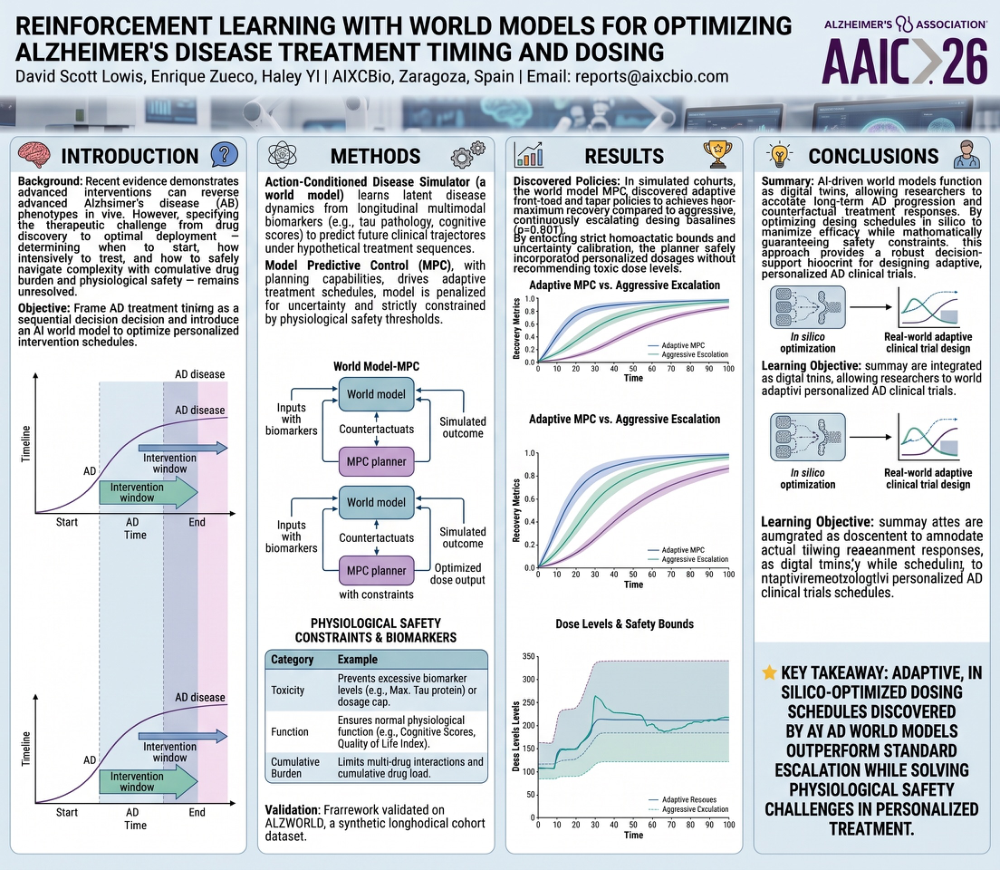
REINFORCEMENT LEARNING WITH WORLD MODELS FOR OPTIMIZING ALZHEIMER'S DISEASE TREATMENT TIMING AND DOSING
David Scott Lowis, Enrique Zueco, Haley Yi | AIXCBio, Zaragoza, Spain | Email: reports@aixcbio.com
ALZHEIMER'S ASSOCIATION
AAIC '26
INTRODUCTION
Background: Recent evidence demonstrates advanced interventions can reverse advanced Alzheimer's disease (AD) phenotypes in vivo. However, specifying the therapeutic challenge from drug discovery to optimal deployment - determining when to start, how intensively to treat, and how to safely navigate complexity with cumulative drug burden and physiological safety - remains unresolved.
Objective: Frame AD treatment timing as a sequential decision and introduce an AI world model to optimize personalized intervention schedules.
METHODS
Action-Conditioned Disease Simulator (a world model) learns latent disease dynamics from longitudinal multimodal biomarkers (e.g., tau pathology, cognitive scores) to predict future clinical trajectories under hypothetical treatment sequences.
Model Predictive Control (MPC), with planning capabilities, drives adaptive treatment schedules. The model is penalized for uncertainty and strictly constrained by physiological safety thresholds.
World Model-MPC
Inputs with biomarkers -> World model -> Counterfactuals -> Simulated outcome
Counterfactuals -> MPC planner -> Optimized dose output with constraints
PHYSIOLOGICAL SAFETY CONSTRAINTS & BIOMARKERS
Category: Toxicity
Example: Prevents excessive biomarker levels (e.g., Max. Tau protein) or dosage cap.
Category: Function
Example: Ensures normal physiological function (e.g., Cognitive Scores, Quality of Life Index).
Category: Cumulative Burden
Example: Limits multi-drug interactions and cumulative drug load.
Validation: Framework validated on ALZWORLD, a synthetic longitudinal cohort dataset.
RESULTS
Discovered Policies: In simulated cohorts, the world model MPC discovered adaptive front-load and taper policies to achieve near-maximum recovery compared to aggressive, continuously escalating dosing baselines.
By enforcing strict homeostatic bounds and uncertainty calibration, the planner safely incorporated personalized dosages without recommending toxic dose levels.
(Graphs: Adaptive MPC vs. Aggressive Escalation showing Recovery Metrics over Time)
(Graph: Dose Levels & Safety Bounds showing Dose Levels over Time)
CONCLUSIONS
Summary: AI-driven world models function as digital twins, allowing researchers to accurately model long-term AD progression and counterfactual treatment responses. By optimizing dosing schedules in silico to maximize efficacy while mathematically guaranteeing safety constraints, this approach provides a robust decision-support blueprint for designing adaptive, personalized AD clinical trials.
In silico optimization -> Real-world adaptive clinical trial design
Learning Objective: AI-driven world models are integrated as digital twins to simulate treatment responses and optimize dosing schedules, allowing researchers to design adaptive, personalized AD clinical trials.
KEY TAKEAWAY: ADAPTIVE, IN SILICO-OPTIMIZED DOSING SCHEDULES DISCOVERED BY AI AD WORLD MODELS OUTPERFORM STANDARD ESCALATION WHILE SOLVING PHYSIOLOGICAL SAFETY CHALLENGES IN PERSONALIZED TREATMENT.
Comments
Email is required but is not shown publicly.
Loading comments...