4,068 posters, 219 videos, 101 topics, 69 sessions, 14,365 authors, 6,128 institutions
ePostersLive by SciGen Technologies S.A. All rights reserved.
Alzheimer's Association International Conference 2026
July 12-15, 2026 | London, United Kingdom, and Online

11962
Initial Real-world Experience In Using Lecanemab In Hong Kong: Safety And Preliminary PET CT Data
Poster Presenter
Authors
Affiliations
Part of Topic
Drug Development -> Human -> Amyloid-targeting therapeutics
Initial Real-world Experience in Using Lecanemab in Hong Kong: Safety and Preliminary PET-CT Data
Background:
Lecanemab, an anti-amyloid monoclonal antibody, is increasingly utilised as a disease-modifying therapy for early Alzheimer's disease (AD) in super-aging Asian societies. Real-world evidence iscritically needed to characterise its efficacy and safety profile in Asian populations.
Methods:
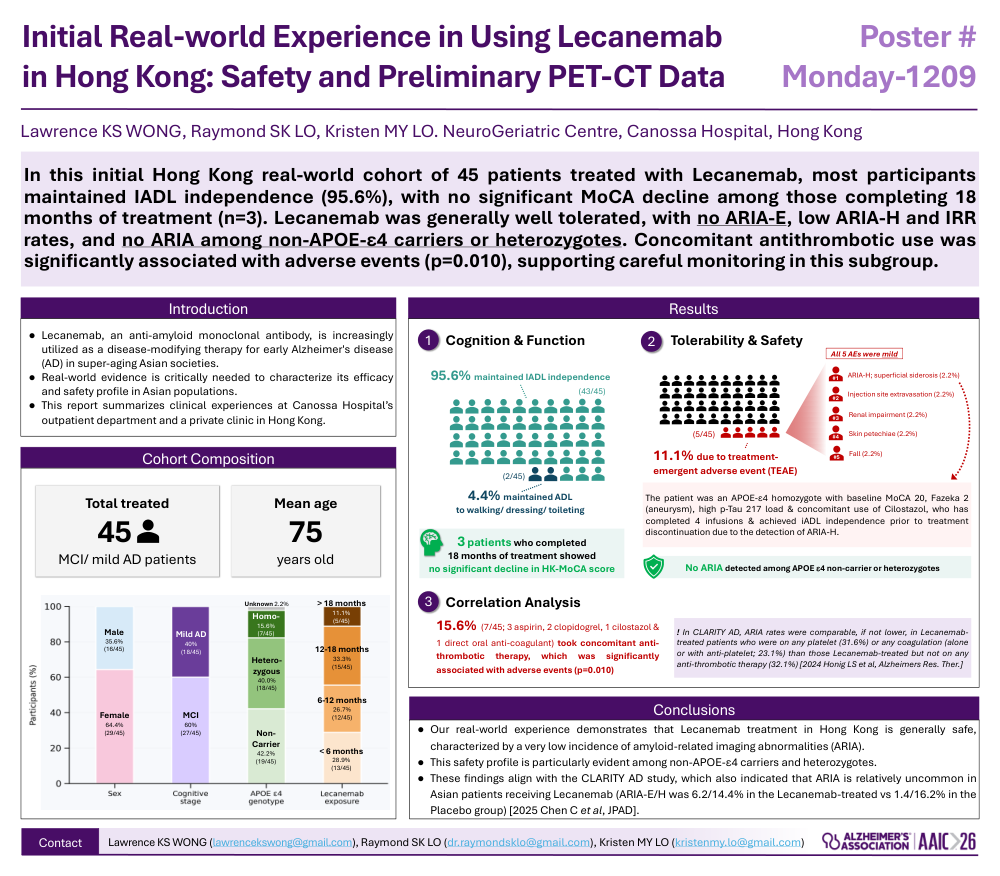
This report summarizes clinical experiences at Canossa Hospital’s outpatient department and aprivate clinic in Hong Kong. The study involved 45 patients—27 with mild cognitive impairment (MCI) and18 with early-stage Alzheimer’s disease (AD)—all of whom had diagnoses confirmed via Amyloid PETscans. Between May 11, 2024, and January 26, 2026, patients received their initial infusion of lecanemab (10mg/kg). Following standard protocols, brain MRIs were conducted at baseline and prior to the 3rd, 5th, 7th,and 14th infusions.
Results:
The cohort’s median age is 75 (range: 56-87), with a female predominance (64.4%, n=29). Twenty-five (55.6%) patients were APOE-ε4 carriers, including 18 (40.0%) heterozygotes and 7 (15.6%)homozygotes. As of 30 March 2026, treatment exposure reached at least 6 months for 32 patients (71.1%),12 months for 20 (44.4%), and 18 months for 5 (11.1%). No ARIA was detected among non-APOE- ε4carriers and heterozygotes. One asymptomatic ARIA-H with superficial siderosis was detected in an APOE-ε4 homozygote. Five patients (11.1%) discontinued treatment due to adverse events, including oneasymptomatic ARIA-H with superficial siderosis (APOE-ε4 homozygote patient), injection site extravasation,falls, skin petechiae and renal impairment. Six patients were on antiplatelet and 1 on direct oralanticoagulant treatments. Concurrent antithrombotic treatment was significantly associated with adverseevents (p=0.010), while age, sex, and APOE-ε4 status were not correlated with adverse events. Repeat PETAmyloid scans were performed in 4 patients, two of them showed complete clearance of amyloid. All fourof them did not progress in the clinical stage of AD.
Conclusion:
Our real-world experience demonstrates that lecanemab treatment in Hong Kong is generallysafe, characterized by a very low incidence of amyloid-related imaging abnormalities (ARIA). This safetyprofile is particularly evident among non-APOE-ε4 carriers and heterozygotes. These findings align with theCLARITY AD study, which also indicated that ARIA is relatively uncommon in Asian patients receivinglecanemab.
Comments
Email is required but is not shown publicly.
Loading comments...