4,068 posters, 219 videos, 101 topics, 69 sessions, 14,365 authors, 6,128 institutions
ePostersLive by SciGen Technologies S.A. All rights reserved.
Alzheimer's Association International Conference 2026
July 12-15, 2026 | London, United Kingdom, and Online

11979
Pre-screening Protocols As A Scalable Infrastructure For Precision Recruitment In Preclinical Alzheimers Disease Trials
Poster Presenter
Authors
Affiliations
Part of Topic
Drug Development -> Human -> Real-world Data / Real-world Evidence
Pre-Screening Protocols as a Scalable Infrastructure for Precision Recruitment in Preclinical Alzheimer's Disease Trials
Daniel Gautieri (SiteRx, Vice President, Strategy & Data Services); Conner Phalen (SiteRx, Senior Analyst, Strategy & Data Services)
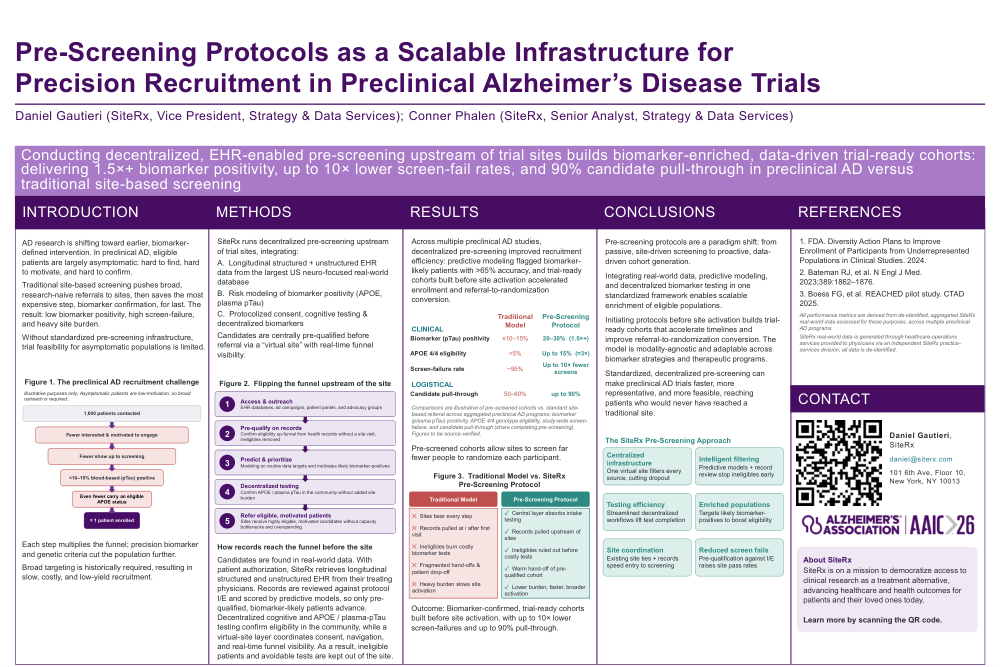
Conducting decentralized, EHR-enabled pre-screening upstream of trial sites builds biomarker-enriched, data-driven trial-ready cohorts: delivering 1.5x+ biomarker positivity, up to 10x lower screen-fail rates, and 90% candidate pull-through in preclinical AD versus traditional site-based screening.
INTRODUCTION
AD research is shifting toward earlier, biomarker-defined intervention. In preclinical AD, eligible patients are largely asymptomatic: hard to find, hard to motivate, and hard to confirm. Traditional site-based screening pushes broad, research-naive referrals to sites, then saves the most expensive step, biomarker confirmation, for last. The result: low biomarker positivity, high screen-failure, and heavy site burden. Without standardized pre-screening infrastructure, trial feasibility for asymptomatic populations is limited.
METHODS
SiteRx runs decentralized pre-screening upstream of trial sites, integrating: A. Longitudinal structured and unstructured EHR data from the largest US neuro-focused real-world database; B. Risk modeling of biomarker positivity (APOE, plasma pTau); C. Protocolized consent, cognitive testing, and decentralized biomarkers. Candidates are centrally pre-qualified before referral via a "virtual site" with real-time funnel visibility.
The SiteRx pre-screening approach: (1) Access and outreach - EHR databases, ad campaigns, patient panels, and advocacy groups. (2) Pre-qualify on records - confirm eligibility up-funnel from health records without a site visit; ineligibles removed. (3) Predict and prioritize - modeling on routine data targets and motivates likely biomarker-positives. (4) Decentralized testing - confirm APOE / plasma pTau in the community without added site burden. (5) Refer eligible, motivated patients - sites receive highly eligible, motivated candidates without capacity bottlenecks and overspending.
How records reach the funnel before the site: Candidates are found in real-world data. With patient authorization, SiteRx retrieves longitudinal structured and unstructured EHR from their treating physicians. Records are reviewed against protocol I/E and scored by predictive models, so only pre-qualified, biomarker-likely patients advance. Decentralized cognitive and APOE / plasma-pTau testing confirm eligibility in the community, while a virtual-site layer coordinates consent, navigation, and real-time funnel visibility. As a result, ineligible patients and avoidable tests are kept out of the site.
RESULTS
Across multiple preclinical AD studies, decentralized pre-screening improved recruitment efficiency: predictive modeling flagged biomarker-likely patients with >65% accuracy, and trial-ready cohorts built before site activation accelerated enrollment and referral-to-randomization conversion.
Traditional Model vs. SiteRx Pre-Screening Protocol:
Clinical - Biomarker (pTau) positivity: less than or equal to 10-15% vs. 20-30% (1.5x+). APOE 4/4 eligibility: less than 5% vs. up to 15% (approximately 3x). Screen-failure rate: approximately 95% vs. up to 10x fewer screens.
Logistical - Candidate pull-through: 50-60% vs. up to 90%.
Pre-screened cohorts allow sites to screen far fewer people to randomize each participant. Outcome: biomarker-confirmed, trial-ready cohorts built before site activation, with up to 10x lower screen-failures and up to 90% pull-through.
Comparisons are illustrative of pre-screened cohorts vs. standard site-based referral across aggregated preclinical AD programs: biomarker (plasma pTau) positivity, APOE 4/4 genotype eligibility, study-wide screen-failure, and candidate pull-through (share completing pre-screening). Figures to be source-verified.
CONCLUSIONS
Pre-screening protocols are a paradigm shift: from passive, site-driven screening to proactive, data-driven cohort generation. Integrating real-world data, predictive modeling, and decentralized biomarker testing in one standardized framework enables scalable enrichment of eligible populations. Initiating protocols before site activation builds trial-ready cohorts that accelerate timelines and improve referral-to-randomization conversion. The model is modality-agnostic and adaptable across biomarker strategies and therapeutic programs. Standardized, decentralized pre-screening can make preclinical AD trials faster, more representative, and more feasible, reaching patients who would never have reached a traditional site.
REFERENCES
- FDA. Diversity Action Plans to Improve Enrollment of Participants from Underrepresented Populations in Clinical Studies. 2024.
- Bateman RJ, et al. N Engl J Med. 2023;389:1862-1876.
- Boess FG, et al. REACHED pilot study. CTAD 2025.
All performance metrics are derived from de-identified, aggregated SiteRx real-world data accessed for these purposes, across multiple preclinical AD programs. SiteRx real-world data is generated through healthcare-operations services provided to physicians via an independent SiteRx practice-services division; all data is de-identified.
CONTACT
Daniel Gautieri, SiteRx. daniel@siterx.com. 101 6th Ave, Floor 10, New York, NY 10013.
Comments
Email is required but is not shown publicly.
Loading comments...