4,068 posters, 219 videos, 101 topics, 69 sessions, 14,365 authors, 6,128 institutions
ePostersLive by SciGen Technologies S.A. All rights reserved.
Alzheimer's Association International Conference 2026
July 12-15, 2026 | London, United Kingdom, and Online

13223
Fll-001, A First-in-class Yars1 Modulator In Preclinical Development For Alzheimer's Disease
Poster Presenter
Authors
Affiliations
Part of Topic
Drug Development -> Human -> Disease Targeting Therapeutics
Video
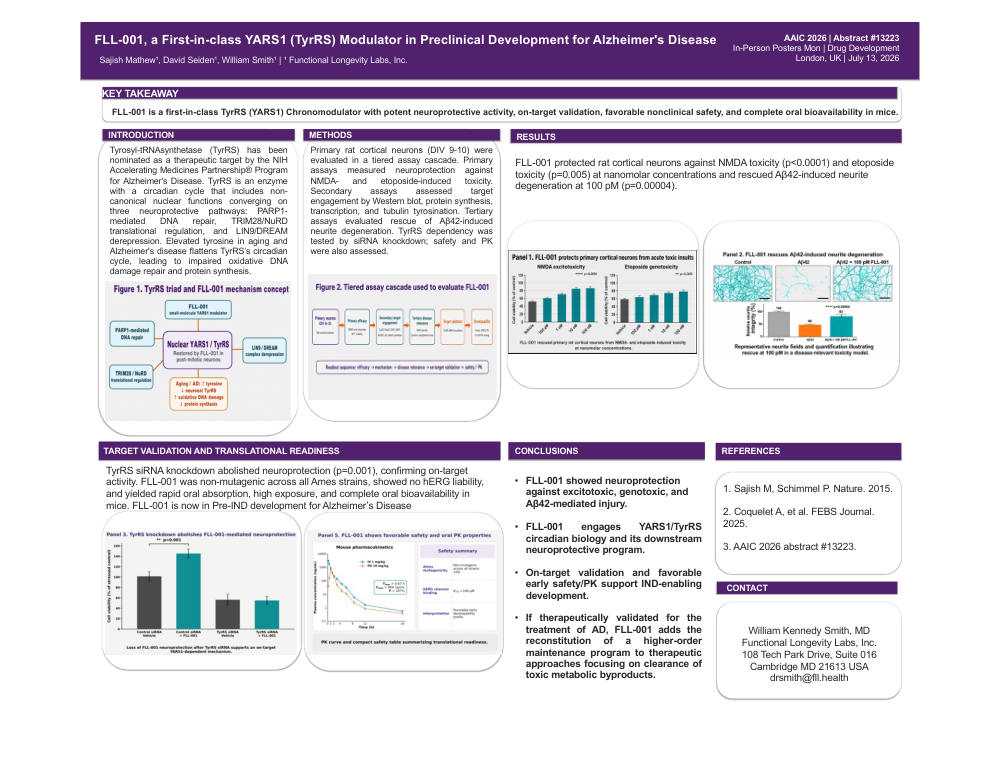
FLL-001, a First-in-Class YARS1 Modulator, Demonstrates Picomolar Neuroprotection and Favorable Safety in Preclinical Models of Alzheimer's Disease
Sajish Mathew, PhD²; David Seiden, MD¹, William K. Smith, MD¹; ¹Functional Longevity Labs, Easton, MD, USA
Background: Tyrosyl-tRNA synthetase (TyrRS/YARS1) possesses non-canonical nuclear functions that converge on three neuroprotective pathways that we collectively term the TyrRS Cascade: PARP1-mediated DNA repair, TRIM28/NuRD translational regulation, and LIN9/DREAM complex derepression (Sajish and Schimmel, Nature 2015; Jhanji et al., Nature Communications 2022; Coquelet et al., FEBS Journal 2025). Elevated tyrosine levels in aging and AD deplete neuronal TyrRS, inducing oxidative DNA damage and inhibiting protein synthesis. We developed FLL-001, a novel small molecule YARS1 modulator designed to restore nuclear TyrRS levels and engage the TyrRS Cascade in post-mitotic neurons.
Methods: FLL-001 was evaluated in primary rat cortical cultures (DIV 9/10) using a tiered assay cascade. Primary assays measured neuroprotection against NMDA- and etoposide-induced toxicity (MTT viability). Secondary assays assessed target engagement via Western blot (TyrRS, PheRS, TOP1, PARP1), global protein synthesis (SUnSET/puromycin incorporation), transcriptional activation (EU incorporation), and tubulin tyrosination. Tertiary assays evaluated protection against neurotoxic Aβ42 and tyrosine/phenylalanine-induced neurite degeneration. Target dependency was confirmed by TyrRS siRNA knockdown. Safety was assessed by Ames mutagenicity assay (OECD 471, five S. typhimurium strains ±S9) and hERG channel binding assay. Pharmacokinetics were characterized following IV (1 mg/kg) and oral (10 mg/kg) dosing in C57BL/6 mice and SD rats.
Results: FLL-001 protected rat cortical neurons against NMDA (p<0.0001) and etoposide (p = 0.005) toxicity at nanomolar concentrations and rescued Aβ42-induced neurite degeneration at 100 pM (p = 0.00004). FLL-001 selectively increased TyrRS levels (p = 0.034) without altering PheRS, activated protein synthesis (p = 0.001) and transcription, increased tubulin tyrosination, and induced TOP1/PARP1 degradation consistent with Cascade pathway engagement. TyrRS siRNA knockdown abolished neuroprotection (p = 0.001), confirming on-target activity. FLL-001 was non-mutagenic across all Ames strains and showed no hERG liability (IC50 >100 µM). Oral dosing in mice yielded rapid absorption (Tmax 0.67 h), high exposure (Cmax 904 ng/mL), and complete oral bioavailability (F = 107%).
Conclusions: FLL-001 is a first-in-class YARS1 modulator with picomolar neuroprotective potency, validated on-target mechanism, clean genotoxicity and cardiac safety profiles, and favorable oral pharmacokinetics in mice. These findings support advancement of FLL-001 toward IND-enabling studies as a novel multi-target therapeutic for Alzheimer’s disease.
Comments
Email is required but is not shown publicly.
Loading comments...