4,068 posters, 219 videos, 101 topics, 69 sessions, 14,365 authors, 6,128 institutions
ePostersLive by SciGen Technologies S.A. All rights reserved.
Alzheimer's Association International Conference 2026
July 12-15, 2026 | London, United Kingdom, and Online

13435
Consistent Cognitive And Functional Outcomes Across Prespecified Subgroups In The Autonomy Trial Evaluating Posdinemab In Early AD
Poster Presenter
Part of Topic
Drug Development -> Human -> Tau-targeting therapeutics
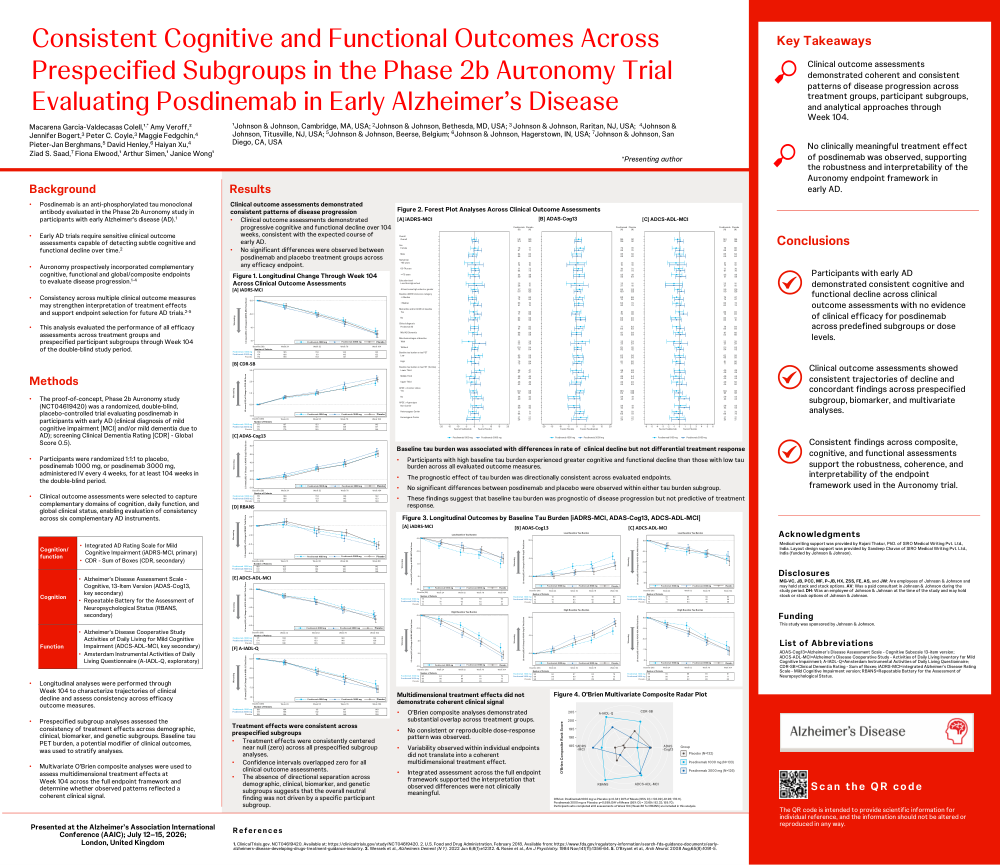
Title: Consistent Cognitive and Functional Outcomes Across Prespecified Subgroups in the Phase 2b Auτonomy Trial Evaluating Posdinemab in Early Alzheimer’s Disease
Authors: Macarena Garcia-Valdecasas Colell,¹,* Amy Veroff,² Jennifer Bogert,3 Peter C. Coyle,3 Maggie Fedgchin,4 Pieter-Jan Berghmans,5 David Henley,6 Haiyan Xu,4 Ziad S. Saad,7 Fiona Elwood,¹ Arthur Simen,¹ Janice Wong¹
*Presenting author
Affiliations: ¹Johnson & Johnson, Cambridge, MA, USA; 2Johnson & Johnson, Bethesda, MD, USA; 3 Johnson & Johnson, Raritan, NJ, USA; 4Johnson & Johnson, Titusville, NJ, USA; 5Johnson & Johnson, Beerse, Belgium; 6Johnson & Johnson, Hagerstown, IN, USA; 7Johnson & Johnson, San Diego, CA, USA
Background
- Posdinemab is an anti-phosphorylated tau monoclonal antibody evaluated in the Phase 2b Auτonomy study in participants with early Alzheimer's disease (AD).1
- Early AD trials require sensitive clinical outcome assessments capable of detecting subtle cognitive and functional decline over time.2
- Auτonomy prospectively incorporated complementary cognitive, functional and global/composite endpoints to evaluate disease progression.1-4
- Consistency across multiple clinical outcome measures may strengthen interpretation of treatment effects and support endpoint selection for future AD trials.2-5
- This analysis evaluated the performance of all efficacy assessments across treatment groups and prespecified participant subgroups through Week 104 of the double-blind study period.
Methods
- The proof-of-concept, Phase 2b Auτonomy study (NCT04619420) was a randomized, double-blind, placebo-controlled trial evaluating posdinemab in participants with early AD (clinical diagnosis of mild cognitive impairment [MCI] and/or mild dementia due to AD); screening Clinical Dementia Rating [CDR] - Global Score 0.5).
- Participants were randomized 1:1:1 to placebo, posdinemab 1000 mg, or posdinemab 3000 mg, administered IV every 4 weeks, for at least 104 weeks in the double-blind period.
- Clinical outcome assessments were selected to capture complementary domains of cognition, daily function, and global clinical status, enabling evaluation of consistency across six complementary AD instruments.
Cognition/function:
- Integrated AD Rating Scale for Mild Cognitive Impairment (iADRS-MCI, primary)
- CDR - Sum of Boxes (CDR, secondary)
Cognition:
- Alzheimer's Disease Assessment Scale - Cognitive, 13-Item Version (ADAS-Cog13, key secondary)
- Repeatable Battery for the Assessment of Neuropsychological Status (RBANS, secondary)
Function:
- Alzheimer's Disease Cooperative Study Activities of Daily Living for Mild Cognitive Impairment (ADCS-ADL-MCI, key secondary)
- Amsterdam Instrumental Activities of Daily Living Questionnaire (A-IADL-Q, exploratory)
- Longitudinal analyses were performed through Week 104 to characterize trajectories of clinical decline and assess consistency across efficacy outcome measures.
- Prespecified subgroup analyses assessed the consistency of treatment effects across demographic, clinical, biomarker, and genetic subgroups. Baseline tau PET burden, a potential modifier of clinical outcomes, was used to stratify analyses.
- Multivariate O'Brien composite analyses were used to assess multidimensional treatment effects at Week 104 across the full endpoint framework and determine whether observed patterns reflected a coherent clinical signal.
Results
Clinical outcome assessments demonstrated consistent patterns of disease progression
- Clinical outcome assessments demonstrated progressive cognitive and functional decline over 104 weeks, consistent with the expected course of early AD.
- No significant differences were observed between posdinemab and placebo treatment groups across any efficacy endpoint.
Treatment effects were consistent across prespecified subgroups
- Treatment effects were consistently centered near null (zero) across all prespecified subgroup analyses.
- Confidence intervals overlapped zero for all clinical outcome assessments.
- The absence of directional separation across demographic, clinical, biomarker, and genetic subgroups suggests that the overall neutral finding was not driven by a specific participant subgroup.
Baseline tau burden was associated with differences in rate of clinical decline but not differential treatment response
- Participants with high baseline tau burden experienced greater cognitive and functional decline than those with low tau burden across all evaluated outcome measures.
- The prognostic effect of tau burden was directionally consistent across evaluated endpoints.
- No significant differences between posdinemab and placebo were observed within either tau burden subgroup.
- These findings suggest that baseline tau burden was prognostic of disease progression but not predictive of treatment response.
Multidimensional treatment effects did not demonstrate coherent clinical signal
- O'Brien composite analyses demonstrated substantial overlap across treatment groups.
- No consistent or reproducible dose-response pattern was observed.
- Variability observed within individual endpoints did not translate into a coherent multidimensional treatment effect.
- Integrated assessment across the full endpoint framework supported the interpretation that observed differences were not clinically meaningful.
Key Takeaways
- Clinical outcome assessments demonstrated coherent and consistent patterns of disease progression across treatment groups, participant subgroups, and analytical approaches through Week 104.
- No clinically meaningful treatment effect of posdinemab was observed, supporting the robustness and interpretability of the Auτonomy endpoint framework in early AD.
Conclusions
- Participants with early AD demonstrated consistent cognitive and functional decline across clinical outcome assessments with no evidence of clinical efficacy for posdinemab across predefined subgroups or dose levels.
- Clinical outcome assessments showed consistent trajectories of decline and concordant findings across prespecified subgroup, biomarker, and multivariate analyses.
- Consistent findings across composite, cognitive, and functional assessments support the robustness, coherence, and interpretability of the endpoint framework used in the Auτonomy trial.
Acknowledgments
- Medical writing support was provided by Rajani Thakur, PhD. of SIRO Medical Writing Pvt. Ltd., India. Layout design support was provided by Sandeep Chavan of SIRO Medical Writing Pvt. Ltd., India (funded by Johnson & Johnson).
Disclosures
- MG-VC, JB, PCC, MF, P-JB, HX, ZSS, FE, AS, and JW: Are employees of Johnson & Johnson and may hold stock and stock options. AV: Was a paid consultant in Johnson & Johnson during the study period. DH: Was an employee of Johnson & Johnson at the time of the study and may hold stock or stock options of Johnson & Johnson.
Funding
- This study was sponsored by Johnson & Johnson.
List of Abbreviations
- DAS-Cog13=Alzheimer’s Disease Assessment Scale - Cognitive Subscale 13-item version; ADCS-ADL-MCI=Alzheimer’s Disease Cooperative Study - Activities of Daily Living Inventory for Mild Cognitive Impairment; A-IADL-Q=Amsterdam Instrumental Activities of Daily Living Questionnaire; CDR-SB=Clinical Dementia Rating - Sum of Boxes; iADRS-MCI=integrated Alzheimer’s Disease Rating Scale - Mild Cognitive Impairment version; RBANS=Repeatable Battery for the Assessment of Neuropsychological Status.
References
- ClinicalTrials.gov. NCT04619420. Available at: https://clinicaltrials.gov/study/NCT04619420.
- U.S. Food and Drug Administration. February 2018. Available from: https://www.fda.gov/regulatory-information/search-fda-guidance-documents/early-alzheimers-disease-developing-drugs-treatment-guidance-industry.
- Wessels et al., Alzheimers Dement (N Y). 2022 Jun 6;8(1):e12312.
- Rosen et al., Am J Psychiatry. 1984 Nov;141(11):1356-64.
- O'Bryant et al., Arch Neurol. 2008 Aug;65(8):1091-5.
Comments
Email is required but is not shown publicly.
Loading comments...