4,068 posters, 219 videos, 101 topics, 69 sessions, 14,365 authors, 6,128 institutions
ePostersLive by SciGen Technologies S.A. All rights reserved.
Alzheimer's Association International Conference 2026
July 12-15, 2026 | London, United Kingdom, and Online

7426
Anchor-based Estimation Of Minimal Clinically Important Decline On Ace-iii In Mci And Dementia
Poster Presenter
Authors
Aditi Dubey, Hina Narzari, Nilima N, Anjali Anjali, Vishnu V.Y., Roopa Rajan, Ashima Nehra, Mamta Bhushan, Rohit Bhatia, Achal Kumar Srivastava, Manjari Tripathi, Anu Gupta
Affiliations
Department of Neurology, All India Institute of Medical Sciences, New Delhi, Department of Biostatistics, All India Institute of Medical Sciences, New Delhi
Part of Topic
Anchor-Based Estimation of Minimal Clinically Important Decline on ACE-III in MCI and Dementia
Background:
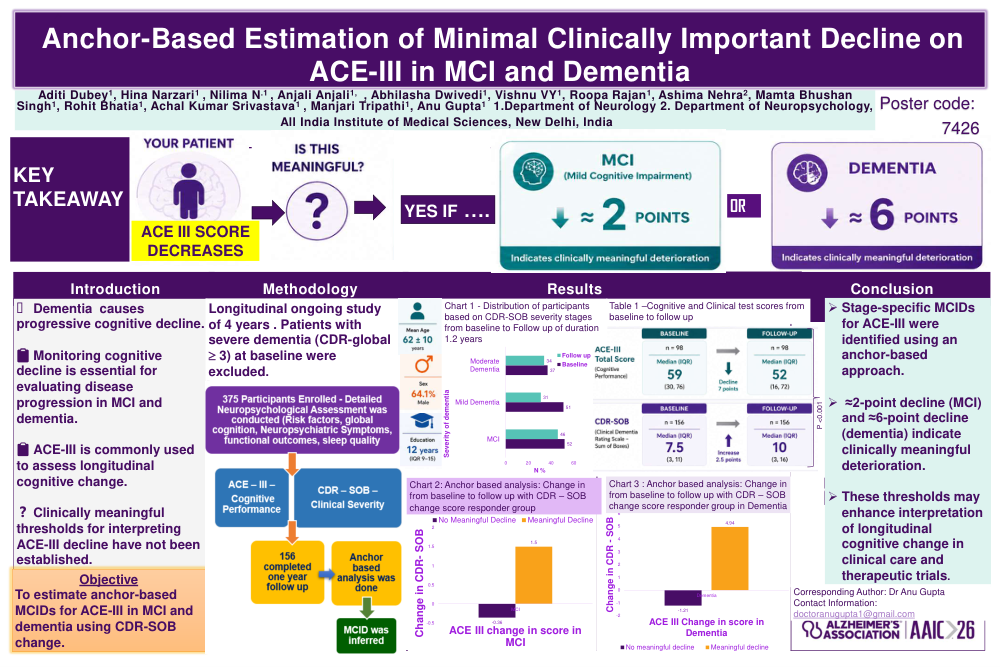
Dementia is a progressive neurodegenerative condition characterized by cognitive and functional decline, making accurate monitoring of change essential. The Minimal Clinically Important Difference (MCID) provides a threshold to determine whether observed decline on cognitive measures is clinically meaningful. This study aimed to estimate anchor-based MCIDs for Addenbrooke’s Cognitive Examination-III (ACE-III), a commonly used tool for cognitive assessment using change in the Clinical Dementia Rating–Sum of Boxes (CDR-SB) as the clinical anchor.
Methods
375 individuals with cognitive impairment were followed for a median of 1.17 years (IQR 1.1–1.6) between April 2021 and November 2025. Cognitive performance was assessed using ACE-III and clinical severity using CDR-SOB; patients with baseline severe dementia (CDR-Global ≥3) were excluded. Change in ACE-III (ΔACE) was defined as follow-up minus baseline. Clinically meaningful worsening was anchored to ΔCDR-SOB ≥ 0.5 for MCI and ≥ 1.0 for dementia. Anchor-based MCID was calculated as the difference in mean ΔACE between anchor-defined groups. Complete paired ACE-III data were available for 98 participants and were used for MCID estimation.
Results
The analysed cohort (n=156) had a mean age of 62 years (SD 10), was predominantly male (64.1%), and had moderate education (median 12 years, IQR 9–15). Significant decline occurred over follow-up: median ACE-III decreased from 59 (30, 76) to 52 (16, 72) (p<0.001) and median CDR-SOB increased from 7.5 (3, 11) to 10 (3, 16) (p<0.001). Disease severity progressed, with the proportion of severe dementia rising from 10.3% to 28.9%. Anchor analyses showed that ACE-III change differentiated participants with and without meaningful CDR-SOB worsening. In MCI (n=22), ΔACE was 1.5±1.49 in the worsened group versus −0.36±0.60 in the stable group (mean difference −1.86; 95% CI −2.79 to −0.93; p<0.001). In dementia (n=114), ΔACE was 4.94± 2.90 versus −1.21±1.60 (mean difference −6.15; 95% CI −7.08 to −5.22; p<0.001).
Conclusions
Anchor-based estimates indicate that an ACE-III decline of approximately 2 points in MCI and 6 points in dementia corresponds to clinically meaningful deterioration. These stage-specific thresholds demonstrate a graded relationship between ACE-III change and progression on CDR-SB and may enhance interpretation of cognitive outcomes in trials and routine dementia care.
Comments
Email is required but is not shown publicly.
Loading comments...