4,068 posters, 219 videos, 101 topics, 69 sessions, 14,365 authors, 6,128 institutions
ePostersLive by SciGen Technologies S.A. All rights reserved.
Alzheimer's Association International Conference 2026
July 12-15, 2026 | London, United Kingdom, and Online

13137
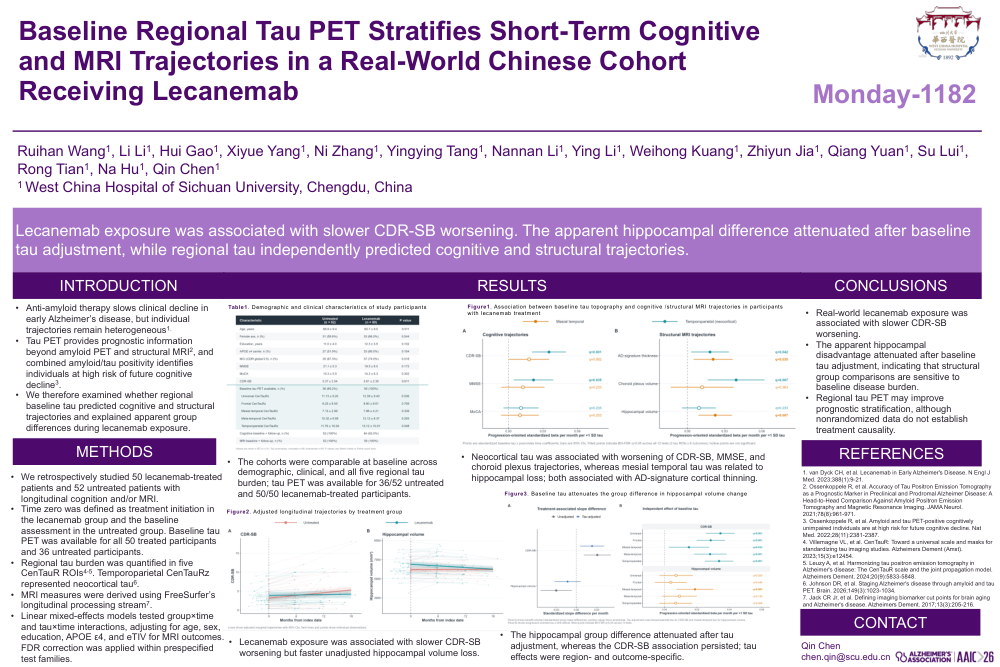
Baseline Regional Tau Pet Stratifies Short-term Cognitive And Mri Trajectories In A Real-world Chinese Cohort Receiving Lecanemab
Poster Presenter
Authors
Ruihan Wang, Li Li, Hui Gao, Xiyue Yang, Ni Zhang, Yingying Tang, Nannan Li, Ying Li, Weihong Kuang, Zhiyun Jia, Qiang Yuan, Su Lui, Rong Tian, Na Hu, Qin Chen
Affiliations
Part of Topic
Drug Development -> Human -> Real-world Data / Real-world Evidence
We conducted a retrospective real-world study of 50 lecanemab-treated and 52 untreated patients with early Alzheimer’s disease to examine whether baseline regional tau PET stratifies short-term cognitive and structural MRI trajectories. Time zero was defined as treatment initiation for the lecanemab group and baseline assessment for untreated participants. Baseline tau PET was available in all treated participants and 36 untreated participants. Tau burden was quantified across five CenTauR regions, and longitudinal MRI measures were derived using FreeSurfer’s longitudinal stream.
Linear mixed-effects models adjusted for age, sex, education, and APOE ε4 status showed that lecanemab exposure was associated with slower CDR-SB worsening. An apparent between-group difference in hippocampal volume loss was attenuated after adjustment for baseline tau, whereas the CDR-SB association persisted. Regional tau showed outcome- and topography-specific prognostic associations: neocortical tau was associated with worsening cognitive and choroid plexus trajectories, while mesial temporal tau was associated with hippocampal volume loss; both were related to AD-signature cortical thinning.
These findings support regional tau PET as a tool for prognostic stratification in real-world early AD. Because this was a nonrandomized observational study, the findings do not establish causal treatment effects or tau-guided treatment decisions.
Comments
Email is required but is not shown publicly.
Loading comments...