4,068 posters, 219 videos, 101 topics, 69 sessions, 14,365 authors, 6,128 institutions
ePostersLive by SciGen Technologies S.A. All rights reserved.
Alzheimer's Association International Conference 2026
July 12-15, 2026 | London, United Kingdom, and Online

13271
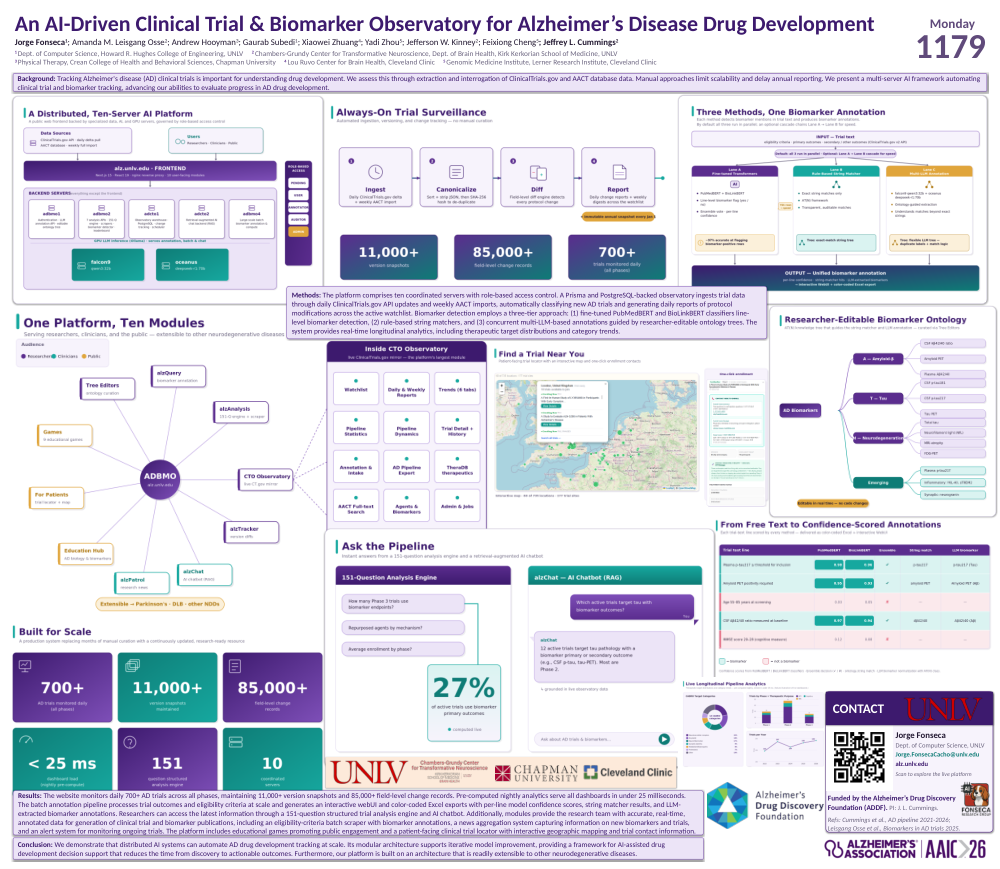
An AI-driven Clinical Trial & Biomarker Observatory For Alzheimer's Disease Drug Development
Poster Presenter
Authors
Jorge Fonseca, Amanda Leisgang Osse, Andrew Hooyman, Gaurab Subedi, Xiaowei Zhuang, Yadi Zhou, Jefferson Kinney, Feixiong Cheng, Jeffrey Cummings
Affiliations
Department of Computer Science, Howard R. Hughes College of Engineering, University of Nevada, Las Vegas, Chambers-Grundy Center for Transformative Neuroscience, Department of Brain Health, Kirk Kerkorian School of Medicine, University of Nevada, Las Vegas, Physical Therapy, Crean College of Health and Behavioral Sciences, Chapman University, Lou Ruvo Center for Brain Health, Cleveland Clinic, Genomic Medicine Institute, Lerner Research Institute, Cleveland Clinic
Part of Topic
Drug Development -> Human -> Trial design
SEARCHABLE FULL-TEXT VARIANT / CLEANED OCR TRANSCRIPT
Source PDF: FONSECA ADBMO AAIC2026 Poster.pdf
Poster: Monday 1179, AAIC 2026
Title
An AI-Driven Clinical Trial & Biomarker Observatory for Alzheimer’s Disease Drug Development
Authors
Jorge Fonseca¹; Amanda M. Leisgang Osse²; Andrew Hooyman³; Gaurab Subedi¹; Xiaowei Zhuang⁴; Yadi Zhou⁵; Jefferson W. Kinney²; Feixiong Cheng⁵; Jeffrey L. Cummings²
Affiliations
¹ Department of Computer Science, Howard R. Hughes College of Engineering, University of Nevada, Las Vegas (UNLV).
² Chambers-Grundy Center for Transformative Neuroscience, Department of Brain Health, Kirk Kerkorian School of Medicine, UNLV.
³ Physical Therapy, Crean College of Health and Behavioral Sciences, Chapman University.
⁴ Lou Ruvo Center for Brain Health, Cleveland Clinic.
⁵ Genomic Medicine Institute, Lerner Research Institute, Cleveland Clinic.
Background
Tracking Alzheimer’s disease (AD) clinical trials is important for understanding drug development. We assess this through extraction and interrogation of ClinicalTrials.gov and AACT database data. Manual approaches limit scalability and delay annual reporting. We present a multi-server AI framework automating clinical trial and biomarker tracking, advancing our abilities to evaluate progress in AD drug development.
Methods
The platform comprises ten coordinated servers with role-based access control. A Prisma and PostgreSQL-backed observatory ingests trial data through daily ClinicalTrials.gov API updates and weekly AACT imports, automatically classifying new AD trials and generating daily reports of protocol modifications across the active watchlist. Biomarker detection employs a three-tier approach: (1) fine-tuned PubMedBERT and BioLinkBERT classifiers for line-level biomarker detection, (2) rule-based string matchers, and (3) concurrent multi-LLM-based annotations guided by researcher-editable ontology trees. The system provides real-time longitudinal analytics, including therapeutic target distributions and category trends.
Results
The website monitors daily 700+ AD trials across all phases, maintaining 11,000+ version snapshots and 85,000+ field-level change records. Pre-computed nightly analytics serve all dashboards in under 25 milliseconds. The batch annotation pipeline processes trial outcomes and eligibility criteria at scale and generates an interactive webUI and color-coded Excel exports with per-line model confidence scores, string matcher results, and LLM-extracted biomarker annotations. Researchers can access the latest information through a 151-question structured trial analysis engine and AI chatbot. Additionally, modules provide the research team with accurate, real-time, annotated data for generation of clinical trial and biomarker publications, including an eligibility-criteria batch scraper with biomarker annotations, a news aggregation system capturing information on new biomarkers and trials, and an alert system for monitoring ongoing trials. The platform includes educational games promoting public engagement and a patient-facing clinical trial locator with interactive geographic mapping and trial contact information.
Conclusion
We demonstrate that distributed AI systems can automate AD drug development tracking at scale. Its modular architecture supports iterative model improvement, providing a framework for AI-assisted drug development decision support that reduces the time from discovery to actionable outcomes. Furthermore, our platform is built on an architecture that is readily extensible to other neurodegenerative diseases.
A Distributed, Ten-Server AI Platform
A public web frontend backed by specialized data, AI, and GPU servers, governed by role-based access control.
Data sources
ClinicalTrials.gov API: daily delta pull.
AACT database: weekly full import.
Users
Researchers, clinicians, and the public.
Frontend
alz.unlv.edu frontend.
Next.js 15, React 19, nginx reverse proxy, 10 user-facing modules.
Backend servers, everything except the frontend
adbmo1: authentication, LLM annotation API, editable ontology tree.
adbmo2: 7 analysis APIs, 151-question engine, scrapers, biomarker detector, leaderboard.
adcto1: observatory warehouse, PostgreSQL, change tracking, scheduler.
adcto2: retrieval-augmented AI chat backend (RAG).
adbmo4: large-scale batch biomarker annotation and compute.
GPU LLM inference
Ollama serves annotation, batch, and chat.
Models/servers shown: falcon9 with qwen3:32b; oceanus with deepseek-r1:70b.
Role-based access
Pending, user, annotator, auditor, admin.
Always-On Trial Surveillance
Automated ingestion, versioning, and change tracking with no manual curation.
Ingest
Daily ClinicalTrials.gov delta plus weekly AACT import.
Canonicalize
Sort and strip JSON, then SHA-256 hash to de-duplicate.
Diff
Field-level diff engine detects every protocol change.
Report
Daily change reports and weekly digests across the watchlist.
Surveillance metrics
11,000+ version snapshots.
85,000+ field-level change records.
700+ trials monitored daily across all phases.
Three Methods, One Biomarker Annotation
Each method detects biomarker mentions in trial text and produces biomarker annotations. By default, all three methods run in parallel. An optional cascade chains Lane A to Lane B for speed.
Input trial text
Eligibility criteria, primary outcomes, and secondary/other outcomes from the ClinicalTrials.gov v2 API.
Lane A: Fine-tuned Transformers
PubMedBERT plus BioLinkBERT.
Line-level biomarker flag: yes or no.
Ensemble vote with per-line confidence.
Approximately 97% accurate at flagging biomarker-positive rows.
Lane B: Rule-Based String Matcher
Exact string matches only.
AT(N) framework.
Transparent, auditable matches.
Tree: exact-match string tree.
Lane C: Multi-LLM Annotation
falcon9, qwen3:32b, oceanus, and deepseek-r1:70b.
Ontology-guided extraction.
Understands matches beyond exact strings.
Tree: flexible LLM tree with duplicate labels and match logic.
Output
Unified biomarker annotation.
Per-line confidence, string-matcher hits, and LLM-extracted biomarkers.
Interactive WebUI and color-coded Excel export.
One Platform, Ten Modules
Serving researchers, clinicians, and the public; extensible to other neurodegenerative diseases.
Audience categories: researchers, clinicians, public.
Central platform: ADBMO, alz.unlv.edu.
Modules and tools
Tree Editors: ontology curation.
alzQuery: biomarker annotation.
Games: 9 educational games.
alzAnalysis: 151-question engine and scraper.
CTO Observatory: live ClinicalTrials.gov mirror.
alzTracker: version diffs.
alzPatrol: research news.
alzChat: AI chatbot with retrieval-augmented generation (RAG).
Education Hub: AD biology and biomarkers.
For Patients: trial locator and map.
Extension path
Extensible to Parkinson’s disease, dementia with Lewy bodies (DLB), and other neurodegenerative diseases (NDDs).
Inside CTO Observatory
Live ClinicalTrials.gov mirror; the platform’s largest module.
CTO Observatory submodules
Watchlist.
Daily and weekly reports.
Trends with 6 tabs.
Pipeline statistics.
Pipeline dynamics.
Trial detail plus history.
Annotation and intake.
AD Pipeline export.
TheraDB therapeutics.
AACT full-text search.
Agents and biomarkers.
Admin and jobs.
Find a Trial Near You
Patient-facing trial locator with an interactive map and one-click enrollment contacts.
Example map and locator text
60 of 735 locations; 177 trial sites.
London, United Kingdom, 0 km away.
18 trials available to join.
Enrolling Now, Phase 1.
A First-In-Human Study of LY3954068 in Participants With Early Symptomatic Alzheimer’s Disease.
A Study to Evaluate ALN-5288 in Patients With Alzheimer’s Disease.
Search all trials.
Interactive map with trial locations and OpenStreetMap/Leaflet mapping.
One-click enrollment example
Enrolling Now, Phase 1, London, United Kingdom.
A First-In-Human Study of LY3954068 in Participants With Early Symptomatic Alzheimer’s Disease.
ClinicalTrials.gov identifier shown: NCT06297590.
Contact here to enroll.
Central Contact (primary): trial questions or participation questions: 1-877-CTLILLY (1-877-285-4559) or 1-317-615-4559. LillyTrials@Lilly.com.
Central Contact (backup): physicians interested in becoming principal investigators please contact clinical_inquiry_hub@lilly.com.
Study Contact - Study Director: call 1-877-CTLILLY (1-877-285-4559) or 1-317-615-4559 Monday through Friday, 8 AM to 8 PM Eastern time (UTC/GMT - 5 hours, EST). Eli Lilly and Company.
Sponsor: Eli Lilly and Company.
Enrollment target: 48 participants.
Disease-targeting therapy - biologic, DTT biologic
These are therapies made from living cells, such as monoclonal antibodies. They are engineered to target the core biology of Alzheimer’s, such as clearing amyloid plaques from the brain or stopping tau protein tangles from spreading. Many of the most exciting recent breakthroughs, including lecanemab and donanemab, are biologics. They are typically given by IV infusion.
Treatment being tested
Intervention / drug name: LY3954068.
How it works / mechanism of action: undisclosed.
Researcher-Editable Biomarker Ontology
AT(N) knowledge tree that guides the string matcher and LLM annotation, curated via Tree Editors.
Editable in real time with no code changes.
AD Biomarkers ontology
A - Amyloid-β / Amyloid-beta:
CSF Aβ42/40 ratio.
Amyloid PET.
Plasma Aβ42/40.
T - Tau:
CSF p-tau181.
CSF p-tau217.
Tau PET.
Total tau.
N - Neurodegeneration:
Neurofilament light (NfL).
MRI atrophy.
FDG-PET.
Emerging biomarkers:
Plasma p-tau217.
Inflammatory: YKL-40, sTREM2.
Synaptic: neurogranin.
From Free Text to Confidence-Scored Annotations
Each trial-text line is scored by every method and delivered as color-coded Excel plus interactive WebUI.
Table columns
Trial text line.
PubMedBERT.
BioLinkBERT.
Ensemble.
String match.
LLM biomarker.
Example annotation rows
Trial text line: Plasma p-tau217 ≥ threshold for inclusion.
PubMedBERT confidence: 0.98.
BioLinkBERT confidence: 0.96.
Ensemble: biomarker detected.
String match: p-tau217.
LLM biomarker: p-tau217 (Tau).
Trial text line: Amyloid PET positivity required.
PubMedBERT confidence: 0.95.
BioLinkBERT confidence: 0.93.
Ensemble: biomarker detected.
String match: amyloid PET.
LLM biomarker: Amyloid PET (Aβ).
Trial text line: Age 55-85 years at screening.
PubMedBERT confidence: 0.03.
BioLinkBERT confidence: 0.05.
Ensemble: not a biomarker.
String match: none.
LLM biomarker: none.
Trial text line: CSF Aβ42/40 ratio measured at baseline.
PubMedBERT confidence: 0.97.
BioLinkBERT confidence: 0.94.
Ensemble: biomarker detected.
String match: Aβ42/40.
LLM biomarker: Aβ42/40 (Aβ).
Trial text line: MMSE score 20-28 (cognitive measure).
PubMedBERT confidence: 0.12.
BioLinkBERT confidence: 0.08.
Ensemble: not a biomarker.
String match: none.
LLM biomarker: none.
Legend
Teal rows: biomarker.
Pink rows: not a biomarker.
Confidence scores from PubMedBERT and BioLinkBERT classifiers; ensemble decision with check or X; ontology string match; LLM biomarker normalization with AT(N) class.
Ask the Pipeline
Instant answers from a 151-question analysis engine and a retrieval-augmented AI chatbot.
151-Question Analysis Engine example questions
How many Phase 3 trials use biomarker endpoints?
Repurposed agents by mechanism?
Average enrollment by phase?
Answer shown: 27% of active trials use biomarker primary outcomes.
alzChat - AI Chatbot (RAG)
User question: Which active trials target tau with biomarker outcomes?
alzChat answer: 12 active trials target tau pathology with a biomarker primary or secondary outcome, for example CSF p-tau and tau-PET. Most are Phase 2.
The response is grounded in live observatory data.
Built for Scale
A production system replacing months of manual curation with a continuously updated, research-ready resource.
Scale metrics
700+ AD trials monitored daily across all phases.
11,000+ version snapshots maintained.
85,000+ field-level change records.
<25 ms dashboard load with nightly pre-compute.
151-question structured analysis engine.
10 coordinated servers.
Live Longitudinal Pipeline Analytics
Therapeutic-target distributions and category trends are pre-computed nightly and served in under 25 ms. Values are illustrative of live dashboards.
CADRO Target Categories
14 CADRO categories.
Neurotransmitter receptors: 22%.
Amyloid-β / Amyloid-beta: 18%.
Neuroinflammation: 17%.
Synaptic plasticity: 9%.
Metabolism / Bioenergetics: 8%.
Proteostasis: 7%.
Other: 19%.
Trials by Phase x Therapeutic Purpose
Therapeutic purpose legend: DTT, NPS, Cognitive.
Phase 1: 39 trials.
Phase 2: 75 trials.
Phase 3: 31 trials.
Trials per Year
2022: 143.
2023: 187.
2024: 164.
2025: 182.
2026: 192.
Contact
Jorge Fonseca.
Department of Computer Science, UNLV.
Jorge.FonsecaCacho@unlv.edu.
alz.unlv.edu.
Scan to explore the live platform.
Funding and references
Funded by the Alzheimer’s Drug Discovery Foundation (ADDF). PI: J. L. Cummings.
References: Cummings et al., AD pipeline 2021-2026; Leisgang Osse et al., Biomarkers in AD trials 2025.
Logos and organizations shown
UNLV.
Chambers-Grundy Center for Transformative Neuroscience.
Chapman University.
Cleveland Clinic.
Alzheimer’s Drug Discovery Foundation.
Fonseca Research Group.
Alzheimer’s Association.
AAIC 2026.
Comments
Email is required but is not shown publicly.
Loading comments...