4,068 posters, 219 videos, 101 topics, 69 sessions, 14,365 authors, 6,128 institutions
ePostersLive by SciGen Technologies S.A. All rights reserved.
Alzheimer's Association International Conference 2026
July 12-15, 2026 | London, United Kingdom, and Online

13101
A Novel GPX4 Positive Allosteric Modulator Ameliorates Cognitive Impairment By Inhibiting Ferroptosis And Neuroinflammation
Poster Presenter
Part of Topic
Drug Development -> Nonhuman -> Target identification and validation studies: Disease Targeting Therapeutics
[Title]
A Novel GPX4 Positive Allosteric Modulator Ameliorates Cognitive Impairment By Inhibiting Ferroptosis And Neuroinflammation
[Authors]
Seo-yun Yang, et al.
Dong-A ST
[Background]
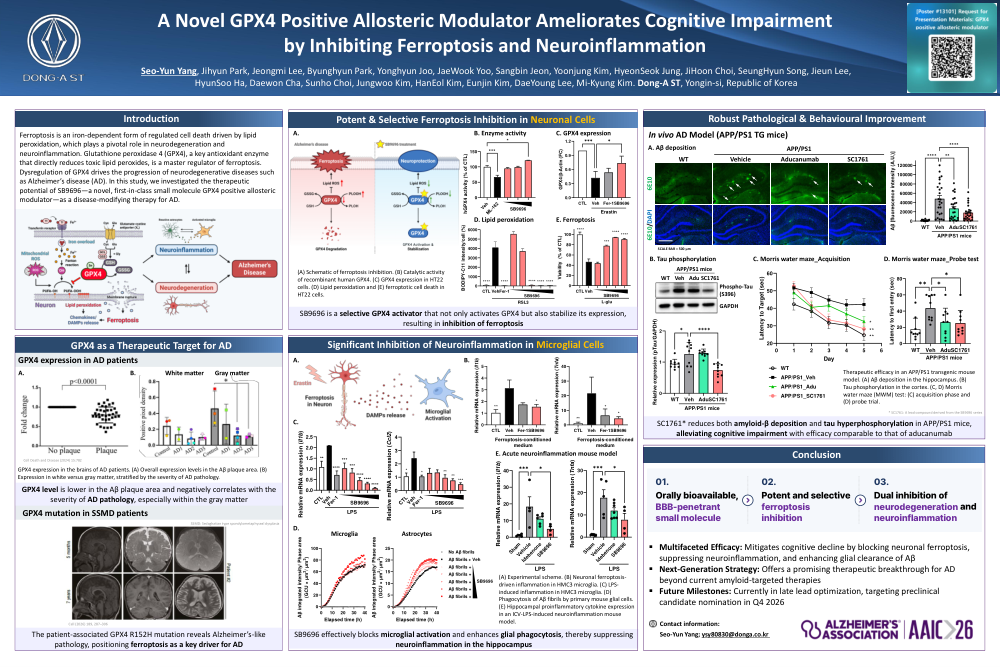
Ferroptosis is an iron-dependent form of regulated cell death driven by lipid peroxidation, and it plays a pivotal role in oxidative stress and neuroinflammation. Glutathione peroxidase 4 (GPX4) is a key antioxidant enzyme that directly reduces lipid hydroperoxides, serving as a master regulator of ferroptosis. Although GPX4 dysfunction is increasingly recognized as a driver of neurodegeneration, including Alzheimer’s disease (AD), therapeutic strategies specifically targeting GPX4 remain largely unexplored. Here, we investigated the therapeutic potential of a first-in-class small molecule modulator of GPX4 as a disease-modifying therapy for AD.
[Methods]
The anti-ferroptotic effects of the compound were evaluated in HT22 hippocampal neuronal cells. Anti-inflammatory activity was assessed in LPS-stimulated microglia, and its impact on Aβ phagocytosis was investigated using primary cultures of microglia and astrocytes. For in vivo validation, neuroinflammation was induced by intracerebroventricular (ICV) injection of LPS in C57BL/6 mice following 7 days of oral compound administration. Chronic efficacy was evaluated in APP/PS1 transgenic mice treated for 12 weeks, followed by cognitive assessment via the Morris water maze (MWM) test.
[Results]
In vitro: The compound significantly inhibited key ferroptotic hallmarks (iron accumulation, GSH depletion, mitochondrial ROS, lipid peroxidation) and restored GPX4 expression in hippocampal neurons. In microglia, the compound not only suppressed neuronal ferroptosis-driven inflammation but also directly inhibited LPS-induced proinflammatory cytokines (IL-1β, CCL2). Furthermore, it promoted phagocytic clearance of Aβ fibrils in both primary microglia and astrocytes.
In vivo: Oral administration effectively reduced hippocampal neuroinflammation in the ICV-LPS model. In APP/PS1 transgenic mice, the compound reduced Aβ plaque burden and tau hyperphosphorylation. Notably, it ameliorated cognitive impairment with an efficacy comparable to the clinically approved antibody, aducanumab.
[Conclusions]
Our findings demonstrate that this novel GPX4 modulator mitigates cognitive decline by concurrently blocking neuronal ferroptosis, suppressing neuroinflammation, and enhancing glial clearance of Aβ. Targeting GPX4 represents a promising, multifaceted therapeutic strategy for AD, offering a potential breakthrough beyond current standard-of-care amyloid-targeting therapies.
[Keywords]
Alzheimer's Disease, Ferroptosis, GPX4, Therapeutics, Drug Discovery
[Disclosures / Acknowledgements]
This research was supported by Dong-A ST. The authors are employees of Dong-A ST.
[Contact Information]
For questions, partnership inquiries, or to request a full copy of the poster, please contact Seo-yun Yang at ysy80830@donga.co.kr.
Comments
Email is required but is not shown publicly.
Loading comments...