4,068 posters, 219 videos, 101 topics, 69 sessions, 14,365 authors, 6,128 institutions
ePostersLive by SciGen Technologies S.A. All rights reserved.
Alzheimer's Association International Conference 2026
July 12-15, 2026 | London, United Kingdom, and Online

10371
Primary Progressive Aphasia Across South Asian Languages: A Cognitive Linguistic Profile
Poster Presenter
Authors
Part of Topic
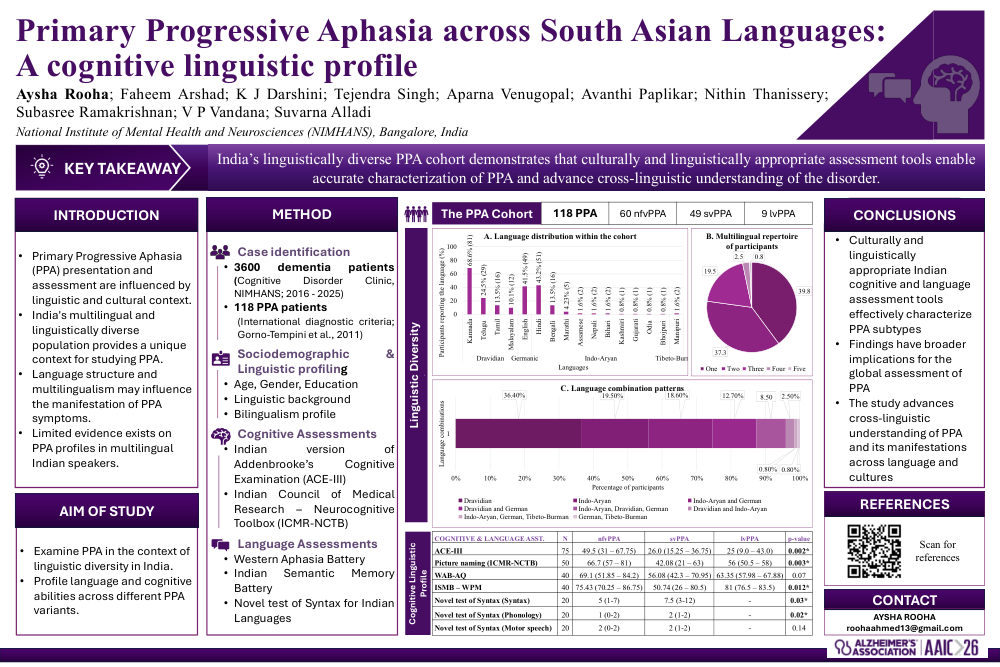
Background: Linguistic and cultural diversity influences the evaluation and phenomenology of primary progressive aphasia (PPA) and its variants. India represents a uniquely diverse linguistic and cultural context, characterized by widespread multilingualism and typologically distinct languages that affect diagnostic evaluation and shape the manifestation of language-led dementia disorders such as PPA. The present study focused on understanding PPA in the context of linguistic diversity and profiling the cognitive and language abilities across variants.
Method: Of 3600 dementia patients evaluated at the Cognitive Disorder Clinic of National Institute of Mental Health and Neurosciences, Bangalore, India, between 2016 and 2025, 118 were diagnosed with PPA according to standard internation diagnostic criteria. Linguistic backgrounds, bilingualism profiles, education and sociodemographic characteristics were noted. Cognitive assessment was done using linguistically and culturally adapted cognitive tests: Addenbrooke’s Cognitive Examination III (ACE-III) and the Indian Council of Medical Research – Neurocognitive Toolbox. Comprehensive language evaluation included Indian version of the Western Aphasia Battery, semantic memory assessed using Indian Semantic Memory Battery and syntactic skills using a Novel Test of Syntax developed for Indian languages. All assessments were done in the patient's preferred language, by examiners proficient in the language.
Results: Of the 118 PPA patients, 60 were nonfluent variant PPA, 49 were semantic variant PPA, and 9 were logogenic variant PPA. The cohort represented sixteen languages across four language families (Dravidian, Indo-Aryan, Germanic, and Tibeto-Burman) (Figure 1). Most reported were Kannada (68.6%), followed by Hindi (43.2%), English (41.5%), and Telugu (24.5%). Overall, 76 (60%) patients were bilinguals. The ACE-III total score and WAB-AQ score was 40+20.7 and 65.7+19 respectively for the cohort. In the overall cohort, cognitive and linguistic scores were 40+20.7 on the ACE-III and 65.7+19 on the WAB-AQ. On linguistic measures, the nfvPPA scored lower on Novel Test of Syntax (p=0.03) and svPPA had worse performance on Indian Semantic Memory Battery (p=0.012)
Conclusion: In the context of high linguistic diversity, our study demonstrates that the development and use of linguistically and culturally appropriate Indian cognitive and language assessment tools effectively characterize PPA subtypes and delineate distinct cognitive–linguistic profiles. These findings have broader implications for the global assessment of PPA supporting cross-linguistic understanding of the disorder.
Comments
Email is required but is not shown publicly.
Loading comments...