4,068 posters, 219 videos, 101 topics, 69 sessions, 14,365 authors, 6,128 institutions
ePostersLive by SciGen Technologies S.A. All rights reserved.
Alzheimer's Association International Conference 2026
July 12-15, 2026 | London, United Kingdom, and Online

10235
Caregiving For People Living With Dementia Is Associated With Higher Pain Intensity And Lower Cognitive Performance Over 12 Months
Poster Presenter
Authors
Christine McClure, Nora Mattek, Jeffrey Kaye, Walter Dawson, Allison Lindauer
Affiliations
Support via Technology: Living and Learning with Advancing Dementia (STELLA), Oregon Center for Aging & Technology (ORCATECH), Oregon Alzheimer’s Disease Research Center (OADRC), Oregon Health & Science University, Portland, OR, Oregon Center for Aging & Technology (ORCATECH), Oregon Alzheimer’s Disease Research Center (OADRC), Oregon Health & Science University, Portland, OR, Support via Technology: Living and Learning with Advancing Dementia (STELLA), Oregon Alzheimer’s Disease Research Center (OADRC), Oregon Health & Science University, Portland, OR
Part of Topic
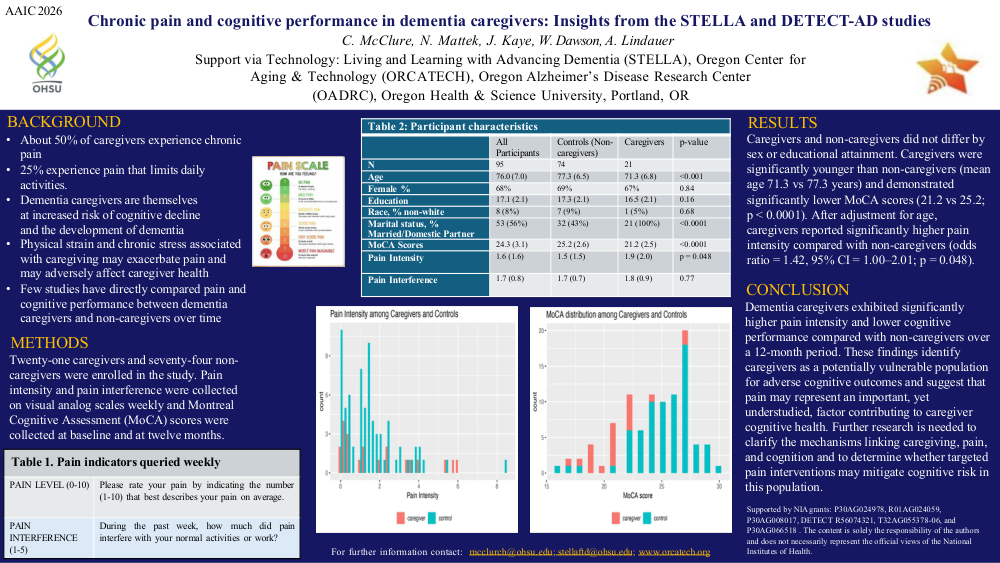
Background: About 50% of caregivers experience chronic pain. 25% experience pain that limits daily activities. Dementia caregivers are themselves at increased risk of cognitive decline and the development of dementia. Physical strain and chronic stress associated with caregiving may exacerbate pain and may adversely affect caregiver health. Few studies have directly compared pain and cognitive performance between dementia caregivers and non-caregivers over time
Methods: Twenty-one caregivers and seventy-four non-caregivers were enrolled in the study. Pain intensity and pain interference were collected on visual analog scales weekly and Montreal Cognitive Assessment (MoCA) scores were collected at baseline and at twelve months.
Results: Caregivers and non-caregivers did not differ by sex or educational attainment. Caregivers were significantly younger than non-caregivers (mean age 71.3 vs 77.3 years) and demonstrated significantly lower MoCA scores (21.2 vs 25.2; p < 0.0001). After adjustment for age, caregivers reported significantly higher pain intensity compared with non-caregivers (odds ratio = 1.42, 95% CI = 1.00–2.01; p = 0.048).
Conclusions: Dementia caregivers exhibited significantly higher pain intensity and lower cognitive performance compared with non-caregivers over a 12-month period. These findings identify caregivers as a potentially vulnerable population for adverse cognitive outcomes and suggest that pain may represent an important, yet understudied, factor contributing to caregiver cognitive health. Further research is needed to clarify the mechanisms linking caregiving, pain, and cognition and to determine whether targeted pain intervention.
Comments
Email is required but is not shown publicly.
Loading comments...