4,068 posters, 219 videos, 101 topics, 69 sessions, 14,365 authors, 6,128 institutions
ePostersLive by SciGen Technologies S.A. All rights reserved.
Alzheimer's Association International Conference 2026
July 12-15, 2026 | London, United Kingdom, and Online

2584
Cohort Comparison Of The FINGER And U.S.POINTER Trials
Poster Presenter
Authors
Jenni Lehtisalo, Tiia Ngandu, Mark A Espeland, Xiaoyan I. Leng, Laura D Baker, Heather M Snyder, Maria C Carrillo, Markku Peltonen, Alina Solomon, Miia Kivipelto
Affiliations
Finnish Institute of Health and Welfare & University of Eastern Finland, Wake Forest University School of Medicine, Alzheimer's Association, FINGERS Brain Health Institute, University of Eastern Finland, Karolinska Insitutet & FINGERS Brain Health Institute
Part of Topic
Background & Aims
Finnish Geriatric Intervention Study to Prevent Cognitive Impairment and Disability (FINGER) was the first trial to show positive effect of multidomain lifestyle intervention on cognitive performance. U.S. Study to Protect Brain Health through Lifestyle Intervention to Reduce Risk (U.S.POINTER) trial resulted in similar findings4, despite the differences in eligibility criteria, recruitment, and population. Our aim was to compare the characteristics of these cohorts to describe target groups that benefit from interventions.
Methods
FINGER included 1259 participants in Finland and U.S. POINTER included 2111 participants in the U.S. Age range was similar (60-77 vs. 60-79 yrs). FINGER recruited high-risk individuals from population based surveys based on dementia risk score (e.g. sex, education, and CVD risk factors) and cognitive test. U.S.POINTER targeted community based older adults who were sedentary, had suboptimal diet, and some other risk factors (e.g. family risk or CVD risk factors). Both studies compared an intensive multidomain intervention to a less intensive program, but the comparator group in the U.S.POINTER was more active (selfguided intervention) than in the FINGER (regular health advice).
We collected published characteristics from the U.S.POINTER trial, harmonized with FINGER data, and compared them using Immediate form of two-sample t test (continuous variables) or test of proportions (categorical).
Results
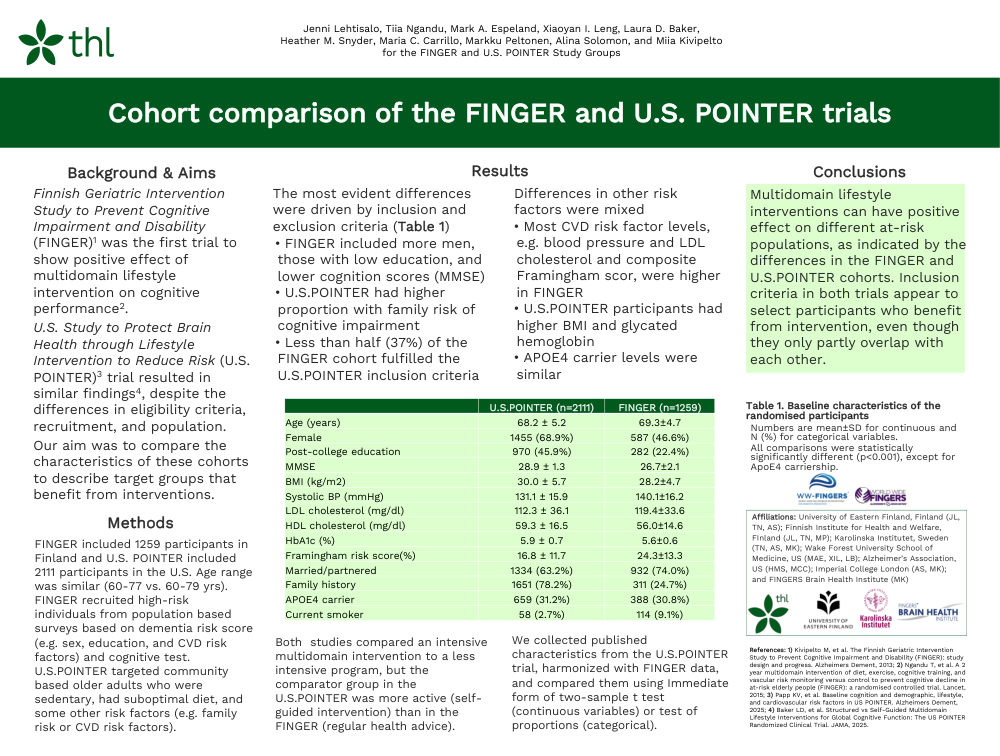
The most evident differences
were driven by inclusion and
exclusion criteria (Table 1)
• FINGER included more men,
those with low education, and
lower cognition scores (MMSE)
• U.S.POINTER had higher
proportion with family risk of
cognitive impairment
• Less than half (37%) of the
FINGER cohort fulfilled the
U.S.POINTER inclusion criteria
Differences in other risk factors were mixed
• Most CVD risk factor levels, e.g. blood pressure and LDL cholesterol and composite Framingham scor, were higher in FINGER
• U.S.POINTER participants had higher BMI and glycated hemoglobin
• APOE4 carrier levels were similar
Conclusions
Multidomain lifestyle interventions can have positive effect on different at-risk populations, as indicated by the differences in the FINGER and U.S.POINTER cohorts. Inclusion criteria in both trials appear to select participants who benefit from intervention, even though they only partly overlap with each other.
Comments
Email is required but is not shown publicly.
Loading comments...