4,068 posters, 219 videos, 101 topics, 69 sessions, 14,365 authors, 6,128 institutions
ePostersLive by SciGen Technologies S.A. All rights reserved.
Alzheimer's Association International Conference 2026
July 12-15, 2026 | London, United Kingdom, and Online

10040
A Mixed-method Approach In Validating The Social Determinants Of Health And Lifestyle Factors Assessments For Dementia Studies In Africa
Poster Presenter
Authors
Temitope Farombi, Chinedu Ude-Mohmoh, Agustin Ibanez, Olufisayo Elugbadebo, Olajoke Akinyemi, Mayowa Ogunrombi, Oluwabukola Ojelabi, Ayobami Adeniji, Eniade Adenike, Eniade Fisayo, Joshua Akinyemi
Affiliations
University College Hospital, Ibadan, Brain and Mind Institute, Aga Khan University, Kenya, Global Brain Health Institute , Trinity College Dublin, Department of Psychiatry, College of Medicine, University of Ibadan, Brain Health Initiative Nigeria, Institute of Neuroscience and ageing , College of Medicine, University of Ibadan, Epidemiology and Medical Statistics, College of Medicine, University of Ibadan
Part of Topic
A Mixed Method Approach in Validating the Social Determinants of Health and Lifestyle Factors Assessment for Dementia Studies in Africa
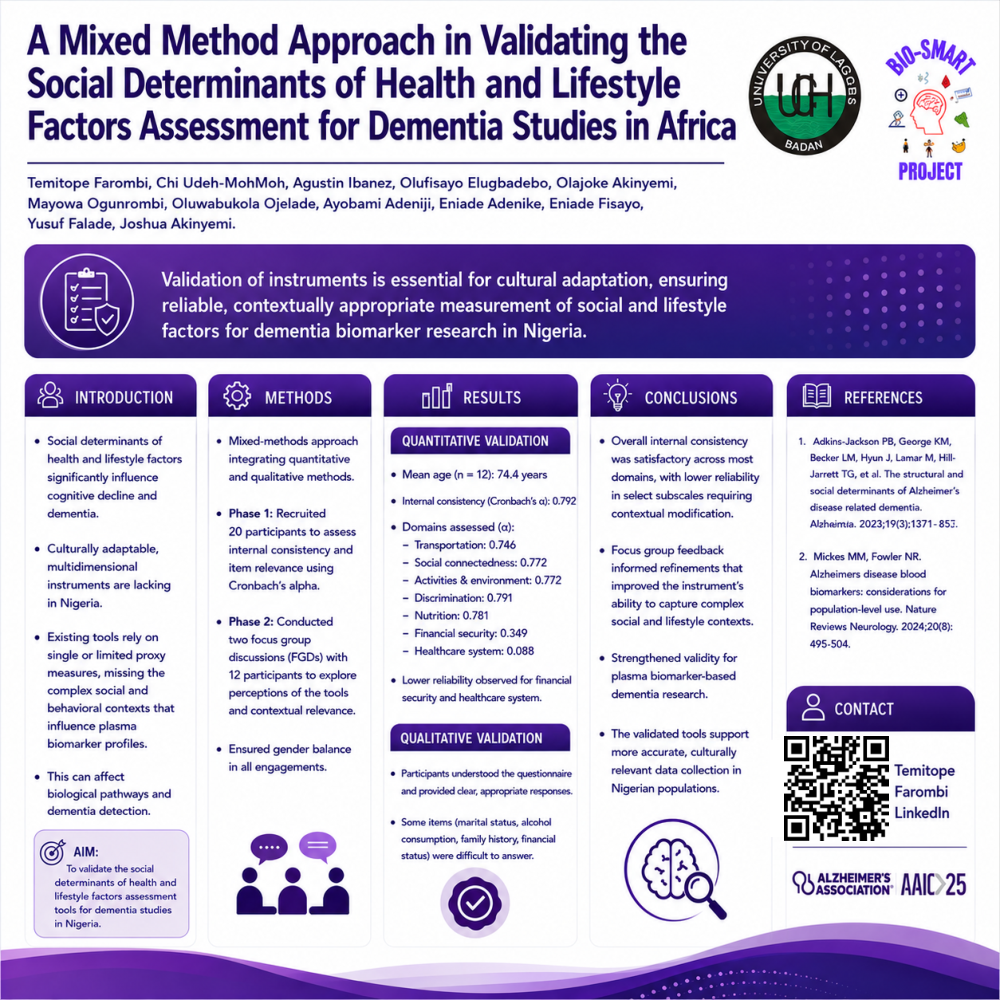
Background: Social determinants of health and lifestyle factors significantly influence cognitive decline and dementia, yet culturally adaptable, multidimensional instruments for assessing these exposures are lacking in Nigeria. Existing tools often rely on single or limited proxy measures, which may inadequately capture the complex social and behavioral contexts that can modify biological pathways and influence plasma biomarker profiles relevant to dementia detection.
Aim: To validate the social determinants of health and lifestyle factors instrument in the Nigerian context.
Method: A mixed-methods approach integrating quantitative and qualitative methods was employed to adapt and validate the Social Determinants of Health and Lifestyle assessment tools. In Phase 1, twenty participants were recruited to assess internal consistency and item relevance, with Cronbach’s alpha used to guide item modification. In Phase 2, two focus group discussions (FGDs) involving twelve participants, with ensured gender balance, were conducted to explore participants’ perceptions of the instrument and to further assess cultural relevance, acceptability, and contextual appropriateness.
Results: The internal consistency of the instrument domains was assessed using Cronbach’s alpha. The reliability coefficient for transportation, social connection, activities and environment, experiences of discrimination, and nutrition were 0.799, 0.746, 0.772, 0.791 respectively, highlighting a good reliability for further analysis. However, domains such as financial security and experiences with the healthcare system had lower reliability coefficient of 0.349 and 0.088 respectively.
Twelve (12) participants were interviewed for FGD. Participant mean age is 74.4years. Most participants reported that they understood all the questions and reported that the response options for the questions were clear and appropriate. Notably participants felt certain questions were personal, including those on marital status, alcohol consumption, family history of dementia and financial status. In addition, most participants reported that the questions were easy to answer, while a few indicated that some questions were somewhat difficult for them.
Conclusion: Overall internal consistency was satisfactory across most domains, with lower reliability observed in select subscales requiring contextual modification. Focus group feedback informed refinements that improved the instrument’s capacity to capture complex social and lifestyle contexts and strengthened its face and content validity for plasma biomarker-based dementia research.
Comments
Email is required but is not shown publicly.
Loading comments...