4,068 posters, 219 videos, 101 topics, 69 sessions, 14,365 authors, 6,128 institutions
ePostersLive by SciGen Technologies S.A. All rights reserved.
Alzheimer's Association International Conference 2026
July 12-15, 2026 | London, United Kingdom, and Online

10910
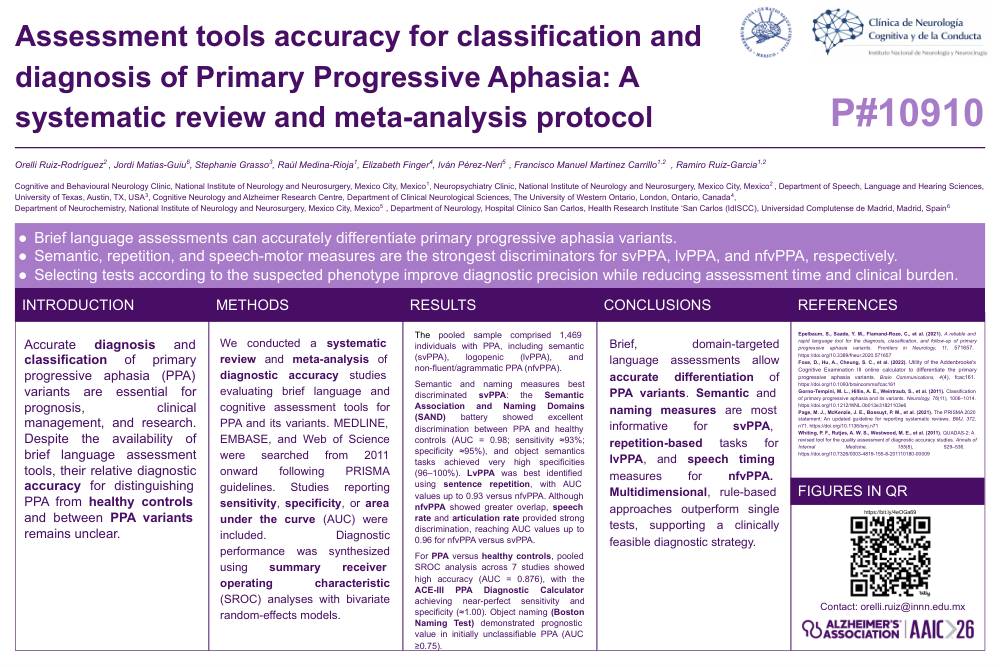
Assessment Tools For Accuracy For Classification And Diagnosis Of Primary Progressive Aphasia: A Systematic Review And Meta-analysis
Poster Presenter
Authors
Claudia Orelli Ruiz Rodriguez, Jordi Matias-Guiu, Stephanie Grasso, Raúl Medina-Rioja, Iván Pérez-Neri, Francisco Manuel Martinez Carrillo, Ramiro Ruiz-Garcia
Affiliations
Neuropsychiatry Clinic, National Institute of Neurology and Neurosurgery, Mexico City, Mexico, Department of Neurology, Hospital Clínico San Carlos, Health Research Institute ‘San Carlos (IdISCC), Universidad Complutense de Madrid, Madrid, Spain, Department of Speech, Language and Hearing Sciences, University of Texas, Austin, TX, USA, Cognitive and Behavioural Neurology Clinic, National Institute of Neurology and Neurosurgery, Mexico City, Mexico, Department of Neurochemistry, National Institute of Neurology and Neurosurgery, Mexico City, Mexico
Part of Topic
Assessment tools accuracy for classification and diagnosis of Primary Progressive Aphasia: A systematic review and meta-analysis protocol
Orelli Ruiz-Rodríguez2 , Jordi Matias-Guiu6, Stephanie Grasso3, Raúl Medina-Rioja1, Elizabeth Finger4, Iván Pérez-Neri5 , Francisco Manuel Martinez Carrillo1,2 , Ramiro Ruiz-Garcia1,2
Cognitive and Behavioural Neurology Clinic, National Institute of Neurology and Neurosurgery, Mexico City, Mexico1, Neuropsychiatry Clinic, National Institute of Neurology and Neurosurgery, Mexico City, Mexico2 , Department of Speech, Language and Hearing Sciences, University of Texas, Austin, TX, USA3, Cognitive Neurology and Alzheimer Research Centre, Department of Clinical Neurological Sciences, The University of Western Ontario, London, Ontario, Canada4
Department of Neurochemistry, National Institute of Neurology and Neurosurgery, Mexico City, Mexico5 , Department of Neurology, Hospital Clínico San Carlos, Health Research Institute ‘San Carlos (IdISCC), Universidad Complutense de Madrid, Madrid, Spain6
INTRODUCTION
Accurate diagnosis and classification of primary progressive aphasia (PPA) variants are essential for prognosis, clinical management, and research. Despite the availability of brief language assessment tools, their relative diagnostic accuracy for distinguishing PPA from healthy controls and between PPA variants remains unclear.
METHODS
We conducted a systematic review and meta-analysis of diagnostic accuracy studies evaluating brief language and cognitive assessment tools for PPA and its variants. MEDLINE, EMBASE, and Web of Science were searched from 2011 onward following PRISMA guidelines. Studies reporting sensitivity, specificity, or area under the curve (AUC) were included. Diagnostic performance was synthesized using summary receiver operating characteristic (SROC) analyses with bivariate random-effects models.
RESULTS
The pooled sample comprised 1,469 individuals with PPA, including semantic (svPPA), logopenic (lvPPA), and non-fluent/agrammatic PPA (nfvPPA).
Semantic and naming measures best discriminated svPPA: the Semantic Association and Naming Domains (SAND) battery showed excellent discrimination between PPA and healthy controls (AUC = 0.98; sensitivity ≈93%; specificity ≈95%), and object semantics tasks achieved very high specificities (96–100%). LvPPA was best identified using sentence repetition, with AUC values up to 0.93 versus nfvPPA. Although nfvPPA showed greater overlap, speech rate and articulation rate provided strong discrimination, reaching AUC values up to 0.96 for nfvPPA versus svPPA.
For PPA versus healthy controls, pooled SROC analysis across 7 studies showed high accuracy (AUC = 0.876), with the ACE-III PPA Diagnostic Calculator achieving near-perfect sensitivity and specificity (≈1.00). Object naming (Boston Naming Test) demonstrated prognostic value in initially unclassifiable PPA (AUC ≥0.75).
CONCLUSIONS
Brief, domain-targeted language assessments allow accurate differentiation of PPA variants. Semantic and naming measures are most informative for svPPA, repetition-based tasks for lvPPA, and speech timing measures for nfvPPA. Multidimensional, rule-based approaches outperform single tests, supporting a clinically feasible diagnostic strategy.
Comments
Email is required but is not shown publicly.
Loading comments...