Loading...

4,068 posters, 219 videos, 101 topics, 69 sessions, 14,365 authors, 6,128 institutions

ePostersLive by SciGen Technologies S.A. All rights reserved.

Alzheimer's Association International Conference 2026

July 12-15, 2026 | London, United Kingdom, and Online

Alzheimer's Association International Conference 2026 banner

425

Centering Lived Experience In Alzheimer's Disease And Related Disorders Research: The Formation Of A Lived Experience Advisory Panel
Part of Topic

Background

•Community-engaged research (CER) relies on collaborative relationships with community partners and bidirectional communication between academic researchers and community representatives.
•Community advisory boards (CABs) are an especially important component of CER, as they provide a forum for community members to share their perspectives, values, and priorities with researchers.
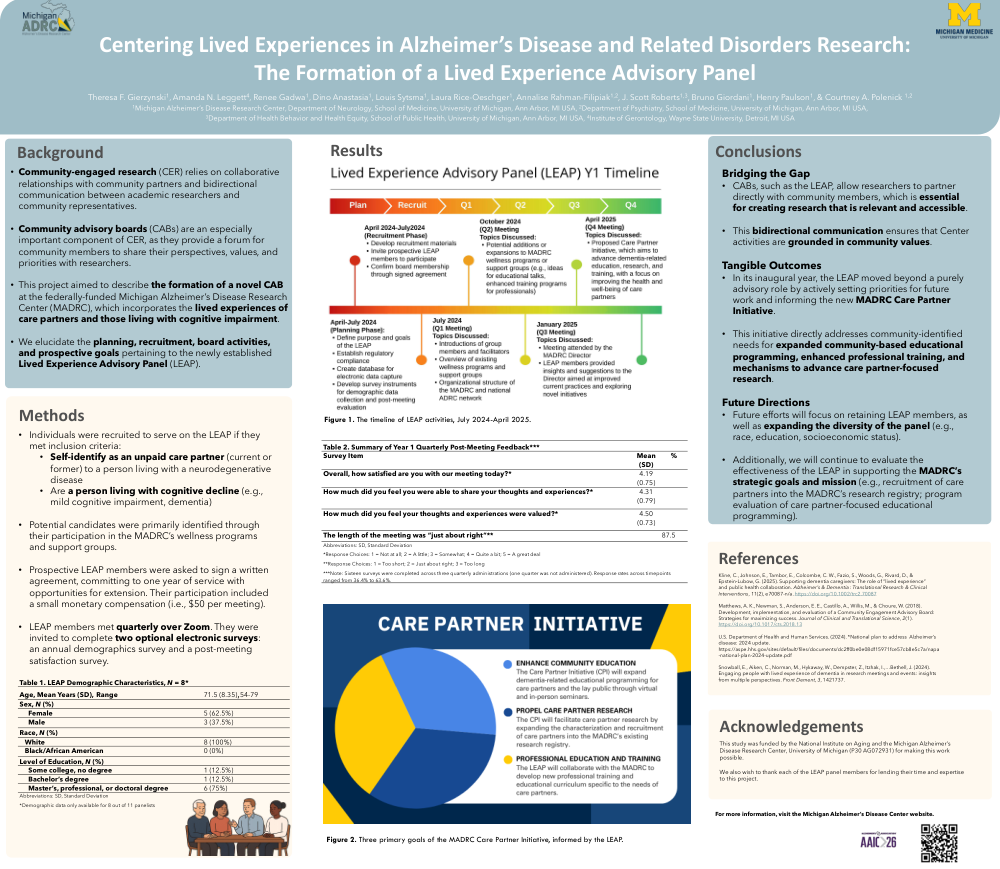
•This project aimed to describe the formation of a novel CAB at the federally-funded Michigan Alzheimer’s Disease Research Center (MADRC), which incorporates the lived experiences of care partners and those living with cognitive impairment.
•We elucidate the planning, recruitment, board activities, and prospective goals pertaining to the newly established Lived Experience Advisory Panel (LEAP).
 
Methods
•Individuals were recruited to serve on the LEAP if they met inclusion criteria:
•Self-identify as an unpaid care partner (current or former) to a person living with a neurodegenerative disease
•Are a person living with cognitive decline (e.g., mild cognitive impairment, dementia)
•Potential candidates were primarily identified through their participation in the MADRC’s wellness programs and support groups.
•Prospective LEAP members were asked to sign a written agreement, committing to one year of service with opportunities for extension. Their participation included a small monetary compensation (i.e., $50 per meeting).
•LEAP members met quarterly over Zoom. They were invited to complete two optional electronic surveys: an annual demographics survey and a post-meeting satisfaction survey.
 
Conclusions

Bridging the Gap

•CABs, such as the LEAP, allow researchers to partner directly with community members, which is essential for creating research that is relevant and accessible.
•This bidirectional communication ensures that Center activities are grounded in community values.

Tangible Outcomes

•In its inaugural year, the LEAP moved beyond a purely advisory role by actively setting priorities for future work and informing the new MADRC Care Partner Initiative.

 •This initiative directly addresses community-identified needs for expanded community-based educational programming, enhanced professional training, and mechanisms to advance care partner-focused research.

Future Directions

•Future efforts will focus on retaining LEAP members, as well as expanding the diversity of the panel (e.g., race, education, socioeconomic status).
Additionally, we will continue to evaluate the effectiveness of the LEAP in supporting the MADRC’s strategic goals and mission (e.g., recruitment of care partners into the MADRC’s research registry; program evaluation of care partner-focused

Comments

Email is required but is not shown publicly.

Loading comments...

aaic2026 banner
Copyright © 2015-2026, ePostersLive® SciGen is a registered trademark of SciGen Technologies S.A. Patent pending.

This website and third-party tools we use rely on cookies for the best user experience. By selecting "I agree", you agree to cookie usage as described in our Privacy Policy.