4,068 posters, 219 videos, 101 topics, 69 sessions, 14,365 authors, 6,128 institutions
ePostersLive by SciGen Technologies S.A. All rights reserved.
Alzheimer's Association International Conference 2026
July 12-15, 2026 | London, United Kingdom, and Online

10976
Divergent Risk Factor Trajectories Across Six African Countries: Evidence For Context-specific Policy From The African Brain Health Atlas
Poster Presenter
Authors
Part of Topic
Divergent Risk Factor Trajectories Across Six African Countries: Evidence For Context-specific Policy From The African Brain Health Atlas:
Author Block: Wambui Karanja1, Ifeanyi Nsofor2, Lebohang Molete3, Kirsten Bobrow4.
1Brain and Mind Institute, Aga Khan University, Nairobi, Kenya, 2Atlantic Fellows for Health Equity, US and Global, Washington DC, DC, USA, 3Atlantic Fellows for Health Equity, TEKANO, Cape Town, South Africa, 4Global Brain Health Institute, San Francisco, CA, USA.
Abstract:
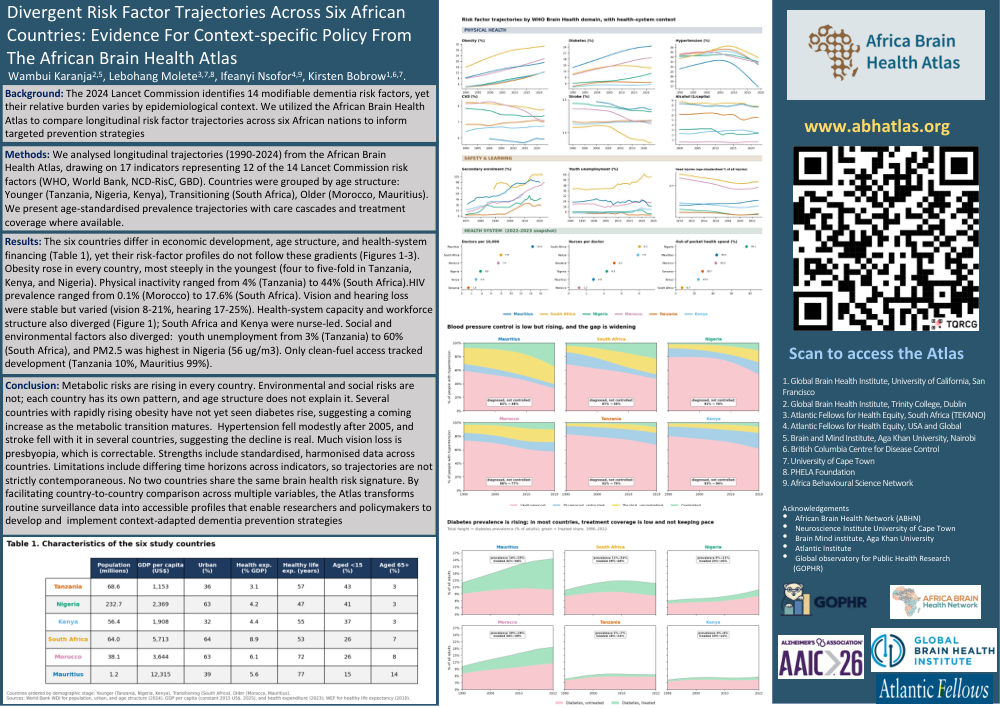
Background: The 2024 Lancet Commission identifies 14 modifiable dementia risk factors, yet their relative burden varies by epidemiological context. We utilized the African Brain Health Atlas to compare longitudinal risk factor trajectories across six African nations at distinct stages of demographic transition to inform targeted prevention strategies.
Methods: We analyzed indexed trends (2000-2023) for 17 harmonized indicators representing 12 of the 14 modifiable risk factors, utilizing country-level data from the WHO, World Bank, and Global Burden of Disease. Countries were stratified by median population age: Young (Nigeria 18y, Tanzania 18y, Kenya 19y), Transitioning (South Africa 28y), and Older (Morocco 30y, Mauritius 37y). Indicators spanned WHO Brain Health domains: Physical Health, Environment, Safety, and Learning. Index values (baseline=100) quantified relative changes in risk exposure over time.
Results: Obesity and diabetes prevalence increased universally, with steeper gradients in younger populations. Obesity indices rose most sharply in Nigeria (+180%) and Kenya (+150%) compared to Mauritius (+100%), with diabetes following a similar upward trajectory (Index Range: 140-210). In contrast, hypertension (24-28%), cardiovascular disease (8-11%), and stroke prevalence (1.1-1.3%) remained stable with minimal cross-country variation.
Environmental and behavioral determinants diverged significantly by age structure. Access to clean fuels was low in younger populations (Nigeria 15%, Tanzania 12%) but near universal in older cohorts (Morocco 95%, Mauritius 95%). Conversely, PM2.5 exposure was highest in Nigeria (50 μg/m³) and lowest in Mauritius (15 μg/m³). Alcohol consumption varied independently of demographics (South Africa 8.4 L/capita vs. Morocco 0.53 L/capita). Regarding cognitive reserve, secondary school enrollment showed robust gains in Nigeria (20% to 50%) and Tanzania (10% to 45%) yet remained below South Africa (85%) and Mauritius (98%).
Youth unemployment was a distinct outlier for South Africa (58%) compared to Tanzania (5%). Traumatic brain injury estimates were uniform across the cohort (8-11%).
Conclusion: While metabolic risks are rising ubiquitously, environmental and social determinants of brain health show distinct national signatures not explained by age structure alone. No two countries share the same priority targets. By facilitating country-to-country comparison across multiple variables, the Atlas transforms routine surveillance data into accessible profiles that enable researchers and policymakers to implement context-adapted prevention strategies.
Comments
Email is required but is not shown publicly.
Loading comments...