4,068 posters, 219 videos, 101 topics, 69 sessions, 14,365 authors, 6,128 institutions
ePostersLive by SciGen Technologies S.A. All rights reserved.
Alzheimer's Association International Conference 2026
July 12-15, 2026 | London, United Kingdom, and Online

3877
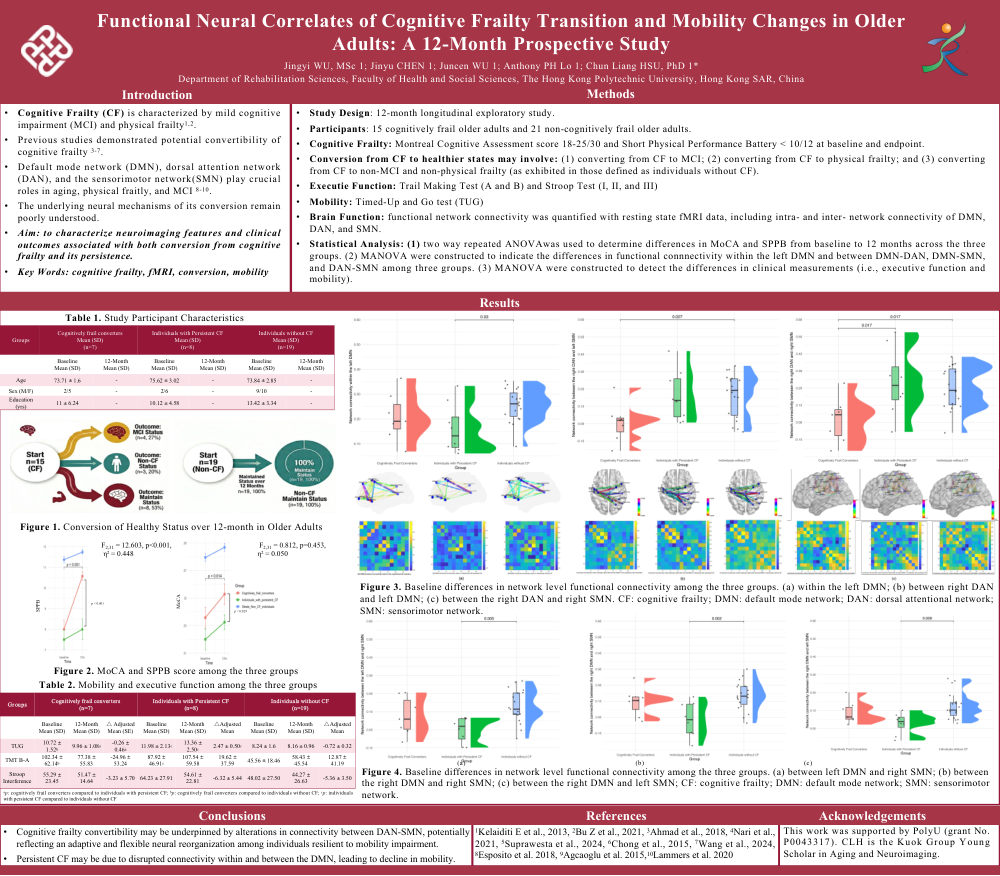
Functional Neural Correlates Of Cognitive Frailty Transition And Mobility Changes In Older Adults: A12-month Prospective Study
Part of Topic
Functional Neural Correlates of Cognitive Frailty Transition and Mobility Changes in Older Adults: A 12-Month Prospective Study
Jingyi WU, MSc 1; Jinyu CHEN 1; Juncen WU 1; Anthony PH Lo 1; Chun Liang HSU, PhD 1*
1. Department of Rehabilitation Sciences, Faculty of Health and Social Sciences, The Hong Kong Polytechnic University, Hong Kong SAR, China
Abstract
Background
Cognitive frailty is a dynamic condition defined by coexisting probable mild cognitive impairment (MCI) and physical frailty in older adults. Older adults with cognitive frailty (CF) are susceptible to substantially greater risk of dementia. Previous studies demonstrated potential convertibility of cognitive frailty, however, the underlying neural mechanisms of its transition remain poorly understood. The 12-month prospective study aims to characterize neuroimaging features and clinical outcomes associated with both conversion from cognitive frailty and its persistence.
Methods
Thirty-six older adults were included and classified as CF (n=15) and non-CF (n=21) via the Short Physical Performance Battery (SPPB) and the Montreal Cognitive Assessment (MoCA). Based on changes observed over 12 months, participants were categorized into three groups: cognitively frail converters (n=7), persistent CF (n=8), and non-CF (n=21). Analysis of variance was conducted to examine baseline differences among the three groups in intra-network connectivity within the default mode network (DMN), as well as inter-network connectivity among the DMN, the dorsal attentional network (DAN), and the sensorimotor network (SMN). Additionally, analysis of covariance was used to assess group differences in clinical outcome (i.e., the Timed Up and Go (TUG) test) over 12 months. Finally, simple linear regression models were used to investigate the associations between baseline within DMN connectivity and change in TUG.
Results
All non-CF remained non-cognitive frailty after 12 months. The 12-month conversion rate from cognitive frailty to MCI or non-cognitive frailty was 46.7%. Compared with non-CF, persistent CF demonstrated significantly lower intra-network connectivity of the left DMN as well as lower connectivity between DMN-SMN. In contrast, CF who converted to MCI and non-cognitive frailty exhibited lower connectivity between DAN-SMN. Furthermore, lower baseline connectivity within the left DMN, especially in prefrontal cortex and posterior cingulate cortex, predicted greater decline in TUG over 12 months, adjusting for baseline MoCA, SPPB, and TUG.
Conclusions
Cognitive frailty convertibility may be underpinned by alterations in connectivity between DAN-SMN, potentially reflecting an adaptive and flexible neural reorganization among individuals resilient to mobility impairment. Conversely, persistent CF may be due to disrupted connectivity within and between the DMN, leading to decline in mobility.
Keywords
Cognitive frailty, fMRI, conversion, mobility
Comments
Email is required but is not shown publicly.
Loading comments...