4,068 posters, 219 videos, 101 topics, 69 sessions, 14,365 authors, 6,128 institutions
ePostersLive by SciGen Technologies S.A. All rights reserved.
Alzheimer's Association International Conference 2026
July 12-15, 2026 | London, United Kingdom, and Online

3833
A Personalized Digital Twin Framework For Alzheimer’s Disease Prediction And Intervention Simulation
Poster Presenter
Authors
Part of Topic
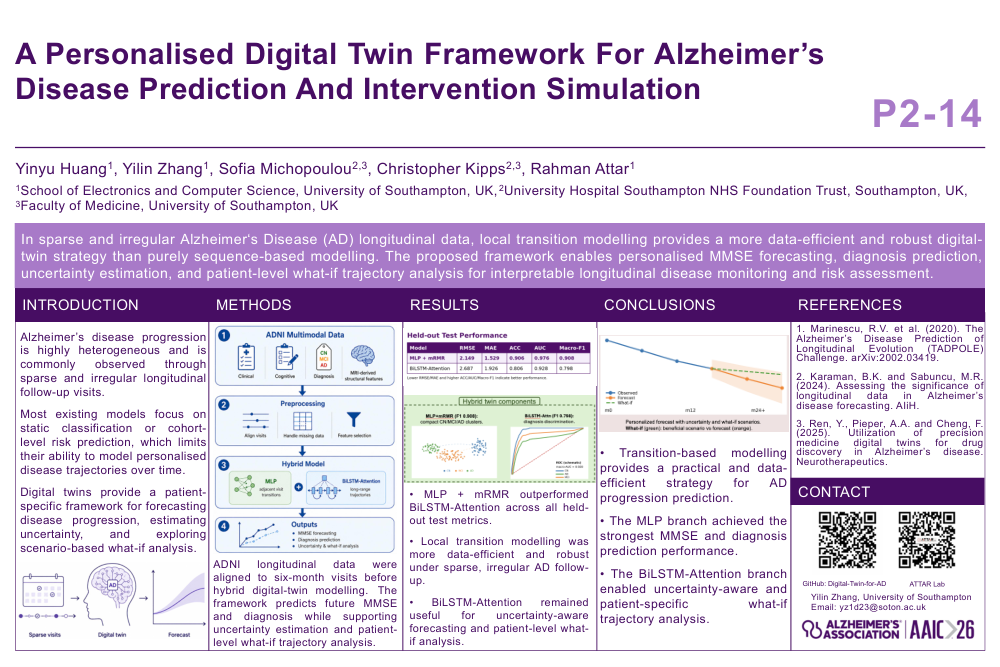
Background: Alzheimer’s disease (AD) progression is heterogeneous, and most machine-learning approaches still rely on cross-sectional “snapshots” that provide limited support for individualized forecasting, uncertainty-aware monitoring, and scenario-based intervention planning. Digital twin (DT) concepts offer a route to patient-specific, dynamically updated models that can integrate multimodal longitudinal data. This study aims to develop and evaluate a personalised digital twin framework for Alzheimer’s disease that enables individualised, uncertainty-aware forecasting of cognitive trajectories and disease diagnosis.
Methods: The DT framework uses multimodal longitudinal data from ADNI to integrate cognitive scales, clinical indicators, and MRI-derived structural phenotypes (FreeSurfer). After harmonization, the dataset contained 2,801 records from 760 subjects with 6-month follow-up intervals (baseline to 60 months) and 385 input features (static + dynamic). We used a leak-free subject-level split (70/20/10% for training/validation/testing). The DT combines (i) a Multilayer Perceptron branch trained on adjacent time pairs (t→t+6 months) with mRMR feature selection for short-horizon transition modelling, and (ii) a BiLSTM-Attention branch trained on aligned longitudinal sequences for trajectory-aware prediction. The framework jointly supports MMSE regression and three-class diagnosis (CN/MCI/AD). In addition, Monte Carlo dropout is utilized at inference to quantify predictive uncertainty and derive subject-specific predictive intervals, while “what-if” simulations are conducted by perturbing clinically meaningful covariates at the forecast origin.
Results: On the held-out test set, the MLP branch achieved MMSE RMSE=2.149 (MAE=1.529) and diagnosis performance ACC=0.906, AUC=0.976, macro-F1=0.908. The BiLSTM-Attention branch achieved RMSE=2.687 (MAE=1.926) and ACC=0.806, AUC=0.928, macro-F1=0.798. Patient-level analyses demonstrated accurate individualised predictions of cognitive trajectories with quantified uncertainty, consistent with the overall test-set performance, and scenario simulations showed directionally consistent but bounded trajectory shifts under plausible functional (e.g., FAQ) and structural (e.g., hippocampal volume) perturbations.
Conclusion: This DT-inspired hybrid framework enables leak-free, individualized AD forecasting that combines strong short-horizon prediction with uncertainty-aware longitudinal trajectories and counterfactual “what-if” simulation for exploratory analysis. It provides a practical pathway toward personalized monitoring and research-oriented intervention planning in Alzheimer’s disease management.
Comments
Email is required but is not shown publicly.
Loading comments...