4,068 posters, 219 videos, 101 topics, 69 sessions, 14,365 authors, 6,128 institutions
ePostersLive by SciGen Technologies S.A. All rights reserved.
Alzheimer's Association International Conference 2026
July 12-15, 2026 | London, United Kingdom, and Online

5823
Perceptions Of Dementia Among Primary Healthcare Professionals In Brazil: A Qualitative Study
Poster Presenter
Part of Topic
Perceptions Of Dementia Among Primary Healthcare Professionals In Brazil: A Qualitative Study.
Author Block: Marcelo Anastácio Diniz1,2, Carolina Godoy1,2, Fabiana A. F. da Mata1,2, Lucas Martins Teixeira1,2, Matheus Ghossain Barbosa, MD, PhD3,2, Fernanda FAria1,2, Ana Ágata Keinert1,2, Thais Suarez1,2, Pedro Pinho1,2, Andrew Miguel1,2, Rosa Camila Lucchetta1, Paula Vilhena Carnevale Vianna, Dr1,2, Cleusa P. Ferri1,2.
1Research Unit - Responsabilidade Social - Hospital Alemão Oswaldo Cruz, São Paulo, Brazil, 2Psychogeriatric unit department of psychiatry - Universidade Federal de São Paulo, São Paulo, Brazil, 3Research Unit - Responsabilidade Social - Hospital Alemão Oswaldo Cruzederal de São Paulo, São Paulo, Brazil.
Background: Health professionals must have knowledge and skills to take care of People Living with Dementia (PLWD) at different levels of the health system. Both lack of knowledge and stigma related to dementia may negatively influence the professional-patient relationship.
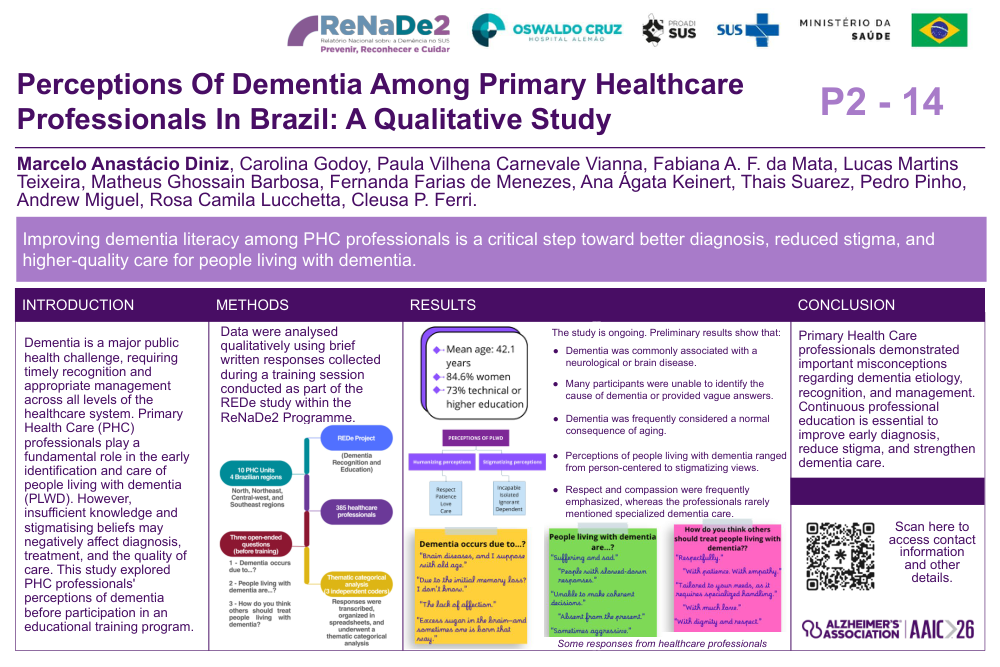
Methods: This study is part of the REDe (Dementia Recognition and Education) project in Brazil. We analyzed perceptions of dementia among 385 healthcare professionals from 10 Primary Health Care Units across the North, Northeast, Central-west, and Southeast regions. Data were qualitatively analyzed using brief textual responses collected during a training session. Before the session’s theoretical content was presented, participants freely responded to three questions/sentences that explored their prior knowledge and beliefs about dementia. The questions/sentences were: 1) "Dementia occurs due to...?"; 2) "People living with dementia are..."; and 3) "How do you think others should treat people living with dementia? ". Responses were transcribed, organized in spreadsheets, and underwent a thematic categorical analysis. Three researchers independently coded, resolving divergences through consensus.
Results: Participants’ mean age was 42.1 years (84.6% female; 73% with technical or higher education) (Table 1). Regarding the first question, thematic analysis yielded six categories: Biomedical, Risk Factor, Lack of knowledge/Misconceptions, Age, Psychosocial, and Symptoms (Table 2). Most professionals (31.7%) identified imprecise biomedical factors (brain/neurological disease). However, 20% provided vague answers or could not identify causes, while 16.7% attributed dementia to normal aging. Regarding the second question, psychosocial factors and symptoms were also frequently mistaken for causes. Regarding perceptions toward PLWD, responses ranged from humanizing views ("people" requiring respect, love and patience) to stigmatizing labels (incapable, ignorant and isolated). Treatment approaches focused predominantly on respect and compassion, with a low emphasis on specialized care.
Conclusion: The results of the analysis and observations during the training sessions evidenced a knowledge gap among Primary Health Care (PHC) workers regarding the etiology, warning signs, identification and management of dementia cases. Dementia and natural aging were strongly related, reflecting a stigmatized perception of PLWD and their care. Investing in continuous training is essential for PHC teams to improve the recognition, diagnosis, and provision of adequate preventive and clinical care for PLWD.
Comments
Email is required but is not shown publicly.
Loading comments...