4,068 posters, 219 videos, 101 topics, 69 sessions, 14,365 authors, 6,128 institutions
ePostersLive by SciGen Technologies S.A. All rights reserved.
Alzheimer's Association International Conference 2026
July 12-15, 2026 | London, United Kingdom, and Online

8649
Predicting AD Dementia Risk: A Framework For Risk Estimation In Clinical Practice
Poster Presenter
Part of Topic
Background
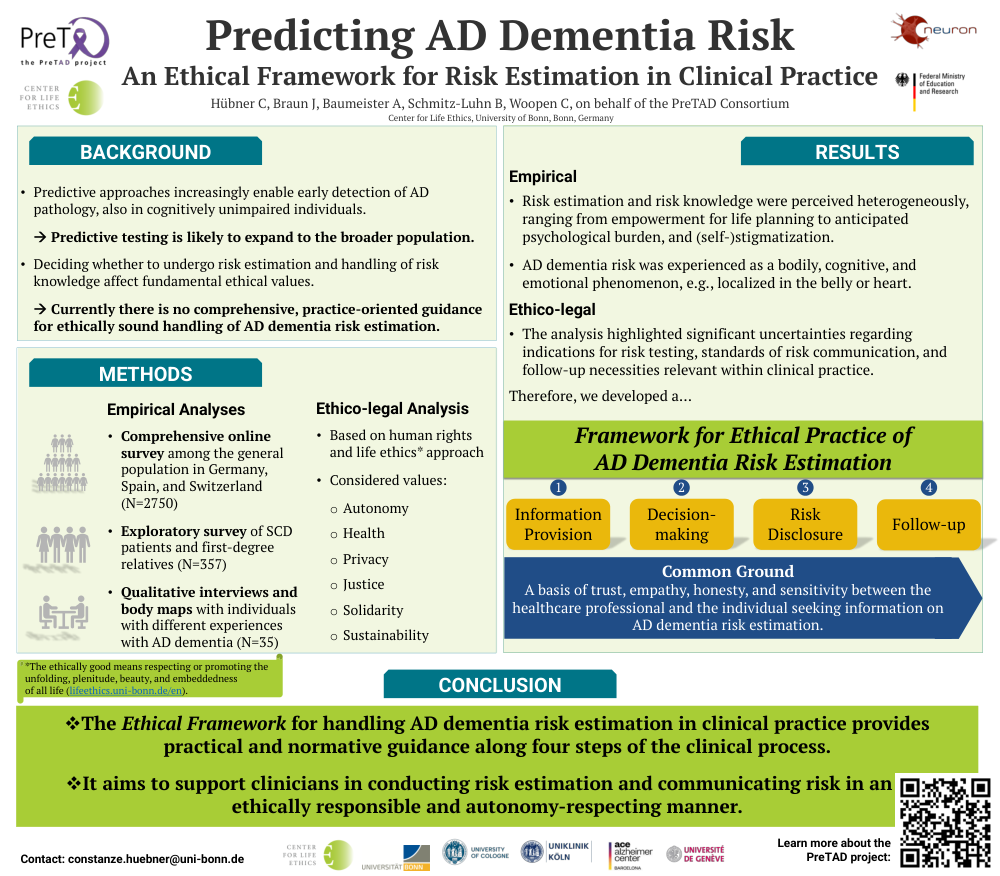
Advances in blood-based biomarkers increasingly enable the detection of Alzheimer’s disease (AD) pathology not only in patients with first, unspecific symptoms but even in cognitively unimpaired individuals. As their use potentially moves beyond specialist settings and toward the broader population, they raise substantial ethical and legal challenges. Decisions about whether to undergo risk estimation and how to handle probabilistic knowledge about future AD (dementia) affect fundamental values such as autonomy, privacy, (psychological) well-being, and the right not to know. However, there is currently no comprehensive, practice-oriented guidance for ethically sound and legally safe AD dementia risk estimation and communication. Within the PreTAD project (“Predictive Turn in Alzheimer’s Disease: Ethical, Clinical, Linguistic and Legal Aspects”), we therefore developed a framework for responsible risk estimation in clinical practice.
Methods
The framework was developed through the systematic integration of empirical research and ethico-legal analysis: Empirical data stem from an exploratory survey of patients with SCD and first-degree relatives of individuals with dementia, a comprehensive online survey of individuals from the general population in Germany, Switzerland, and Spain, and qualitative interviews with individuals with different experiences with dementia. These studies explored attitudes, expectations, and concerns related to risk estimation and risk knowledge. An ethico-legal normative assessment examined core principles including autonomy, privacy, justice, and sustainability. On these grounds, we identified ethically critical points along the risk estimation process and translated them into actionable guidance for good clinical practice.
Results
Empirical findings revealed marked heterogeneity in how individuals perceive dementia risk estimation and risk information, ranging from empowerment for life planning to concerns about psychological burden, and stigmatization. The ethico-legal analysis highlighted significant uncertainties regarding indications for risk testing, standards of risk communication, and follow-up obligations. Accordingly, the framework includes ethically and legally sound recommendations for the clinical process of AD dementia risk estimation considering (1) information provision, (2) decision-making, (3) risk disclosure, and (4) follow-up care.
Conclusion
As predictive approaches advance rapidly, careful ethical reflection is essential. The proposed framework provides practical and normative guidance, supporting clinicians in conducting AD dementia risk estimation in an ethically responsible and autonomy-respecting manner.
Comments
Email is required but is not shown publicly.
Loading comments...