4,068 posters, 219 videos, 101 topics, 69 sessions, 14,365 authors, 6,128 institutions
ePostersLive by SciGen Technologies S.A. All rights reserved.
Alzheimer's Association International Conference 2026
July 12-15, 2026 | London, United Kingdom, and Online

9226
Effects Of One-year Physical Activity And Successful Aging Interventions On Cognitive Function In Older African Americans: The RAATE Study
Poster Presenter
Authors
Affiliations
Part of Topic
Background: Engagement in behavioral lifestyle change interventions is associated with better cognitive performance among older adults. But to date, these interventions have not featured sufficient numbers of older African Americans despite their lower prevalence of healthy behavior attainment and higher risk of Alzheimer’s Disease.
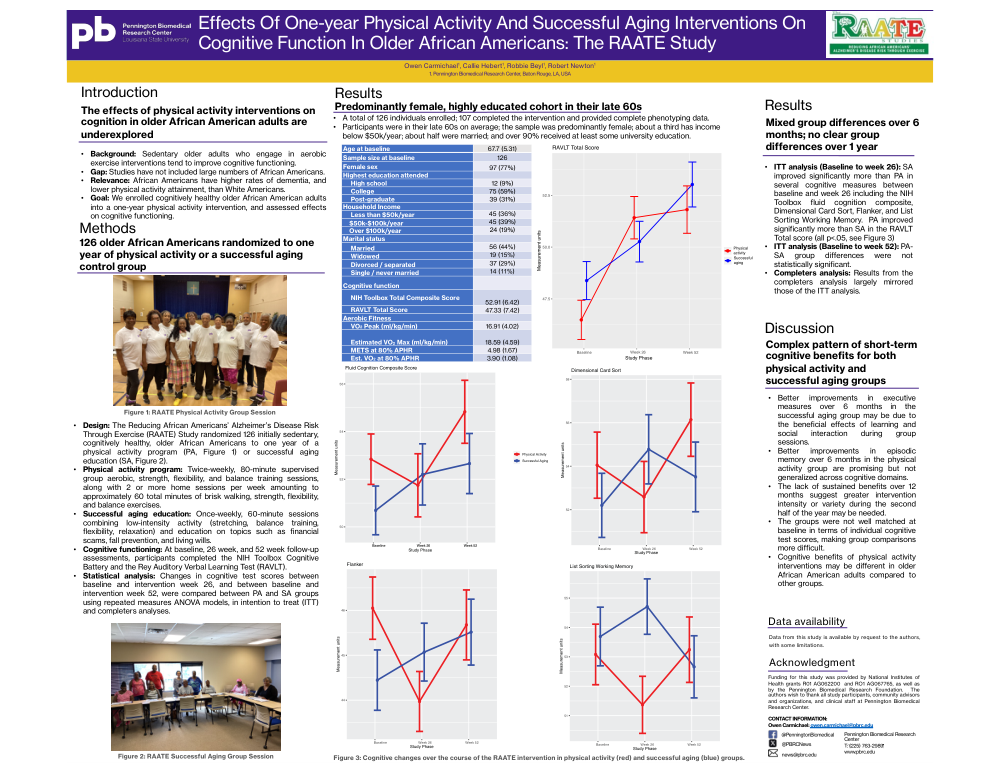
Method: The Reducing African Americans’ Alzheimer’s Disease Risk Through Exercise (RAATE) study randomized 129 initially sedentary, cognitively healthy, older African American adults to one year of physical activity (PA) training or successful aging (SA) education. At baseline, and after 26 and 52 weeks of intervention, participants completed the NIH Toolbox cognitive battery and the Rey Auditory Verbal Learning Test (RAVLT). All cognitive test scores were normed for age, education, sex, and race-ethnicity. Changes in cognitive test scores between baseline and intervention week 26, and between baseline and intervention week 52, were compared between PA and SA groups using repeated measures ANOVA models, in intention to treat (ITT) and completers analyses.
Results: A total of 126 individuals (mean age 68 +/- 5 years; 77% female; 36% with income < $50k/year; 44% married) were randomized (61/65 PA/SA) and included in the ITT analysis while 107 provided full data for the completers analysis. In the ITT analysis, the change in the NIH Toolbox fluid cognition composite score (p=.05), as well as several individual test scores (Dimensional Card Sort, p=.03; Flanker, p=.02; List Sorting Working Memory, p=.03) between baseline and 26 weeks was significantly better in SA compared to PA (see Figure). However, corresponding group differences in change between baseline and 52 were not significant. In contrast, the change in Oral Reading Recognition test scores between baseline and week 52 was significantly better in PA than in SA (p=.03). All other group differences in cognitive changes were not statistically significant. The completers analysis largely mirrored these results.
Conclusion: Cognitive benefits of PA may be slow to develop, leading to significant PA-SA group differences only in baseline to week 52 change. In contrast, better cognitive changes in SA compared to PA between baseline and week 26 could be due to beneficial effects of learning and social interaction in SA, or beneficial behavior changes caused by SA learning. Fading benefits of SA after 26 weeks could be due to early saturation of SA benefits together with slowly accumulating PA benefits.
Comments
Email is required but is not shown publicly.
Loading comments...