4,068 posters, 219 videos, 101 topics, 69 sessions, 14,365 authors, 6,128 institutions
ePostersLive by SciGen Technologies S.A. All rights reserved.
Alzheimer's Association International Conference 2026
July 12-15, 2026 | London, United Kingdom, and Online

9879
Attitudinal And Behavioral Factors Affecting Willingness To Engage In Alzheimer's Disease Biomarker Testing
Poster Presenter
Authors
Diane C. Gooding, Emre Umucu, Carol Van Hulle, Gilda E. Ennis, Fabu Cartrer, Lauren McLeister-Davis, Maria Mora Pinzón, Jordan P. Lewis, Megan Zuelsdorff, Taryn James, Carey E. Gleason
Affiliations
UW-Madison College of Letters & Science, UW-Wisconsin SMPH, Wisconsin ADRC, UT-El Paso, UW-Madison SMPH, Wisconsin ADRC, UW-Madison, UW-Madison SMPH, Wisconsin Aging Institute, University of Hawaii, UW School of Nursing, Wisconsin ADRC, UW-Madison SMPH, Wisconsin ADRC, Middleton VAMC
Part of Topic
BACKGROUND
Advances in Alzheimer's Disease (AD) biomarker studies have been promising. Despite this, there remains a relative dearth of dementia biomarker studies which include sizable numbers of ethnoracialized (e.g., African-Americans (AA), American Indian/Alaska Native (AI/AN), and Latinx (LTX) samples. Efforts to help mitigate this research disparity include investigating how and whether ethnoracialized groups differ in their willingness to engage in preclinical AD biomarker studies. We improve upon extend knowledge in this area by including community-based participants, utilizing quantitative methods, and larger numbers of racialized participants.
METHODS
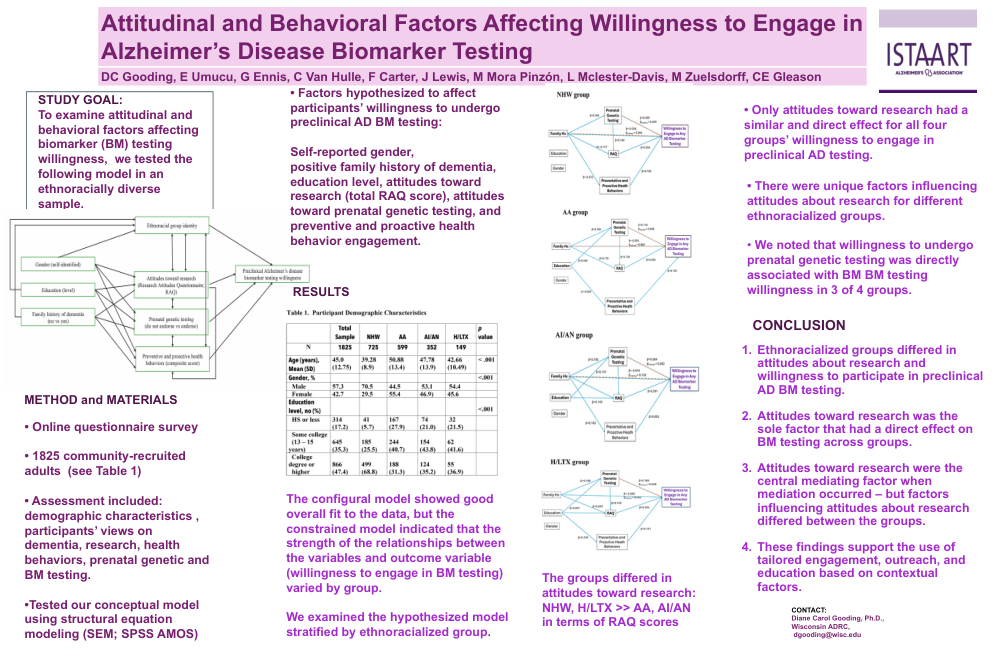
We administered an online questionnaire to 1825 community-derived adults and assessed demographic characteristics as well as participants' views on dementia, research, and genetic and biomarker testing. We examined factors hypothesized to increase community participants' willingness to undergo preclinical AD biomarker testing (see Figure ): self-reported gender, positive family history of dementia, education level, attitudes toward research (as measured by total RAQ score), attitudes toward prenatal genetic testing, and preventive and proactive health behavior engagement. We tested our conceptual model using structural equation modeling (SEM; SPSS AMOS).
RESULTS
The sample included: NHW (n=725), AA (n = 599), AI/AN (n = 352), and LTX (n = 149) participants. The unconstrained (configural) model demonstrated good overall fit to the data, χ²(24) = 56.18, p < .001, χ²/df = 2.34, RMSEA = 0.027 (90% CI [.018, .036]), CFI = 0.969. However, the constrained model and nested chi-square difference test indicated that there was not structural invariance, i.e., the strength of the relationships between the variables and outcome variable (willingness to engage in testing) varied according by group. Therefore, we examined the hypothesized model in each group separately. The Table provides the results of the SEM (standardized coefficients) for each group. Attitudes toward research was the sole factor that had a direct effect on biomarker testing willingness across all the groups.
CONCLUSIONS
While research attitudes appear to play a large role in influencing willingness to engage in preclinical AD biomarker testing, willingness to undergo prenatal genetic testing also appears to exert an effect. Implications of these findings for community-based outreach and engagement for biomarker studies will be discussed.
Comments
Email is required but is not shown publicly.
Loading comments...