4,068 posters, 219 videos, 101 topics, 69 sessions, 14,365 authors, 6,128 institutions
ePostersLive by SciGen Technologies S.A. All rights reserved.
Alzheimer's Association International Conference 2026
July 12-15, 2026 | London, United Kingdom, and Online

8641
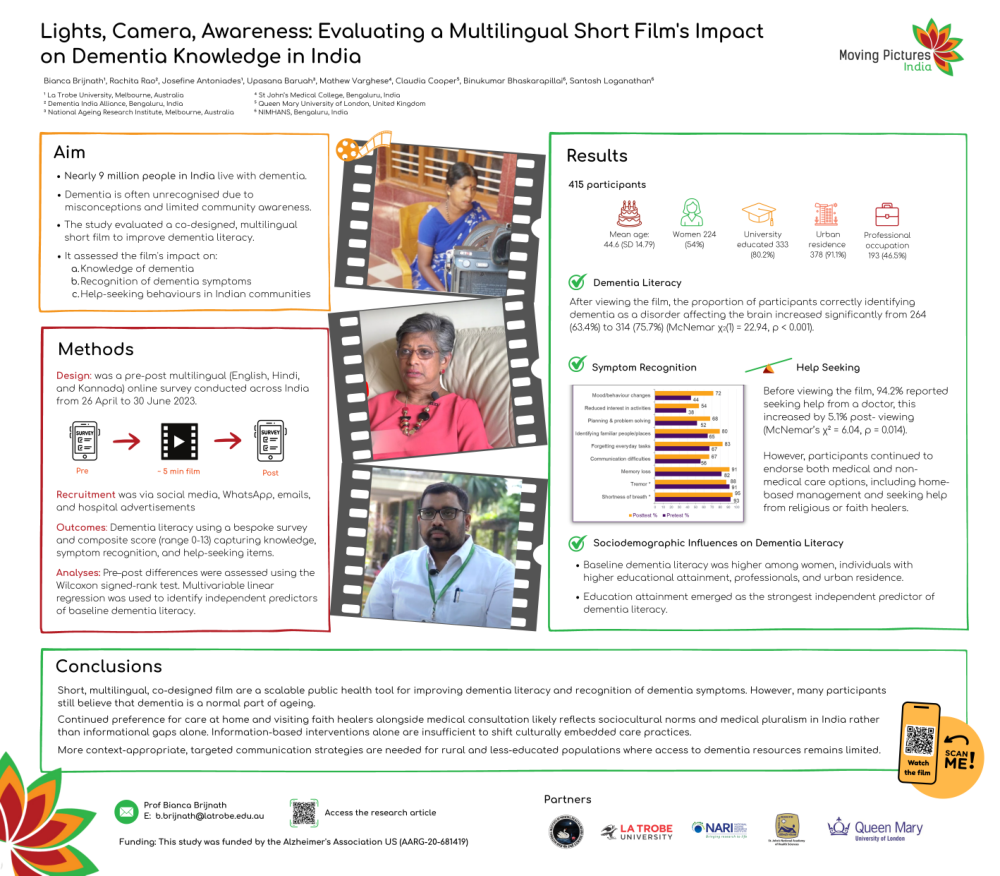
Lights, Camera, Awareness: Evaluating A Multilingual Short Film's Impact On Dementia Knowledge In India.
Poster Presenter
Authors
Bianca Brijnath, Rachita Rao, Josefine Antoniades, Upasana Baruah, Mathew Varghese, Claudia Cooper, Binukumar Bhaskarapillai, Santosh Loganathan
Affiliations
Dementia India Alliance, Bengaluru, India, La Trobe University, Melbourne, Australia, National Ageing Research Institute, Melbourne, Australia, St. John's Medical College, Bengaluru, India, Queen Mary University of London, United Kingdom, National Institute of Mental Health and Neurosciences (NIMHANS), Bengaluru, India
Part of Topic
Lights, Camera, Awareness: Evaluating a Multilingual Short Film's Impact on Dementia Knowledge in India
Moving Pictures India
Authors: Bianca Brijnath¹, Rachita Rao², Josefine Antoniades¹, Upasana Baruah³, Mathew Varghese⁴, Claudia Cooper⁵, Binukumar Bhaskarapillai⁶, Santosh Loganathan⁶
Affiliations:
- La Trobe University, Melbourne, Australia
- Dementia India Alliance, Bengaluru, India
- National Ageing Research Institute, Melbourne, Australia
- St John's Medical College, Bengaluru, India
- Queen Mary University of London, United Kingdom
- NIMHANS, Bengaluru, India
Aim
- Nearly 9 million people in India live with dementia.
- Dementia is often unrecognised due to misconceptions and limited community awareness.
- The study evaluated a co-designed, multilingual short film to improve dementia literacy.
- It assessed the film's impact on:
a. Knowledge of dementia
b. Recognition of dementia symptoms
c. Help-seeking behaviours in Indian communities
Methods
Design: was a pre-post multilingual (English, Hindi, and Kannada) online survey conducted across India from 26 April to 30 June 2023.
Process: Survey (Pre) → 5-min film → Survey (Post)
Recruitment was via social media, WhatsApp, emails, and hospital advertisements.
Outcomes: Dementia literacy using a bespoke survey and composite score (range 0–13) capturing knowledge, symptom recognition, and help-seeking items.
Analyses: Pre-post differences were assessed using the Wilcoxon signed-rank test. Multivariable linear regression was used to identify independent predictors of baseline dementia literacy.
Results
415 participants
- Mean age: 44.6 (SD 14.79)
- Women: 224 (54%)
- University educated: 333 (80.2%)
- Urban residence: 378 (91.1%)
- Professional occupation: 193 (46.5%)
Dementia Literacy
After viewing the film, the proportion of participants correctly identifying dementia as a disorder affecting the brain increased significantly from 264 (63.4%) to 314 (75.7%) (McNemar χ²(1) = 22.94, p < 0.001).
Symptom Recognition (Pretest % / Posttest %)
- Mood/behaviour changes: 65 / 72
- Reduced interest in activities: 44 / 54
- Planning & problem solving: 38 / 52
- Identifying familiar people/places: 68 / 80
- Forgetting everyday tasks: 67 / 83
- Communication difficulties: 65 / 77
- Memory loss: 82 / 91
- Tremor*: 91 / 79 (approximate — check original)
- Shortness of breath*: 90 / 96
Help Seeking
Before viewing the film, 94.2% reported seeking help from a doctor; this increased by 5.1% post-viewing (McNemar's χ² = 6.04, p = 0.014).
However, participants continued to endorse both medical and non-medical care options, including home-based management and seeking help from religious or faith healers.
Sociodemographic Influences on Dementia Literacy
- Baseline dementia literacy was higher among women, individuals with higher educational attainment, professionals, and urban residence.
- Education attainment emerged as the strongest independent predictor of dementia literacy.
Conclusions
Short, multilingual, co-designed film are a scalable public health tool for improving dementia literacy and recognition of dementia symptoms. However, many participants still believe that dementia is a normal part of ageing.
Continued preference for care at home and visiting faith healers alongside medical consultation likely reflects sociocultural norms and medical pluralism in India rather than informational gaps alone.
More context-appropriate, targeted communication strategies are needed for rural and less-educated populations where access to dementia resources remains limited.
Contact: Prof Bianca Brijnath — E: b.brijnath@latrobe.edu.au
Access the research article (QR code)
Watch the film — Scan Me (QR code)
Funding: This study was funded by the Alzheimer's Association US (AARG-20-681419)
Partners: NIMHANS, La Trobe University, NARI, St John's National Academy of Health Sciences, Queen Mary University of London
Comments
Email is required but is not shown publicly.
Loading comments...