4,068 posters, 219 videos, 101 topics, 69 sessions, 14,365 authors, 6,128 institutions
ePostersLive by SciGen Technologies S.A. All rights reserved.
Alzheimer's Association International Conference 2026
July 12-15, 2026 | London, United Kingdom, and Online

9984
Overcoming Barriers To Brain Donation: Analyzing Public Attitudes And Knowledge Gaps In Turkey
Poster Presenter
Authors
Didem Oz, Zerrin Yıldırım, Hilal Kula, Aslı Kartal, Yağmur Özbek, Ilayda Kiyi Atilla, İbrahim Kulaç, Bedia Samancı, Boon Lead Tee, Naci Murat, Gökhan Erkol, Tarık Tihan, Görsev Yener, Maria Luisa Gorno-Tempini
Affiliations
Department of Neurosciences, Dokuz Eylül University, Izmir, Turkey, Faculty of Medicine, Izmir University of Economics, Izmir, Turkey, Neurology, Dokuz Eylül University, Izmir, Turkey, Neurology, Istanbul University, Istanbul, Turkey, Pathology, Koç University, Istanbul, Turkey, ⁷Memory and Aging Center, Memory and Aging Center, University of California San Francisco, San Francisco, CA, USA, Industrial Engineering, Ondokuz Mayıs University, Samsun, Turkey, Neurology, Koç University, Istanbul, Turkey, Neuropathology, University of Miami, Miami, FL, USA
Part of Topic
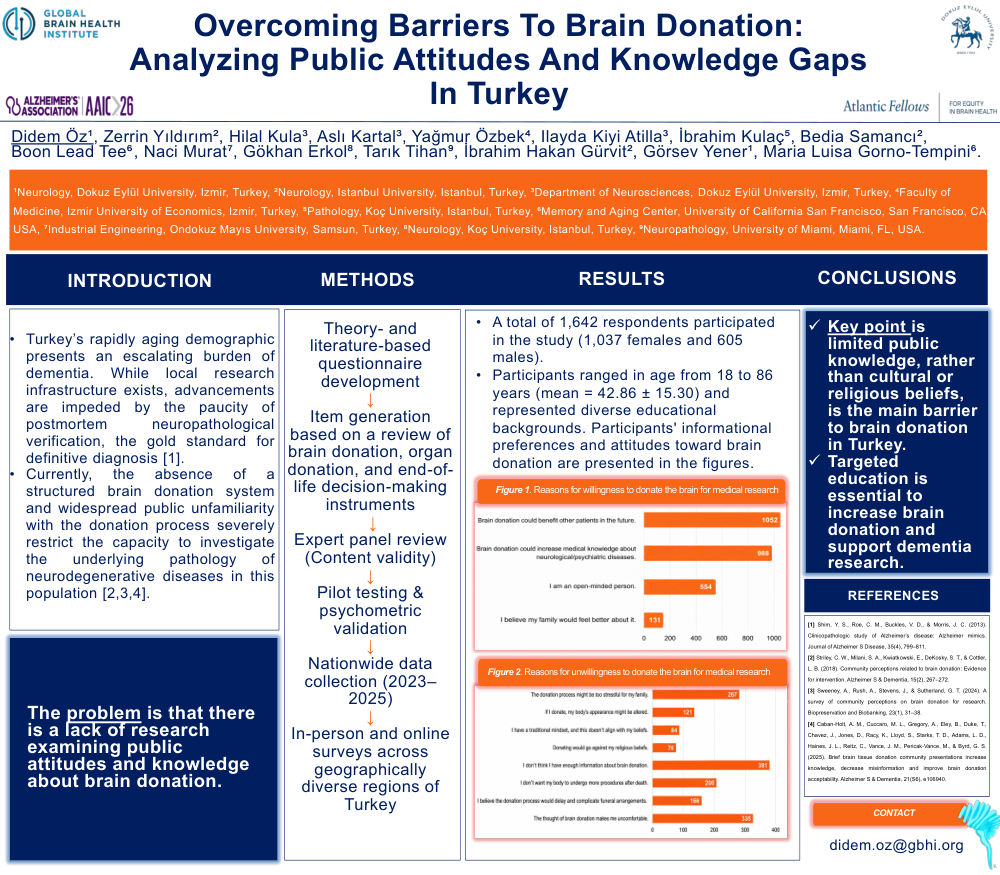
Introduction: Turkey’s rapidly aging demographic presents an escalating burden of dementia. While local research infrastructure exists, advancements are impeded by the paucity of postmortem neuropathological verification, the gold standard for definitive diagnosis [1]. Currently, the absence of a structured brain donation system and widespread public unfamiliarity with the donation process severely restrict the capacity to investigate the underlying pathology of neurodegenerative diseases in this population [2,3,4]. The problem is that there is a lack of research examining public attitudes and knowledge about brain donation.
Methods: Theory- and literature-based questionnaire development ↓ Item generation based on a review of brain donation, organ donation, and end-of life decision-making instruments ↓ Expert panel review (Content validity) ↓ Pilot testing & psychometric validation ↓ Nationwide data collection (2023-2025) ↓ In-person and online surveys across geographically diverse regions of Turkey.
Results: A total of 1,642 respondents participated in the study (1,037 females and 605 males). Participants ranged in age from 18 to 86 years (mean = 42.86 ± 15.30) and represented diverse educational backgrounds. Participants' informational preferences and attitudes toward brain donation are presented in the figures.
Conclusions: Key point is limited public knowledge, rather than cultural or religious beliefs, is the main barrier to brain donation in Turkey. Targeted education is essential to increase brain donation and support dementia research.
References:
[1] Shim, Y. S., Roe, C. M., Buckles, V. D., & Morris, J. C. (2013). Clinicopathologic study of Alzheimer’s disease: Alzheimer mimics. Journal of Alzheimer S Disease, 35(4), 799–811.
[2] Striley, C. W., Milani, S. A., Kwiatkowski, E., DeKosky, S. T., & Cottler, L. B. (2018). Community perceptions related to brain donation: Evidence for intervention. Alzheimer S & Dementia, 15(2), 267–272.
[3] Sweeney, A., Rush, A., Stevens, J., & Sutherland, G. T. (2024). A survey of community perceptions on brain donation for research. Biopreservation and Biobanking, 23(1), 31–38.
[4] Caban‐Holt, A. M., Cuccaro, M. L., Gregory, A., Eley, B., Duke, T., Chavez, J., Jones, D., Racy, K., Lloyd, S., Starks, T. D., Adams, L. D., Haines, J. L., Reitz, C., Vance, J. M., Pericak‐Vance, M., & Byrd, G. S. (2025). Brief brain tissue donation community presentations increase knowledge, decrease misinformation and improve brain donation acceptability. Alzheimer S & Dementia, 21(S6), e106940.
Comments
Email is required but is not shown publicly.
Loading comments...