4,068 posters, 219 videos, 101 topics, 69 sessions, 14,365 authors, 6,128 institutions
ePostersLive by SciGen Technologies S.A. All rights reserved.
Alzheimer's Association International Conference 2026
July 12-15, 2026 | London, United Kingdom, and Online

6300
Social Determinants Of Health In Neurocognitive Disorder Risk Among Adults From An Urban-marginalized Area Of Lima, Peru
Poster Presenter
Authors
Monica M. Diaz, Lesley A. Guareña, Jacqueline M. Koble, Nilton Custodio, Serggio C. Lanata, Eder Herrera-Perez
Affiliations
Instituto Peruano de Neurociencias, Lima, Peru, University of North Carolina at Chapel Hill, Chapel Hill, NC, USA, University of Arizona, Tucson, Arizona, USA, University of California, San Francisco, CA, USA, Universidad San Ignacio de Loyola, Lima, Peru
Part of Topic
Title: Social Determinants of Health in Neurocognitive Disorder Risk among adults from an urban-marginalized area of Lima, Peru
Author:
Monica M. Diaz (1); Nilton Custodio (2,3); Serggio C. Lanata (4); Eder Herrera-Perez (5,6);
Author Affiliations:
- University of North Carolina at Chapel Hill, Chapel Hill, NC, USA
- Unidad de Investigación, Instituto Peruano de Neurociencias, Lima, Peru
3. Escuela Profesional de Medicina Humana, Universidad Privada San Juan Bautista, Lima, Peru
- University of California, San Francisco, San Francisco, CA, USA
- Vicerrectorado de Investigación, Universidad San Ignacio de Loyola, Lima, Peru
- Centro de Excelencia en Biotecnología e Investigación Traslacional (CEBIT LATAM), Lima, Peru
Background
Socioeconomic disparities may worsen NCDs, particularly in urban-marginalized areas of low-to-middle-income countries (LMICs). Social determinants of health (SDOH) risk factors impacting NCDs in both younger and older adults in urban-marginalized areas of Latin America have been inadequately studied. Our study investigated SDOH risk factors and their associations with NCDs among community-dwelling younger and older adults in Puente Piedra, an urban-marginalized district of Lima, Peru.
Methods
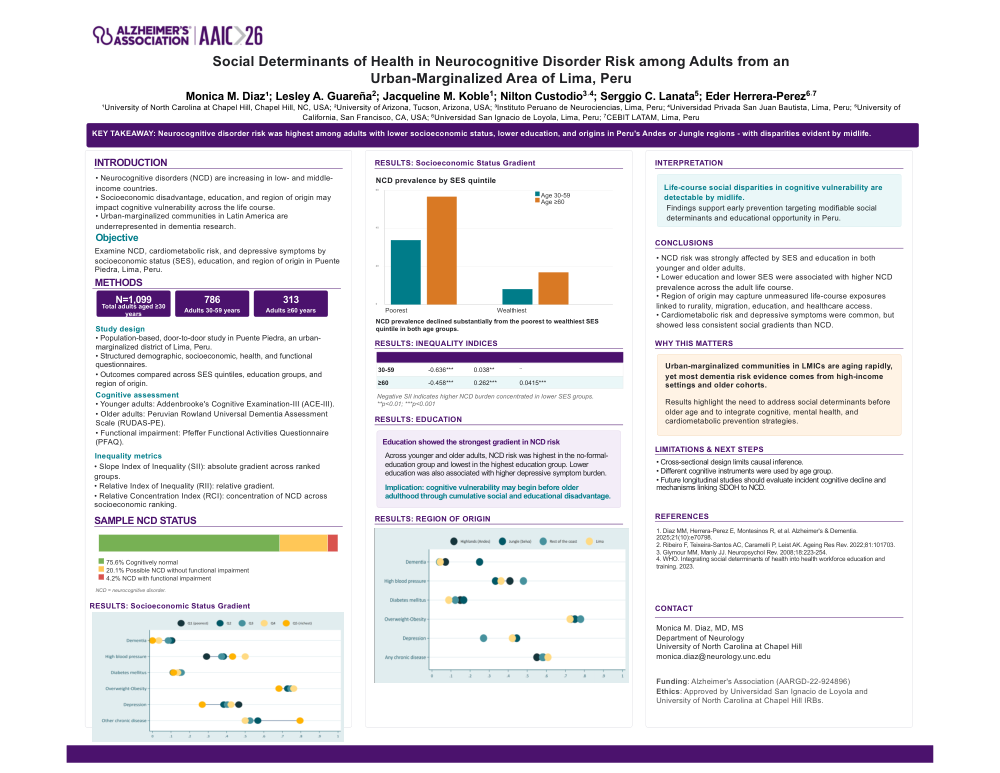
A population-based study was conducted from July 2022 through September 2023 with door-to-door visits and structured questionnaires to collect demographic, health, and socioeconomic data from 1,099 community-dwelling adults aged 30 years and older. Neurocognitive assessments included the Addenbrooke's Cognitive Examination for younger adults and Rowland Universal Dementia Assessment Scale for older adults. We estimated the Slope Index of Inequality (SII), Relative Index of Inequality (RII), and Relative Concentration Index (RCI) for NCD.
Results:
We found 75.6% were cognitively normal, 20.1% had possible NCD without functional impairment, and 4.2% with functional impairment. In young adults, (aged 30-59) those with NCDs had a higher risk of being in the lowest SES category: SII = –0.636 (p < 0.001), RII = 0.038 (p < 0.01). In older adults (aged 60 or older), similar findings were seen (SII = –0.458 [p < 0.001], RII = 0.262 [p < 0.001], RCI = 0.0415 [p < 0.001]). Across educational strata, NCD risk decreased with higher educational levels, with the lowest education group consistently showing the highest NCD risk and the highest education group the lowest. NCD risk was highest when the participant’s region of origin was from the Jungle or Andes region compared with being from the coastal or capital city.
Conclusions:
NCD risk is impacted by socioeconomic strata, educational level, and urban or rural region of origin within Peru across the adult life course. SDOH inequities in young adulthood and persisting patterns seen in older adulthood highlight the importance of early intervention on adverse SDOH and educational attainment.
Comments
Email is required but is not shown publicly.
Loading comments...