4,068 posters, 219 videos, 101 topics, 69 sessions, 14,365 authors, 6,128 institutions
ePostersLive by SciGen Technologies S.A. All rights reserved.
Alzheimer's Association International Conference 2026
July 12-15, 2026 | London, United Kingdom, and Online

1793
Assessment Of Executive Functions And Naming In Arabic-speaking Patients With Alzheimer’S Disease
Poster Presenter
Part of Topic
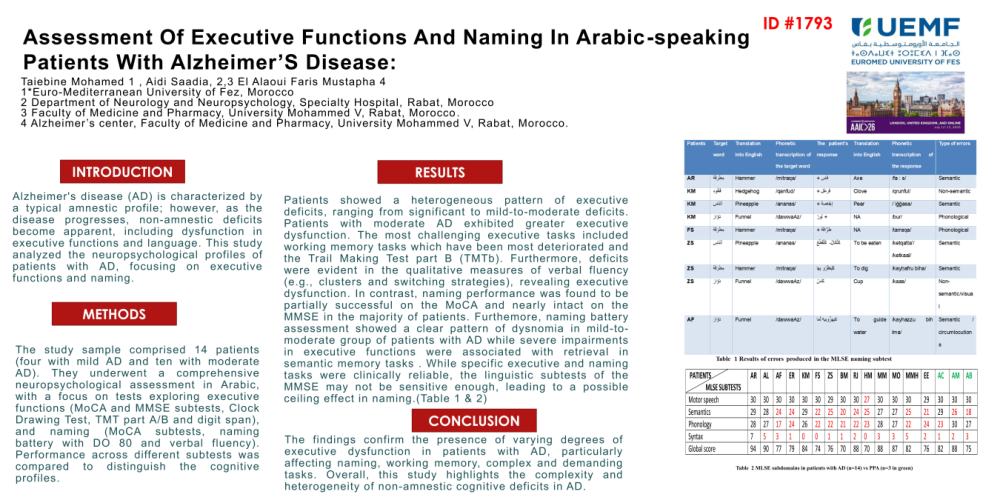
Background: Alzheimer's disease (AD) is characterized by a typical amnestic profile; however, as the disease progresses, non-amnestic deficits become apparent, including dysfunction in executive functions and language. This study analyzed the neuropsychological profiles of patients with AD, focusing on executive functions and naming.
Methods: The study sample comprised 14 patients (four with mild AD and ten with moderate AD). They underwent a comprehensive neuropsychological assessment in Arabic, with a focus on tests exploring executive functions (MoCA and MMSE subtests, Clock Drawing Test, TMT part A/B and digit span), and naming (MoCA subtests, naming battery with DO 80 and verbal fluency). Performance across different subtests was compared to distinguish the cognitive profiles.
Results: Patients showed a heterogeneous pattern of executive deficits, ranging from significant to mild-to-moderate deficits. Patients with moderate AD exhibited greater executive dysfunction. The most challenging executive tasks included working memory tasks which have been most deteriorated and the Trail Making Test part B (TMTb). Furthermore, deficits were evident in the qualitative measures of verbal fluency (e.g., clusters and switching strategies), revealing executive dysfunction. In contrast, naming performance was found to be partially successful on the MoCA and nearly intact on the MMSE in the majority of patients. Furthemore, naming battery assessment showed a clear pattern of dysnomia in mild-to-moderate group of patients with AD while severe impairments in executive functions were associated with retrieval in semantic memory tasks . While specific executive and naming tasks were clinically reliable, the linguistic subtests of the MMSE may not be sensitive enough, leading to a possible ceiling effect in naming.
Conclusion: The findings confirm the presence of varying degrees of executive dysfunction in patients with AD, particularly affecting naming, working memory, complex and demanding tasks. Overall, this study highlights the complexity and heterogeneity of non-amnestic cognitive deficits in AD.
Comments
Email is required but is not shown publicly.
Loading comments...