4,068 posters, 219 videos, 101 topics, 69 sessions, 14,365 authors, 6,128 institutions
ePostersLive by SciGen Technologies S.A. All rights reserved.
Alzheimer's Association International Conference 2026
July 12-15, 2026 | London, United Kingdom, and Online

6311
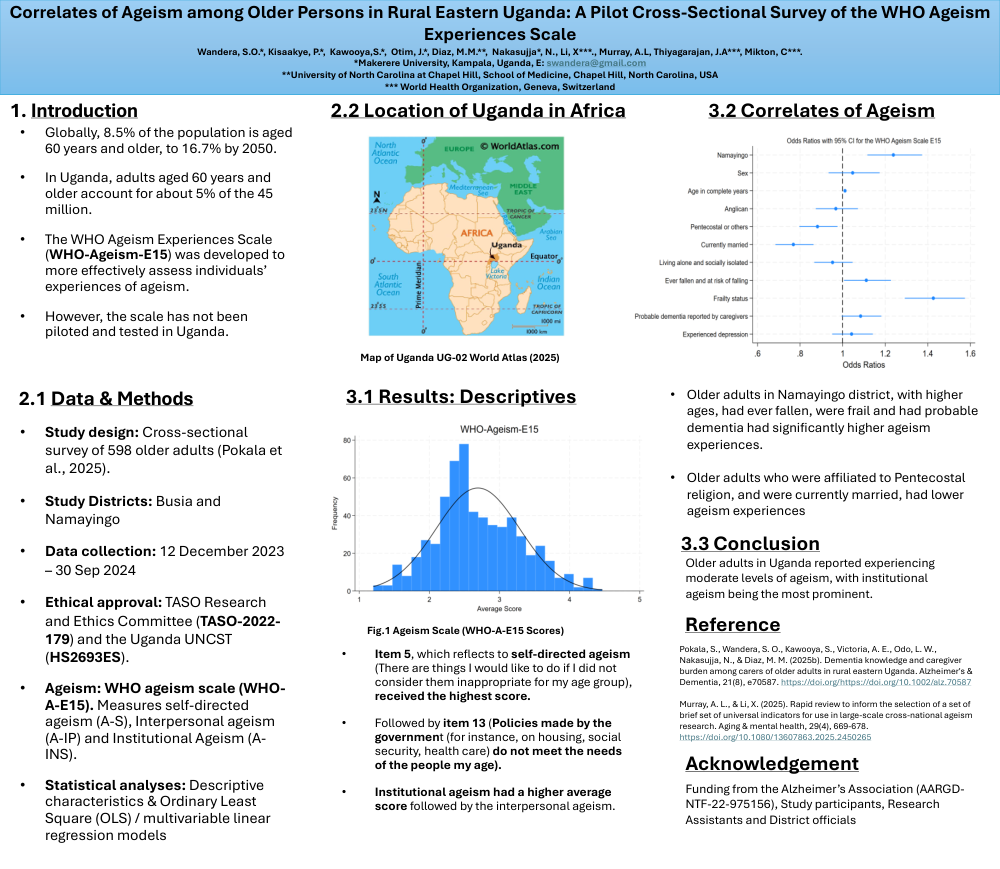
Risk Factors Of Ageism Among Older Persons In Rural Eastern Uganda: A Pilot Cross-sectional Survey Of The Who Ageism Experiences Scale
Poster Presenter
Authors
Stephen Ojiambo Wandera, Peter Kisaakye, Shafiq Kawooya, Jude Otim, Monica M. Diaz, Noeline Nakasujja, Xuefei Li, Aja Louis Murray, Jothees Amuthavalli Thiyagarajan, Christopher Mikton
Affiliations
Makerere University, Kampala, Uganda, University of North Carolina at Chapel Hill School of Medicine, Chapel Hill, North Carolina, USA, University of Edinburgh, United Kingdom, World Health Organization, Geneva, Switzerland
Part of Topic
ABSTRACT
Introduction: The World Health Organisation (WHO) and its partners are leading a Global Campaign to Combat Ageism globally. The WHO Ageism Experiences Scale (WHO-Ageism-E15) was developed to more effectively assess individuals’ experiences of ageism. This scale is designed to capture the major dimensions of ageism. However, the scale has not been piloted and tested in Uganda.
Methods: We conducted a cross-sectional survey to pilot and test the WHO-Ageism-E15 scale among 598 older adults in rural Eastern Uganda.
Results: Overall, the WHO-Ageism-E15 demonstrated acceptable psychometric properties in the Ugandan context. Older adults in Uganda reported experiencing moderate levels of ageism, with institutional ageism being the most prominent. We found that overall ageism was associated with higher age, being from Namayingo district, being male, having no education, not being currently married, falls, frailty and dementia. The protective factors were being currently married and being educated.
Conclusion: Institutional ageism is higher than interpersonal ageism in rural eastern Uganda. Overall ageism is associated with rurality (Namayingo district), increment in age, falls and being frail. Being married and educated decreased the odds of ageism.
Keywords: Ageism, Assessment, Rural, Uganda, Older Adult
Comments
Email is required but is not shown publicly.
Loading comments...