4,068 posters, 219 videos, 101 topics, 69 sessions, 14,365 authors, 6,128 institutions
ePostersLive by SciGen Technologies S.A. All rights reserved.
Alzheimer's Association International Conference 2026
July 12-15, 2026 | London, United Kingdom, and Online

7087
Frontotemporal Dementia: Does MRI-based Clustering Match Clinical Syndromes?
Poster Presenter
Authors
Neha Singh-Reilly, Irene Sintini, Farwa Ali, Joseph Duffy, Heather Clark, Rene Utianski, Gabriela Meade, Mary Machulda, Ryota Satoh, Val Lowe, Keith Josephs, Jennifer Whitwell
Affiliations
Part of Topic
Background:
Frontotemporal dementia (FTD) is an umbrella term that encompasses several clinical syndromes with impaired behavioral, language, and motor functions. These syndromes show considerable overlap in clinical features and imaging patterns. Therefore, there is a need to investigate the syndromic heterogeneity in FTD using unbiased data-driven approaches.
Objectives:
To determine whether structural magnetic resonance imaging (MRI) based clusters would capture the FTD clinical syndromes and determine how these clusters relate to clinical characteristics.
Methods:
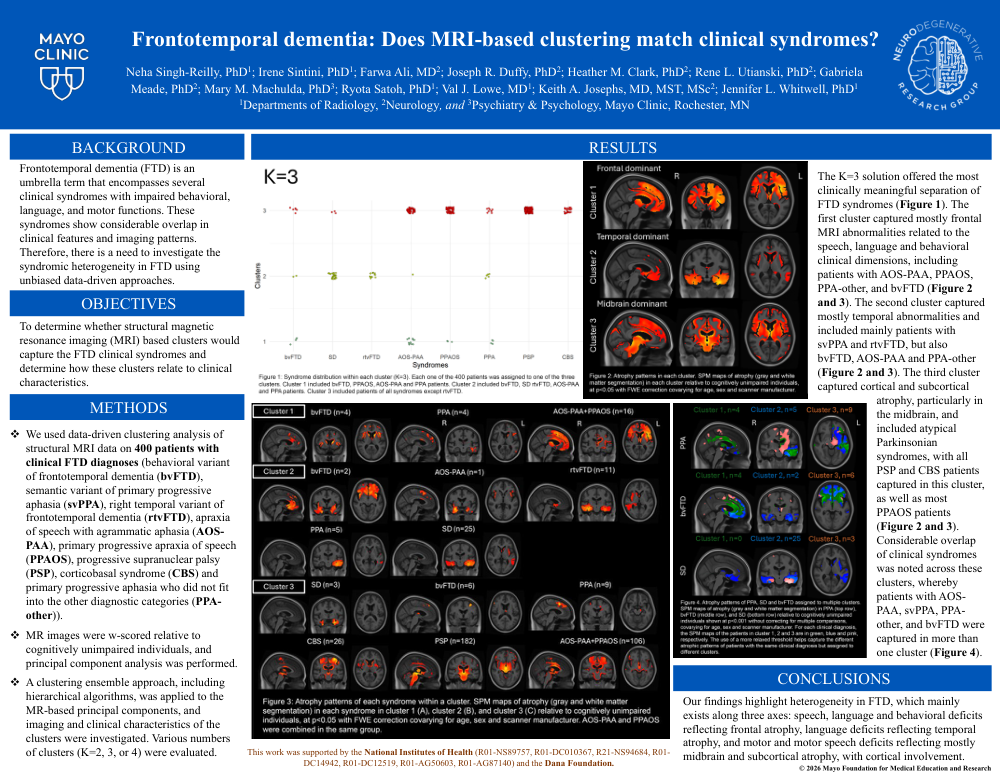
The K=3 solution offered the most clinically meaningful separation of FTD syndromes (Figure 1). The first cluster captured mostly frontal MRI abnormalities related to the speech, language and behavioral clinical dimensions, including patients with AOS-PAA, PPAOS, PPA-other, and bvFTD (Figure 2 and 3). The second cluster captured mostly temporal abnormalities and included mainly patients with svPPA and rtvFTD, but also bvFTD, AOS-PAA and PPA-other (Figure 2 and 3). The third cluster captured cortical and subcortical atrophy, particularly in the midbrain, and included atypical Parkinsonian syndromes, with all PSP and CBS patients captured in this cluster, as well as most PPAOS patients (Figure 2 and 3). Considerable overlap of clinical syndromes was noted across these clusters, whereby patients with AOS-PAA, svPPA, PPA-other, and bvFTD were captured in more than one cluster (Figure 4).
Conclusion:
Our findings highlight heterogeneity in FTD, which mainly exists along three axes: speech, language and behavioral deficits reflecting frontal atrophy, language deficits reflecting temporal atrophy, and motor and motor speech deficits reflecting mostly midbrain and subcortical atrophy, with cortical involvement.
Comments
Email is required but is not shown publicly.
Loading comments...