4,068 posters, 219 videos, 101 topics, 69 sessions, 14,365 authors, 6,128 institutions
ePostersLive by SciGen Technologies S.A. All rights reserved.
Alzheimer's Association International Conference 2026
July 12-15, 2026 | London, United Kingdom, and Online

4403
Artificial Light At Night And Dementia Prevalence And Morality In U.S. Counties
Poster Presenter
Part of Topic
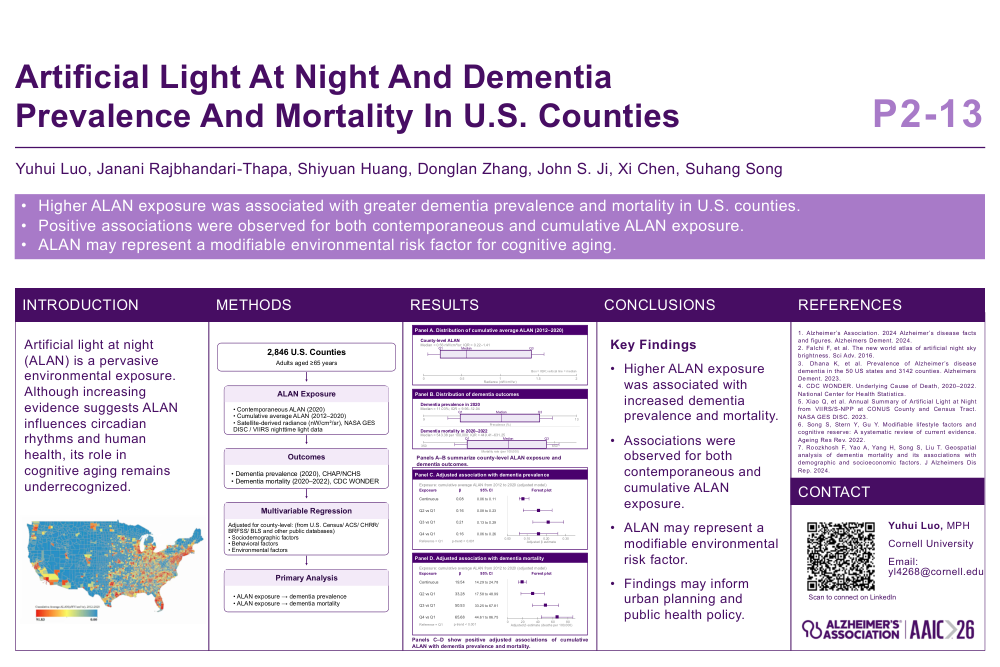
Background: Artificial light at night (ALAN) has emerged as a pervasive environmental exposure with potential implications for human health, yet its role in cognitive aging remains underrecognized. This study examined the associations between county-level ALAN exposure and dementia prevalence and mortality across the United States.
Methods: We conducted a pooled cross-sectional analysis of 2,846 U.S. counties. County-level dementia prevalence among adults aged ≥65 years in 2020 and dementia mortality during 2020-2022 were linked to contemporaneous ALAN exposure in 2020 and cumulative average ALAN from 2012 to 2020. ALAN was measured using satellite-derived nighttime radiance (nW/cm2/sr). Multivariable regression models adjusted for baseline county-level sociodemographic, behavioral, and environmental covariates
Results: Across counties, the median cumulative average ALAN from 2012 to 2020 was 0.56 nW/cm2/sr (interquartile range [IQR], 0.22-1.41). Median dementia prevalence in 2020 was 11.03% (IQR, 9.96-12.04), and median dementia mortality during 2020-2022 was 543.38 per 100,000 population (IQR, 449.41-631.25) among adults aged >65 years. Contemporaneous ALAN exposure in 2020 was positively associated with dementia outcomes. A 1% increase in ALAN was associated with a 0.07 percentage-point increase in dementia prevalence (95% CI, 0.05-0.09; p<0.001) and a 0.19 per 100,000 increase in dementia mortality (95%CI, 0.14-0.24;p<0.001), after full covariate adjustment. Similar positive associations were observed for cumulative average ALAN exposure from 2012 to 2020.
Conclusion: Higher county-level exposure to artificial light at night was associated with greater dementia prevalence and mortality among older adults. These findings suggest that ALAN may represent a modifiable environmental risk factor relevant to cognitive aging, with important implications for urban planning and public health policy.
Comments
Email is required but is not shown publicly.
Loading comments...