4,068 posters, 219 videos, 101 topics, 69 sessions, 14,365 authors, 6,128 institutions
ePostersLive by SciGen Technologies S.A. All rights reserved.
Alzheimer's Association International Conference 2026
July 12-15, 2026 | London, United Kingdom, and Online

553
Development And Validation Of A Dementia Risk Prediction Model In Patients With Depression Using Competing Risk Analysis
Poster Presenter
Authors
Maha Alshahrani, Mario Siervo, Zhongyang Guan, Blossom CM Stephan
Affiliations
1 Curtin School of Population Health, Curtin University, Perth, WA 6102, Australia, 2 Research Centre of Advanced Materials, King Khalid University, Abha, Saudi Arabia, 3 Dementia Centre of Excellence, Curtin enAble Institute, Curtin University, Perth 6102, Australia, 4 Saudi Arabian Cultural Mission, Canberra, Australia, Curtin School of Population Health, Curtin University, Perth, WA 6102, Australia, Dementia Centre of Excellence, Curtin enAble Institute, Curtin University, Perth 6102, Australia, 1 Curtin School of Population Health, Curtin University, Perth, WA 6102, Australia, Dementia Centre of Excellence, Curtin enAble Institute, Curtin University, Perth 6102, Australia, Australia, Dementia Centre of Excellence, Curtin enAble Institute, Curtin University, Perth 6102, Australia
Part of Topic
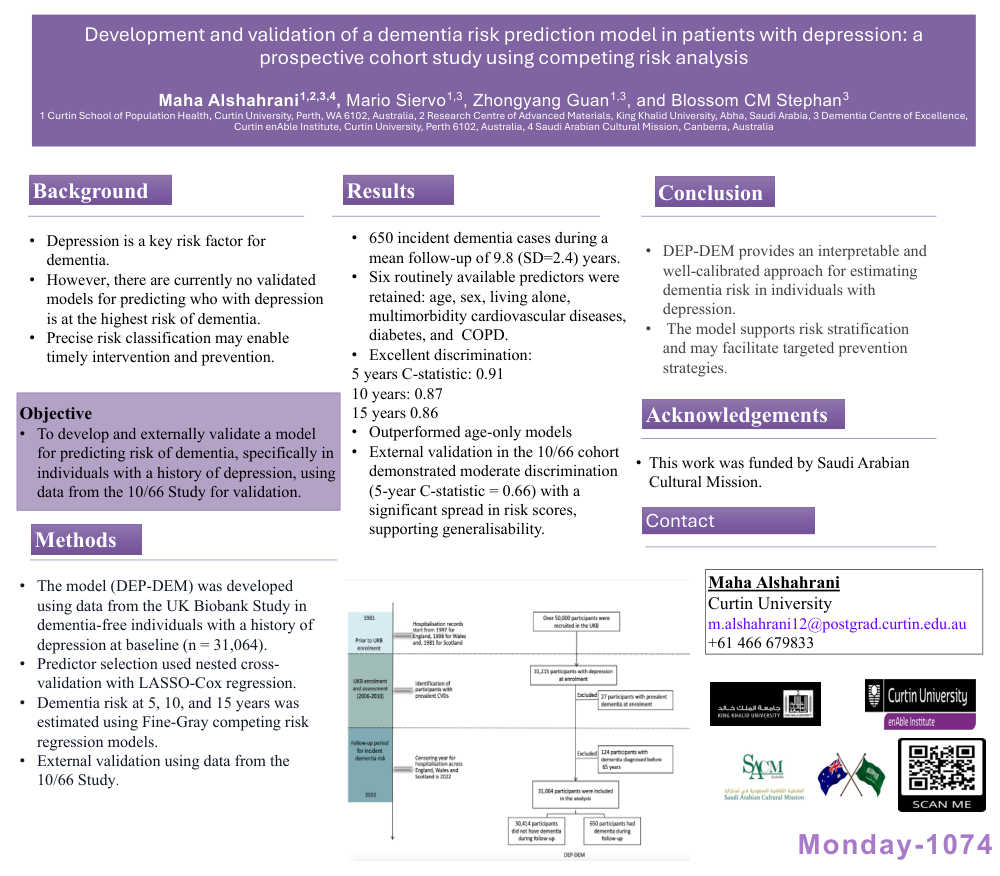
Development and validation of a dementia risk prediction model in patients with depression: a prospective cohort study using competing risk analysis
Maha Alshahrani1,2,3,4, Mario Siervo1,3, Zhongyang Guan1,3, and Blossom CM Stephan3
1 Curtin School of Population Health, Curtin University, Perth, WA 6102, Australia
2 Research Centre of Advanced Materials, King Khalid University, Abha, Saudi Arabia
3 Dementia Centre of Excellence, Curtin enAble Institute, Curtin University, Perth 6102, Australia.
4 Saudi Arabian Cultural Mission, Canberra, Australia
Abstract
Background: Depression is a key risk factor for dementia. Yet, there are currently no validated models for predicting who with depression is at the highest risk of dementia. Precise risk classification may enable timely intervention and prevention.
Objective: To develop and externally validate a model for predicting risk of dementia, specifically in individuals with a history of depression, using data from the 10/66 Study for validation.
Methods: The model (DEP-DEM) was developed using data from the UK Biobank Study in dementia-free individuals with a history of depression at baseline (n = 31,064). Predictor selection was undertaken using nested cross-validation utilising LASSO-Cox regression, followed by Fine-Gray competing risk models to assess dementia risk at 5, 10, and 15 years. Model discrimination was evaluated by time-dependent C-statistics, calibration was measured using Aalen-Johansen estimators, and clinical utility was determined via decision curve analysis. Regression coefficients were converted into point-based risk scores. External validation of the DEP-DEM model was conducted using data from the 10/66 Study, a large population-based cohort from multiple low and middle-income countries LMICs.
Results: During a mean follow-up of 9.8 (SD=2.4) years, 650 participants with depression progressed to dementia in the UK Biobank. The DEP-DEM model included age, sex, living alone, multimorbidity cardiovascular diseases, diabetes, and COPD. It demonstrated excellent discrimination at 5 years, with a c-statistic of 0.91 (95% CI: 0.89–0.94), with slightly lower but robust performance at 10 years, 0.87 (95% CI: 0.86-0.88), and 15 years 0.86 (95% CI: 0.84-0.88). DEP-DEM significantly outperformed age-only models across all follow-up periods (p = 0.03). Point-based risk scores were generated to provide individualised probabilities of dementia at 5, 10, and 15 years, showing similarly strong discrimination. External validation in the 10/66 cohort demonstrated moderate discrimination (5-year C-statistic = 0.66) with a significant spread in risk scores, supporting generalisability.
Conclusions: DEP-DEM is a clinically interpretable and well-calibrated model that relies on routinely collected data to estimate the risk of dementia in people with depression. The development dataset demonstrates high discrimination and calibration, identification of individuals at greater risk, and supporting early preventive strategies. Further external validation is required to confirm its clinical applicability and generalisability.
Keywords: Dementia, Depression, Risk Prediction, UKB, Competing Risks
Comments
Email is required but is not shown publicly.
Loading comments...