4,068 posters, 219 videos, 101 topics, 69 sessions, 14,365 authors, 6,128 institutions
ePostersLive by SciGen Technologies S.A. All rights reserved.
Alzheimer's Association International Conference 2026
July 12-15, 2026 | London, United Kingdom, and Online

5928
Alzheimer’S Disease And Related Dementias State Policies And Mortality In The United States From 2008-2020: A Descriptive Study
Poster Presenter
Authors
Part of Topic
BACKGROUND
-
Alzheimer’s Disease and Related Dementias (ADRD) were the sixth leading cause of death among people aged 65+ in 2022 and are currently the leading cause of disability and morbidity in older adults.
-
In an effort to reduce the burden of ADRD, states have adopted specific strategic plans.
OBJECTIVE
We describe
1) the trends in the adoption ofADRD policies that were implemented in the U.S. from 2008-2020, and
2) the trends in ADRD mortality during 1999-2022.
METHODS
-
Wepresentedmortalitydata for the age-adjusted rate of ADRD mortality per 100,000 people in 1999-2022 from CDC Wide-ranging ONline Data for Epidemiologic Research (WONDER) Data
-
Wealsocollectedpolicy data(2008-2020) from state websites
RESULTS
-
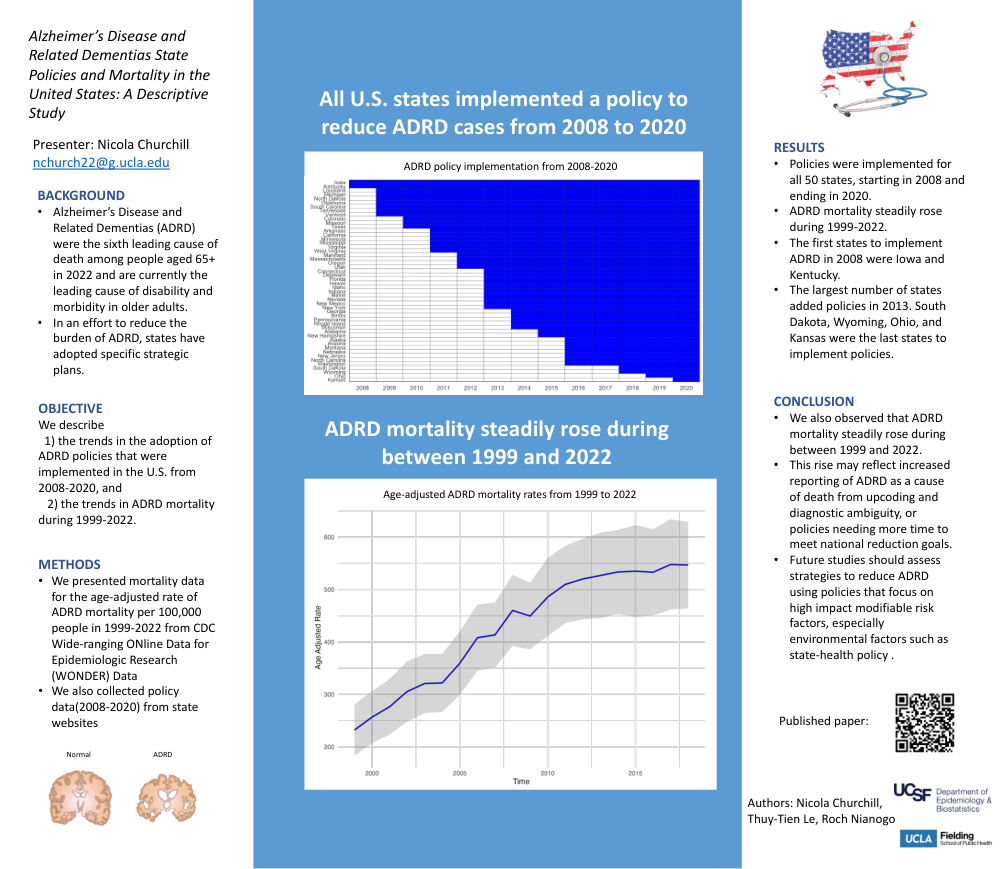
Policies were implemented for all 50 states, starting in 2008 and ending in 2020.
-
ADRD mortality steadily rose during 1999-2022.
-
The first states to implement ADRD in 2008 were Iowa and Kentucky.
-
The largest number of states added policies in 2013. South Dakota, Wyoming, Ohio, and Kansas were the last states to implement policies.
CONCLUSION
-
We also observed that ADRD mortality steadily rose during between 1999 and 2022.
-
This rise may reflect increased reporting of ADRD as a cause of death from upcoding and diagnostic ambiguity, or policies needing more time to meet national reduction goals.
-
Future studies should assess strategies to reduce ADRD using policies that focus on high impact modifiable risk factors, especially environmental factors such as state-health policy .
-
Comments
Email is required but is not shown publicly.
Loading comments...