4,068 posters, 219 videos, 101 topics, 69 sessions, 14,365 authors, 6,128 institutions
ePostersLive by SciGen Technologies S.A. All rights reserved.
Alzheimer's Association International Conference 2026
July 12-15, 2026 | London, United Kingdom, and Online

10234
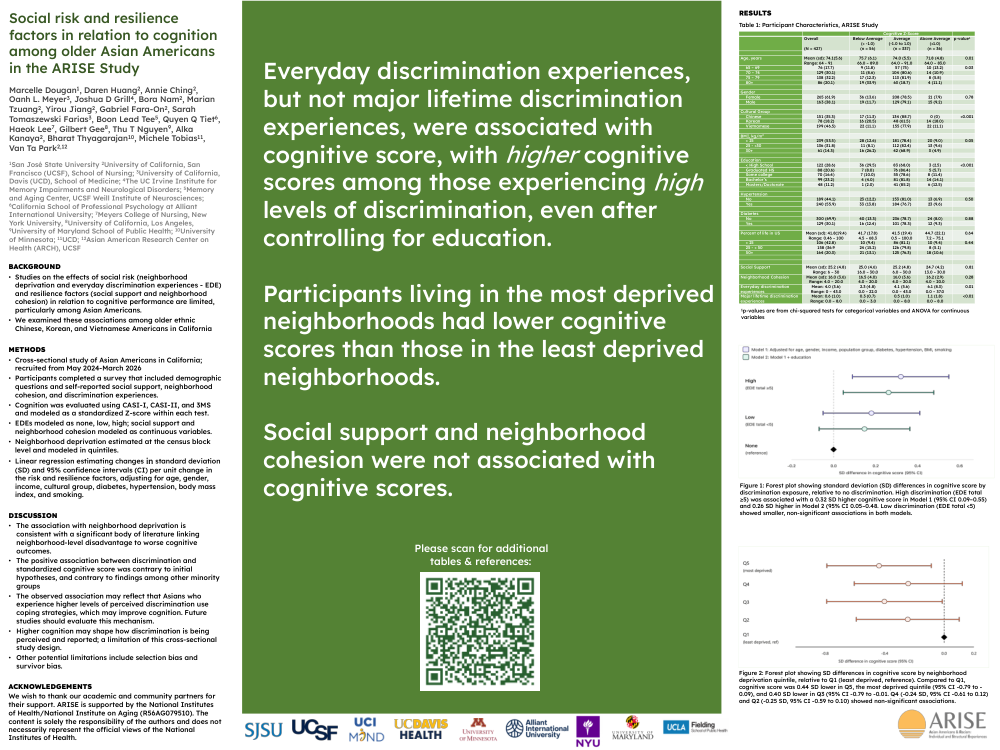
Social Risk And Resilience Factors In Relation To Cognitive Scores In The ARISE Study With Older Asian Americans
Poster Presenter
Authors
Marcelle Dougan, Daren Huang, Annie Ching, Oanh Meyer, Joshua Grill, Bora Nam, Marian Tzuang, Yirou Jiang, Gabriel Fara-on, Sarah Tomaszewski Farias, Boon Lead Tee, Quyen Tiet, Haeok Lee, Gilbert Gee, Thu Nguyen, Bharat Thyagarajan, Michele Tobias, Van Ta Park
Affiliations
University of California, Los Angeles, University of California, Davis, University of Minnesota, University of Maryland School of Public Health, San José State University, University of California, San Francisco, School of Nursing, University of California, Davis, School of Medicine, The UC Irvine Institute for Memory Impairments and Neurological Disorders, Memory and Aging Center, UCSF Weill Institute of Neurosciences, California School of Professional Psychology at Alliant International University, Meyers College of Nursing, New York University, University of California, San Francisco, School of Nursing and Asian American Research Center on Health (ARCH), University of California San Francisco
Part of Topic
BACKGROUND
- Studies on the effects of social risk (neighborhood deprivation and everyday discrimination experiences - EDE) and resilience factors (social support and neighborhood cohesion) in relation to cognitive performance are limited, particularly among Asian Americans.
- We examined these associations among older ethnic Chinese, Korean, and Vietnamese Americans in California
METHODS
- Cross-sectional study of Asian Americans in California; recruited from May 2024-March 2026
- Participants completed a survey that included demographic questions and self-reported social support, neighborhood cohesion, and discrimination experiences.
- Cognition was evaluated using CASI-I, CASI-II, and 3MS and modeled as a standardized Z-score within each test.
- EDEs modeled as none, low, high; social support and neighborhood cohesion modeled as continuous variables.
- Neighborhood deprivation estimated at the census block level and modeled in quintiles.
- Linear regression estimating changes in standard deviation (SD) and 95% confidence intervals (CI) per unit change in the risk and resilience factors, adjusting for age, gender, income, cultural group, diabetes, hypertension, body mass index, and smoking.
RESULTS
• Average age (SD) of participants was 74.3 (5.5), 61% female, 47.2% Vietnamese, 37.5% ethnic Chinese, and 15.5% Korean.
• Mean (SD; range) cognitive scores were 86.4 (8.2; 44.0-99.0), 93.5 (7.9; 45.4-100.0), and 86.8 (8.1; 62.0 - 98.0) for CASI-I, CASI-II, and 3MS, respectively.
• Neighborhood deprivation was associated with cognitive score: compared to those living in the least deprived neighborhoods, those in the most deprived neighborhoods had a 0.438-SD (95% CI 0.086 – 0.789; p-trend = 0.02) lower cognitive score
• High EDEs were associated with higher cognitive scores: compared to those with no experiences of discrimination, those who experienced high discrimination had a 0.33 -SD (95% CI 0.08 - 0.58) higher cognitive score.
• Education attenuated the effect to 0.25 (95% CI 0.02 - 0.48).
• Social support and neighborhood cohesion were not associated with cognitive scores.
DISCUSSION
- The association with neighborhood deprivation is consistent with a significant body of literature linking neighborhood-level disadvantage to worse cognitive outcomes.
- The positive association between discrimination and standardized cognitive score was contrary to initial hypotheses, and contrary to findings among other minority groups
- The observed association may reflect that Asians who experience higher levels of perceived discrimination use coping strategies, which may improve cognition. Future studies should evaluate this mechanism.
- Higher cognition may shape how discrimination is being perceived and reported; a limitation of this cross-sectional study design.
- Other potential limitations include selection bias and survivor bias.
Comments
Email is required but is not shown publicly.
Loading comments...