4,068 posters, 219 videos, 101 topics, 69 sessions, 14,365 authors, 6,128 institutions
ePostersLive by SciGen Technologies S.A. All rights reserved.
Alzheimer's Association International Conference 2026
July 12-15, 2026 | London, United Kingdom, and Online

9295
Association Between Greenspace Spatial Social Polarization And Dementia Among Older Adults In Los Angeles County
Poster Presenter
Authors
Hoda Abdel Magid, Mengya Xu, McKailey Walters, Evelyn Gonzalez, Weilin Wang, Sidra Haye, Julie Zissimopoulos, Michelle Odden
Affiliations
Keck School of Medicine, University of Southern California, Spatial Sciences Institute, University of Southern California, Department of Health Policy and Management, Sol Price School of Public Policy, University of Southern California,, Department of Health Policy and Management, Sol Price School of Public Policy, University of Southern California, Department of Epidemiology and Population Health, School of Medicine, Stanford University
Part of Topic
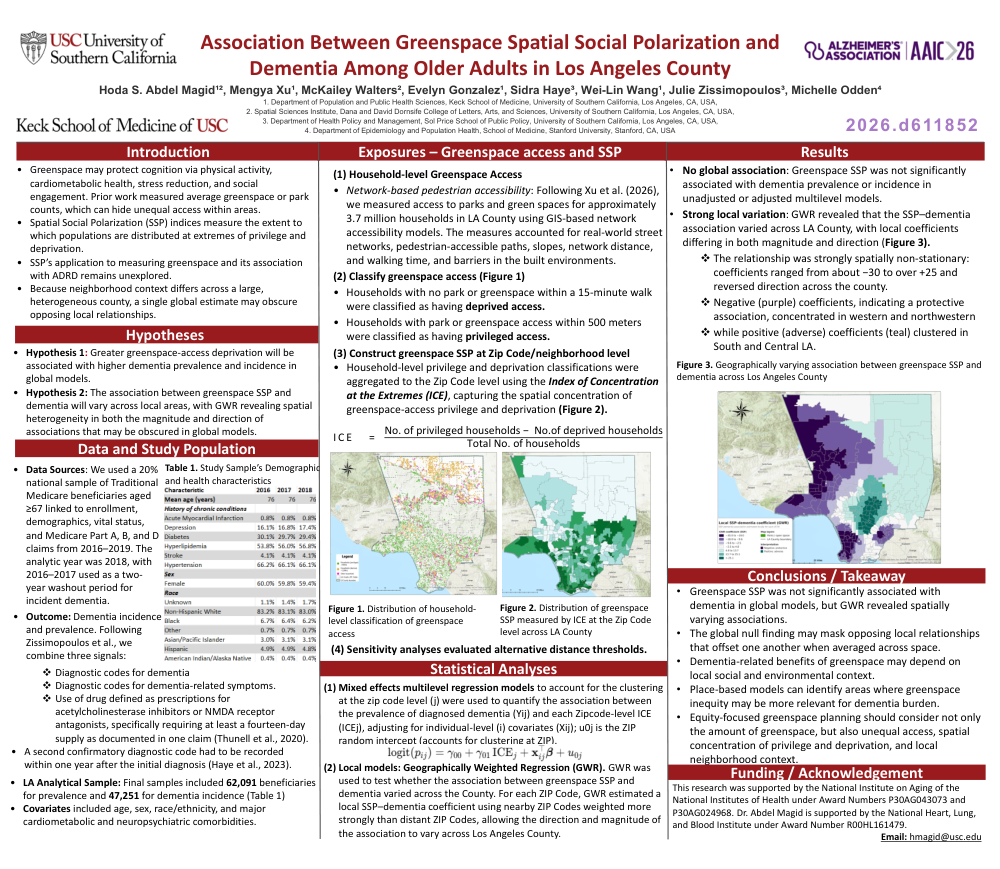
Greenspace may support cognitive health through stress reduction, physical activity, and social engagement, but epidemiologic studies relying on area-level averages and global models may obscure inequities. Spatial Social Polarization (SSP)—the unequal distribution of environmental access between privileged and deprived populations—may produce geographically divergent associations that global models fail to detect. As part of an ongoing national Medicare study, we used Los Angeles County as a case study to examine whether associations between greenspace SSP and dementia risk vary spatially. We analyzed a 20% random sample of Medicare beneficiaries aged ≥67 years (2016–2019). Dementia cases were identified using diagnosis and prescription-based algorithms. We constructed a ZCTA-level Greenspace SSP index using the Index of Concentration at the Extremes, classifying households as privileged (≤500m to parks) or deprived (>1,200m). Associations were estimated using multilevel logistic regression adjusted for sociodemographics and comorbidities, and Geographically Weighted Regression (GWR) models to assess spatial non-stationarity. The sample included 62,091 beneficiaries (prevalence) and 47,251 (incidence). Global models showed no association between Greenspace SSP and dementia. GWR revealed spatial heterogeneity and bidirectional associations. Local fit varied (e.g., East Los Angeles local R² = 0.49 vs. <0.20 in West and South Los Angeles). Higher Greenspace SSP was associated with lower dementia risk in affluent areas but higher risk in disadvantaged ZCTAs. These findings demonstrate that global models mask spatial variation. Accounting for SSP and local heterogeneity may be essential for accurately characterizing environmental inequities in dementia risk across the U.S.
Comments
Email is required but is not shown publicly.
Loading comments...