4,068 posters, 219 videos, 101 topics, 69 sessions, 14,365 authors, 6,128 institutions
ePostersLive by SciGen Technologies S.A. All rights reserved.
Alzheimer's Association International Conference 2026
July 12-15, 2026 | London, United Kingdom, and Online

1814
Health Conditions And Social Determinants Associated With Higher Dementia Risk Among LGBTQIA+ People With Parkinson’s Disease
Poster Presenter
Authors
Affiliations
University of Colorado Anschutz, USA, University of Nevada Las Vegas, USA
Part of Topic
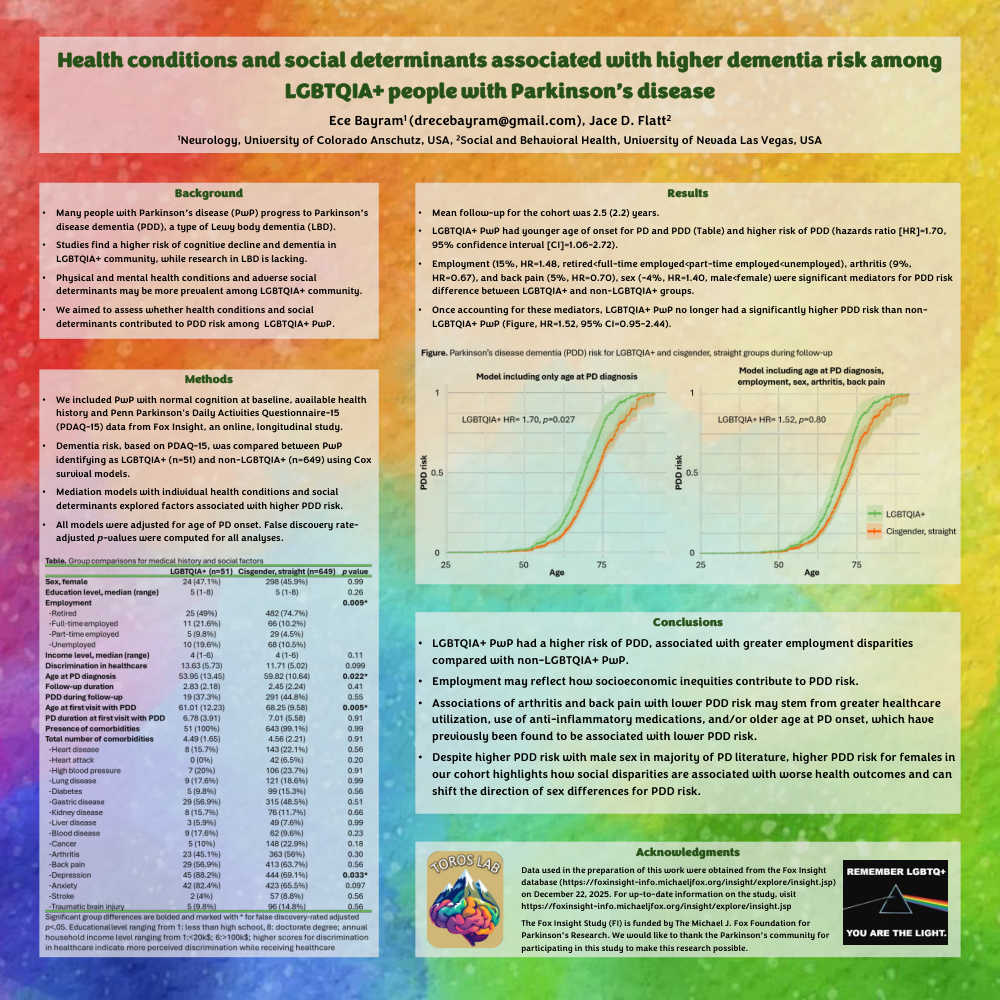
Background: Many people living with Parkinson’s disease (PwP) progress to Parkinson’s disease dementia (PDD), a type of Lewy body dementia (LBD). Studies find a higher odd of cognitive decline and dementia in LGBTQIA+ community, while research in LBD is lacking. Physical and mental health conditions and adverse social determinants may be more prevalent among LGBTQIA+ people. We aimed to assess whether health conditions and social determinants contributed to PDD risk among LGBTQIA+ PwP.
Methods: We included PwP with normal cognition at baseline, available health history and Penn Parkinson's Daily Activities Questionnaire-15 (PDAQ-15) data from Fox Insight, an online, longitudinal study. Dementia risk based on PDAQ-15, was compared between PwP identifying as LGBTQIA+ (n=51) and non-LGBTQIA+ (n=649) using Cox survival models. Mediation models with individual health conditions and social determinants explored factors associated with higher PDD risk. All models were adjusted for age of PD onset. False discovery rate-adjusted p-values were computed for all analyses.
Results: Mean follow-up for the cohort was 2.5 (2.2) years. LGBTQIA+ PwP had younger age of onset for PD and PDD (Table) and higher risk of PDD (hazards ratio [HR]=1.70, 95% confidence interval [CI]=1.06-2.72). Employment (15%, HR=1.48, retired<full-time employed<part-time employed<unemployed), arthritis (9%, HR=0.67), and back pain (5%, HR=0.70) attenuated the PDD risk difference between LGBTQIA+ and non-LGBTQIA+ groups; while sex (-4%, HR=1.40, male<female) suppressed the difference. Once accounting for these mediators, LGBTQIA+ PwP no longer had a significantly higher PDD risk than non-LGBTQIA+ PwP (Figure, HR=1.52, 95% CI=0.95-2.44).
Conclusions: LGBTQIA+ PwP had a higher risk of PDD, associated with greater employment disparities compared with non-LGBTQIA+ PwP. Employment may reflect how socioeconomic inequities contribute to PDD risk. Associations of arthritis and back pain with lower PDD risk may stem from greater healthcare utilization, use of anti-inflammatory medications, and/or older age at PD onset, which have previously been found to be associated with lower PDD risk. Despite higher PDD risk with male sex in majority of PD literature, higher PDD risk for females in our cohort highlights how social disparities are associated with worse health outcomes and can shift the direction of sex differences for PDD risk.
Acknowledgments: Data used in the preparation of this work were obtained from the Fox Insight database (https://foxinsight-info.michaeljfox.org/insight/explore/insight.jsp) on December 22, 2025. For up-to-date information on the study, visit https://foxinsight-info.michaeljfox.org/insight/explore/insight.jsp
The Fox Insight Study (FI) is funded by The Michael J. Fox Foundation for Parkinson’s Research. We would like to thank the Parkinson’s community for participating in this study to make this research possible.
Comments
Email is required but is not shown publicly.
Loading comments...