4,068 posters, 219 videos, 101 topics, 69 sessions, 14,365 authors, 6,128 institutions
ePostersLive by SciGen Technologies S.A. All rights reserved.
Alzheimer's Association International Conference 2026
July 12-15, 2026 | London, United Kingdom, and Online

4903
Characterization Of A Metabolomics Signature Of The Brain-health-promoting Mind Diet In Older Persons
Poster Presenter
Authors
Jeanne Neuffer, Raúl González-Domínguez, Sophie Lefèvre-Arbogast, Dorrain Y Low, Alba Tor-Roca, Catherine Helmer, Andrea Du Preez, Chiara de Lucia, Silvie R. Ruigrok, Barbara Altendorfer, Ludwig Aigner, Paul J. Lucassen, Aniko Korosi, Sandrine Thuret, Claudine Manach, Mercè Pallàs, Alex Sánchez-Pla, Cristina Andres-Lacueva, Mireia Urpi-Sarda, Cécilia Samieri
Affiliations
King’s College London, UK, King's College London, UK, University of Bordeaux, University Paris-Saclay, France, University of Barcelona, Institue of Salud Carlos III, Spain, University of Bordeaux, France, University Clermont Auvergne (France), Nanyang Technological University (Singapore), University of Amsterdam, The Netherlands, Paracelsus Medical University, Austria, University Clermont Auvergne,France, University of barcelona, Spain
Part of Topic
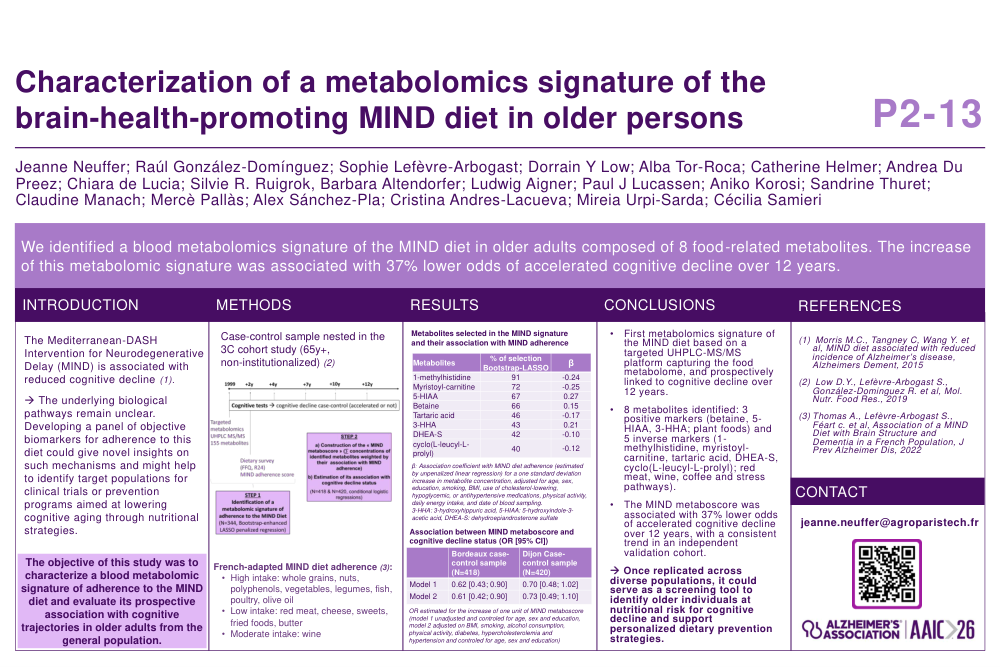
Background: The Mediterranean-DASH Intervention for Neurodegenerative Delay (MIND) diet has been linked to reduced cognitive decline. However, the underlying biological pathways remain unclear. Developing a panel of objective biomarkers for adherence to this diet could give novel insights on such mechanisms and might help to identify target populations for clinical trials or prevention programs aimed at lowering cognitive aging through nutritional strategies. To address this challenge, blood metabolomics, which reflect both external exposures and endogenous metabolism, is a valuable tool. The objective of this study was to characterize a blood metabolomic signature of adherence to the MIND diet and evaluate its prospective association with cognitive trajectories in older adults from the general population.
Methods: We leveraged data from the French Three-City cohort, that included individuals aged ≥65 years in 1999. Two independent nested case-control samples were defined, contrasting participants with higher versus lower cognitive decline trajectories over 12-year: a discovery (n=418) and a validation sample (n=420). A targeted metabolomic analysis allowed to quantify 155 diet-related metabolites in serum at study baseline. We first analyzed the 344 participants from the first sample who answered a dietary survey to identify, with a penalized regression, a signature of metabolites linked to greater MIND diet adherence. We then leveraged the full discovery and validation samples to evaluate associations between the metabolomic signature and cognitive decline.
Results: Eight metabolites were selected in the metabolomic signature of the MIND diet; three were associated with greater MIND adherence (3-HHA, 5-HIAA and betaine, mainly phenolic acids and amino acid derivatives, related to plant foods) and five were associated with lower adherence (1-methylhistidine, cyclo(L-leucyl-L-prolyl), tartaric acid, Myristoyl-carnitine and DHEA-S, derived from red meat, coffee, wine or endogenously produced). The MIND metabolomic signature was significantly associated with lower odds of cognitive decline in the discovery sample. Results were in the same direction, although not statistically significant, in the validation sample.
Conclusions: The metabolomic signature of the MIND diet provides an objective measure of adherence to a brain-healthy diet in a targeted population that may be useful for implementation of prevention programs aimed at improving nutritional deficiencies to promote cognitive health.
Comments
Email is required but is not shown publicly.
Loading comments...