4,068 posters, 219 videos, 101 topics, 69 sessions, 14,365 authors, 6,128 institutions
ePostersLive by SciGen Technologies S.A. All rights reserved.
Alzheimer's Association International Conference 2026
July 12-15, 2026 | London, United Kingdom, and Online

1975
Long-term Annonaceae Fruit Consumption Is Associated With Cognitive Decline And Brain Atrophy In Tropical Populations
Poster Presenter
Authors
Samuel Cattan, Manon Gomes, Aimee Petit, Blanche Bapst, Philippe Remy, Anne-Catherine Bachoud-Lévi, Laurent Cleret de Langavant
Affiliations
Part of Topic
Abstract
Background
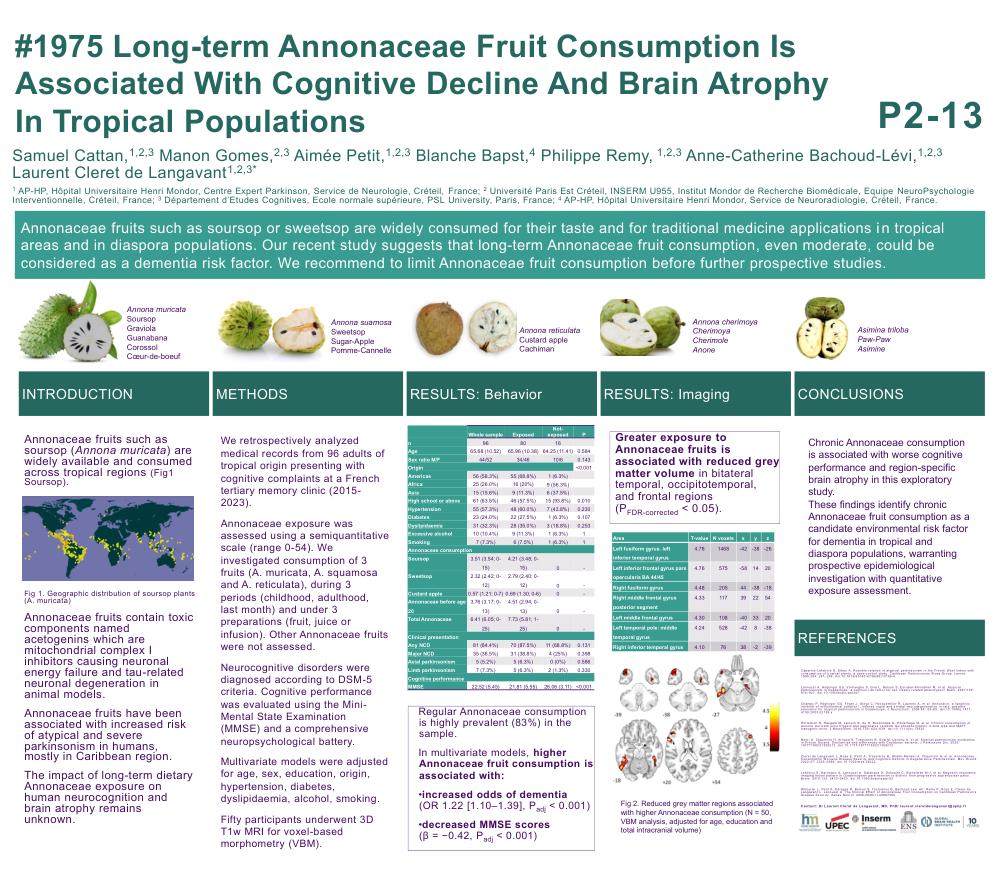
Annonaceae fruits including soursop (Annona muricata) and sugar apple (Annona squamosa) are widely consumed across tropical regions and contain acetogenins, mitochondrial complex I inhibitors causing neuronal energy failure and tau-related neurodegeneration in animal models. The potential impact of long-term dietary Annonaceae exposure on human neurocognition remains largely unknown.
Methods
We retrospectively analyzed medical records from 96 adults of tropical origin presenting with cognitive complaints at a French tertiary memory clinic (2015–2023). Dietary exposure was assessed using a semiquantitative Annonaceae Consumption Score (ACS). Cognitive performance was evaluated using the Mini-Mental State Examination (MMSE) and a comprehensive neuropsychological battery. Neurocognitive disorders were diagnosed according to DSM-5 criteria. A subsample of 50 participants underwent 3D T1-weighted MRI allowing voxel-based morphometry (VBM). Multivariate models were adjusted for confounding factors.
Results
Participants were aged 65.7 ± 10.5 years (54% female) and originated from the Americas (58.3%), Africa (26.0%), and Asia (15.6%). Regular Annonaceae consumption was highly prevalent (83%). Higher lifetime ACS was independently associated with lower MMSE scores (β = −0.42, P < 0.001) and increased odds of dementia (OR 1.22 [95% CI 1.10–1.39], P < 0.001). Greater exposure was associated with reduced grey matter volume bilaterally in temporal, occipitotemporal, and frontal regions (PFDR-corrected < 0.05).
Conclusions
Chronic Annonaceae consumption was associated with worse cognitive performance and region-specific brain atrophy in this exploratory study. These findings identify chronic Annonaceae fruit consumption as a candidate environmental risk factor for dementia in tropical and diaspora populations, warranting prospective epidemiological investigation with quantitative exposure assessment.
Comments
Email is required but is not shown publicly.
Loading comments...