4,068 posters, 219 videos, 101 topics, 69 sessions, 14,365 authors, 6,128 institutions
ePostersLive by SciGen Technologies S.A. All rights reserved.
Alzheimer's Association International Conference 2026
July 12-15, 2026 | London, United Kingdom, and Online

10292
Greater Alzheimer’s Disease Risk Associated With Culture Of Honor Norm Endorsement Among U.S. Adults
Poster Presenter
Authors
Affiliations
Part of Topic
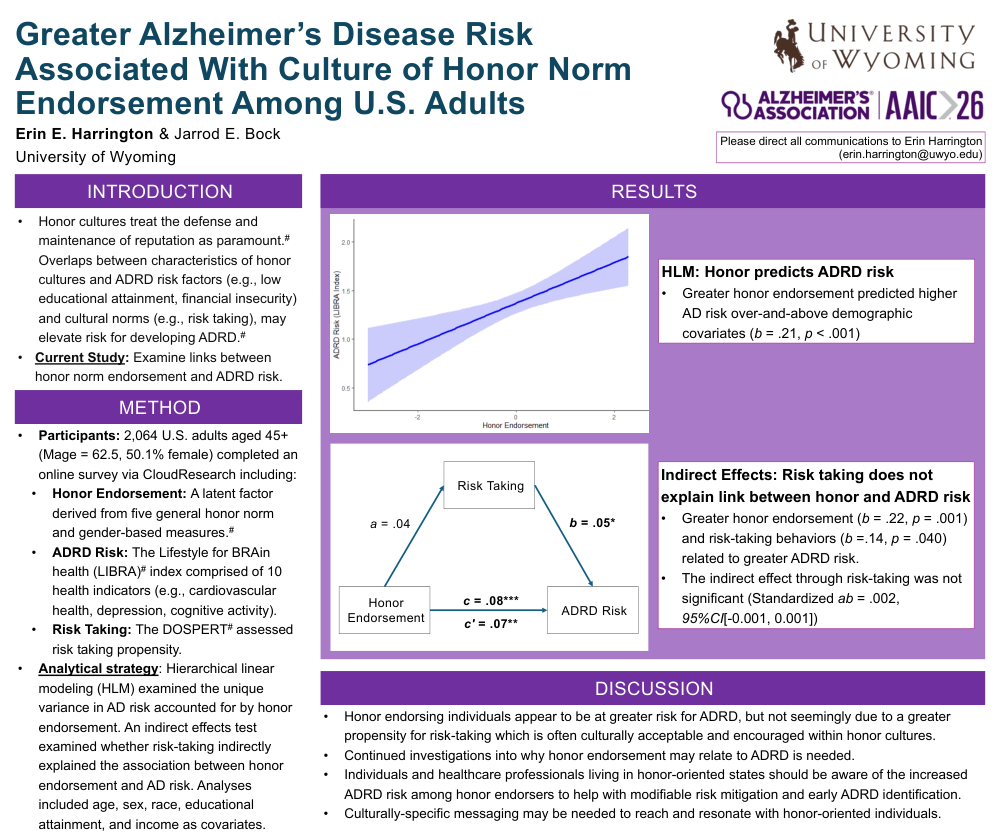
Background: Interest in cultural risk factors for Alzheimer’s disease (AD) is growing. And yet, the prominent culture of honor (i.e., cultural emphasis on defense and maintenance of one’s reputation) has been largely neglected. Recent work suggests that individuals who more strongly endorse honor culture norms are less knowledgeable about AD and state-level examinations suggest that more honor-oriented U.S. states exhibit higher AD death rates. However, AD risk has yet to be examined at an individual level and mechanisms that may help explain the possible link between honor and AD risk (e.g., greater risk-taking behaviors) require examination. We examined the association between U.S. adults’ honor culture endorsement and AD risk, as well as the indirect link between these factors through risk-taking.
Method: We sampled 2,064 U.S. adults (Mage = 62.47; 50.1% female) via CloudResearch. We assessed AD risk using the Lifestyle for Brain Health (LIBRA) index (Decker et al., 2014), by combining 10 modifiable lifestyle and health factors (e.g., cardiovascular health, depression, cognitive activity) into a single risk score. A latent honor endorsement factor was derived from five gender-based and general honor norm measures (Bock et al., 2024; IJzerman et al., 2007). Finally, the DOSPERT (Weber et al., 2002) assessed risk-taking. Hierarchical linear modeling (HLM) examined the unique variance in AD risk accounted for by honor endorsement over-and-above demographic covariates (i.e., age, sex, educational attainment, income). An indirect effects test examined whether risk-taking indirectly explained the association between honor endorsement and AD risk.
Results: Greater honor endorsement predicted higher AD risk over-and-above demographic covariates (b = .21, p<.001). The indirect effects test revealed a significant direct effect between honor endorsement and AD risk (b = .22, p<.001), but the indirect effect through risk-taking was not significant.
Conclusion: This study advances our understanding of AD risk and suggests that greater honor endorsement relates to higher AD risk. Contrary to hypotheses, this link was not indirectly explained through risk-taking. Findings highlight a need for developing culturally relevant education and intervention efforts to help reduce AD risk and continued research into mechanisms through which honor endorsement may relate to AD risk.
Comments
Email is required but is not shown publicly.
Loading comments...