4,068 posters, 219 videos, 101 topics, 69 sessions, 14,365 authors, 6,128 institutions
ePostersLive by SciGen Technologies S.A. All rights reserved.
Alzheimer's Association International Conference 2026
July 12-15, 2026 | London, United Kingdom, and Online

2826
InLife: Harmonizing Cognitive Tests Of Episodic Memory And Executive Function Across Randomized Controlled Trials
Poster Presenter
Authors
Nathan Ryder, Nathan Tintle, Christian Corral, Jason Westra, Martha Koenig, Heather Hrynyk, Laura Baker, Zoe Arvanitakis, Alden Gross, Shannon Halloway
Affiliations
Johns Hopkins Bloomberg School of Public Health, College of Nursing, University of Illinois Chicago, Health and Kinesiology, University of Illinois Urbana-Champaign, School of Public Health, University of Illinois Chicago, School of Medicine, Wake Forest University, Rush Alzheimer’s Disease Center, Rush University
Part of Topic
InLife Study
Pool and harmonize participant-level data from
U.S. randomized controlled trials with lifestyle
behavior interventions promoting:
Physical, cognitive, social activities, and/or healthy diet
Aimed at improving long term cognition in older adults
The InLife Study aims to quantify the impact of changes in lifestyle health behaviors on cognitive outcomes, including:
Episodic Memory – ability to encode and store, then consciously retrieve information about specific events at particular times and/or places
Executive Function – conceptualized as having four components: volition, planning, purposive action, and effective performance
Methods
Group of experts in cognitive aging, psychology, statistics, and psychometrics meeting regularly since 2025
Collecting, categorizing, and combining cognitive tests across trials with a harmonization process (see middle column →) that:
Is reproducible — well-documented steps with decisions tracked and approved as a group
Preserves the relationships between cognition and lifestyle that will be the subject of future analyses
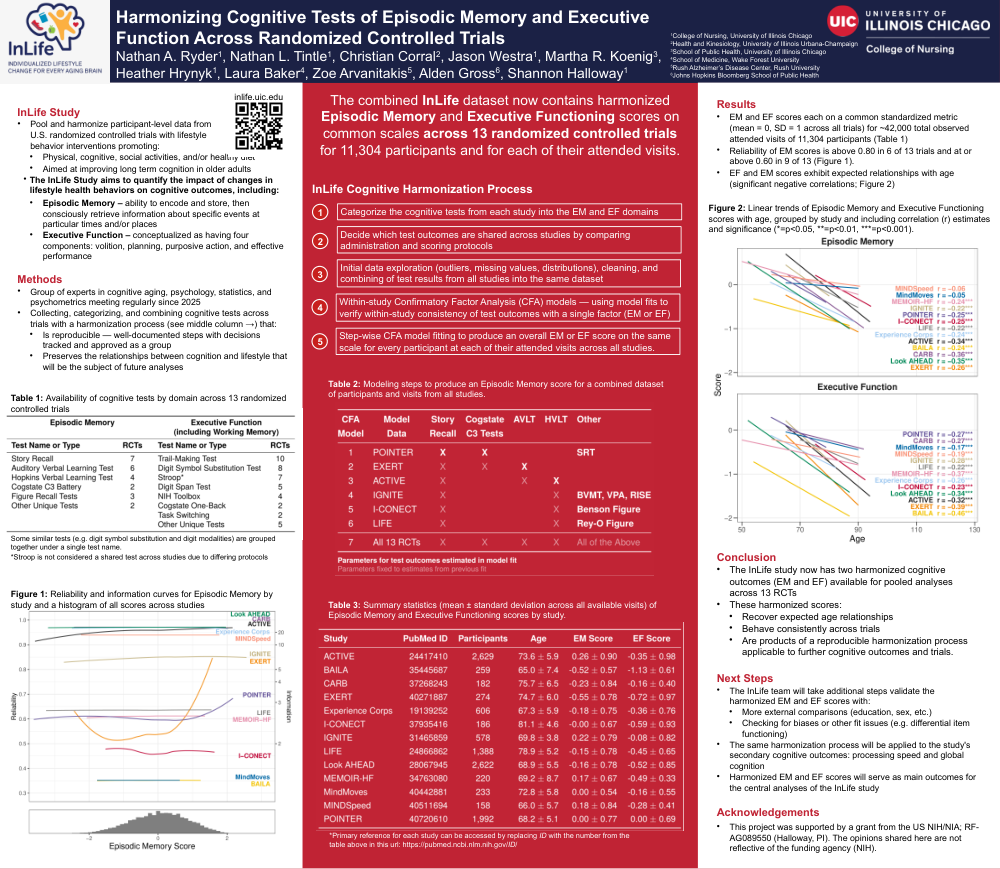
The combined InLife dataset now contains harmonized Episodic Memory and Executive Functioning scores on common scales across 13 randomized controlled trials for 11,304 participants and for each of their attended visits.
InLife Cognitive Harmonization Process
1 Categorize the cognitive tests from each study into the EM and EF domains
2 Decide which test outcomes are shared across studies by comparing administration and scoring protocols
3 Initial data exploration (outliers, missing values, distributions), cleaning, and combining of test results from all studies into the same dataset
4 Within-study Confirmatory Factor Analysis (CFA) models — using model fits to verify within-study consistency of test outcomes with a single factor (EM or EF)
5 Step-wise CFA model fitting to produce an overall EM or EF score on the same scale for every participant at each of their attended visits across all studies.
Results
EM and EF scores each on a common standardized metric (mean = 0, SD = 1 across all trials) for ~42,000 total observed attended visits of 11,304 participants (Table 1)
Reliability of EM scores is above 0.80 in 6 of 13 trials and at or above 0.60 in 9 of 13 (Figure 1).
EF and EM scores exhibit expected relationships with age (significant negative correlations; Figure 2)
Conclusion
The InLife study now has two harmonized cognitive outcomes (EM and EF) available for pooled analyses across 13 RCTs
These harmonized scores:
Recover expected age relationships
Behave consistently across trials
Are products of a reproducible harmonization process applicable to further cognitive outcomes and trials.
Next Steps
The InLife team will take additional steps validate the harmonized EM and EF scores with:
More external comparisons (education, sex, etc.)
Checking for biases or other fit issues (e.g. differential item functioning)
The same harmonization process will be applied to the study's secondary cognitive outcomes: processing speed and global cognition
Harmonized EM and EF scores will serve as main outcomes for the central analyses of the InLife study
Acknowledgements
This project was supported by a grant from the US NIH/NIA; RF-AG089550 (Halloway, PI). The opinions shared here are not reflective of the funding agency (NIH).
Comments
Email is required but is not shown publicly.
Loading comments...