4,068 posters, 219 videos, 101 topics, 69 sessions, 14,365 authors, 6,128 institutions
ePostersLive by SciGen Technologies S.A. All rights reserved.
Alzheimer's Association International Conference 2026
July 12-15, 2026 | London, United Kingdom, and Online

10598
Pre-intervention Baseline Assessment Of Cognitive Function: Initial Analysis In The Latam FINGERS Project Using Brainhq.
Poster Presenter
Authors
Maria Eugenia Martin, Monica Yassuda Sánchez, Natalia Acosta Baena, Ricardo Francisco Allegri, David Aguillon, Isamel Calandri, Paulo Caramelli, Nicolás Corvalán, Diego Fernández Slezak, Ricardo Nitrini, Rosa Maria Salinas-Contreras, Gustavo Sevlever, Ana Luisa Sosa, Claudia K Suemoto, Lucia Crivelli
Affiliations
Fleni, Buenos Aires, Argentina,, Neuroscience Group of Antioquia, Facultad de Medicina, Universidad de Antioquia, Medellin, Colombia, Cognitive and BehavioralNeurology Unit, Department of Neurology, University of São Paulo School of Medicine, São Paulo, Brazil, Neuroscience Group of Antioquia, Facultad de Medicina, Universidad de Antioquia, Medellin, Colombia,, Behavioral and Cognitive Neurology Unit, Faculdade de Medicina, UniversidadeFederal de Minas Gerais,, Belo Horizonte, Brazil, Departamento de Computación, Facultad de Ciencias Exactas y Naturales, Universidad de Buenos Aires Buenos Aires, Buenos Aires, Argentina,, Laboratorio de Demencias del Instituto Nacional de Neurología y Neurocirugía Manuel Velasco Suárez,, Ciudad deMéxico, Mexico,, Fleni, Buenos Aires, Argentina, Laboratorio de Demencias del Instituto Nacional de Neurología y Neurocirugía Manuel Velasco Suárez,, Ciudad de Mexico, Mexico,, Division of Geriatrics, University of São Paulo Medical School, SãoPaulo, Brazil,
Part of Topic
BackgroundThe LatAm FINGERS project aims to promote lifestyle changes for dementia prevention through a two-year multidomain non-pharmacological intervention across Latin America including 11 countries in theregion. Prior to the intervention, participants were assessed using BrainHQ, a digital cognitive platform with adaptive exercises, and the LatAm Neuropsychological Test Battery (LatAm-NTB) to establish baseline cognitiveperformance and examine coherence between digital and traditional measures.
ObjectivesTo examine the relationship between age and education and BrainHQ performance, and to evaluate the convergent validity between BrainHQ and LatAm-NTB cognitive composites.
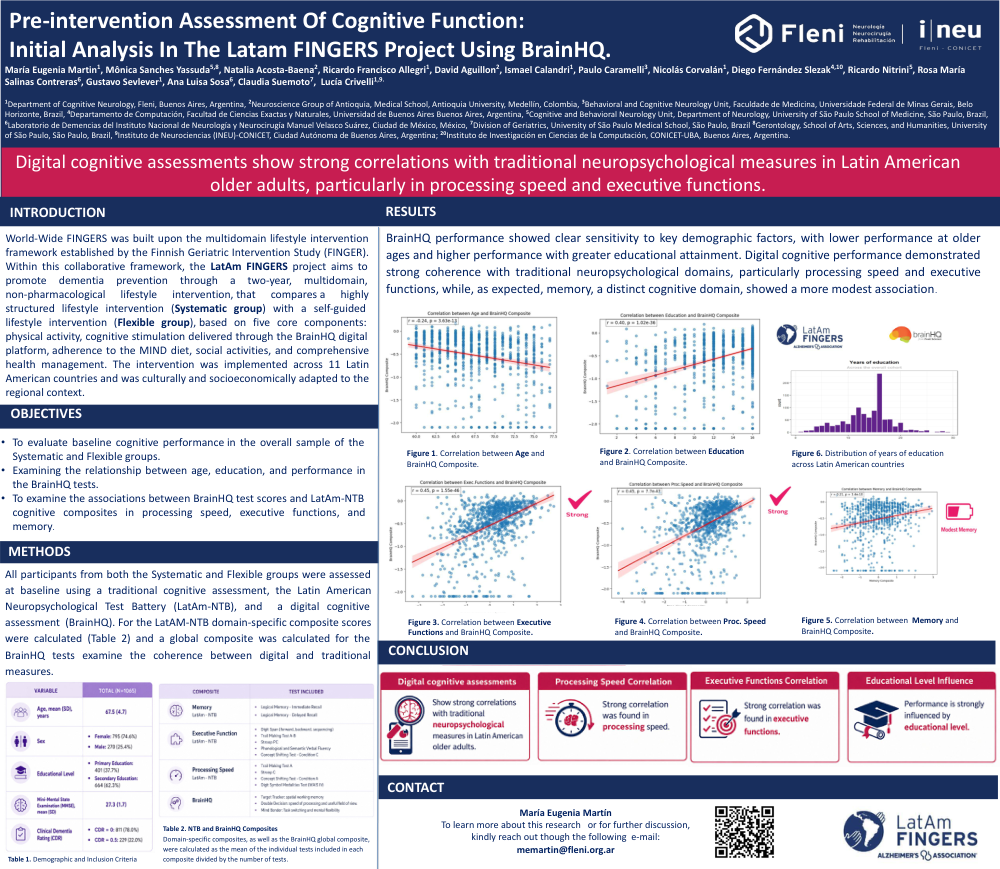
MethodsThe total sample included 1,099 participants: 74.7% were women. The mean age was 67.4 years (SD=4.7). The average number of years of education was 13.5 (SD=4.6). Regarding global cognitive/functionalstatus, 69.8% of participants had a Clinical Dementia Rating (CDR) of 0 and 30.2% had a CDR of 0.5. The mean Mini-Mental State Examination (MMSE) score was 27.3 (SD=1.7). A BrainHQ composite was calculated as themean of z-scores from three digital tasks (Double Decision, Mind Bender, Target Tracker). LatAm-NTB composites were computed for Memory (Logical Memory Immediate Recall, Logical Memory Delayed Recall),Executive Functions (Digit Span Forward, Backward and Sequencing, Trail Making Test A-B, Stroop, Phonological and Semantic Verbal Fluency, Concept Shifting Test - Condition C), and Processing Speed (Trail Making TestA, Stroop C, Concept Shifting Test - Condition A, Digit SymbolTest-WAIS IV). Pearson correlations were calculated.
ResultsBrainHQ performance was negatively associated with age (r = -0.24, p < 0.001) and positively associated with education (r = 0.40, p < 0.001). Strong correlations were observed between the BrainHQ composite andProcessing Speed (r = 0.45, p < 0.001) and Executive Functions (r = 0.45, p < 0.001). A weaker but significant association was found with Memory (r = 0.21, p < 0.001).
ConclusionBrainHQ performance is significantly related to age, education, and core cognitive domains assessed by the LatAm-NTB, particularly processing speed and executive functions, with a more modestly withepisodic memory. These findings support the validity of using digital platforms such as BrainHQ for assessing cognitive functioning in Latin-American older adults, providing initial evidence of coherence betweentraditional and digital cognitive measures.
Comments
Email is required but is not shown publicly.
Loading comments...