4,068 posters, 219 videos, 101 topics, 69 sessions, 14,365 authors, 6,128 institutions
ePostersLive by SciGen Technologies S.A. All rights reserved.
Alzheimer's Association International Conference 2026
July 12-15, 2026 | London, United Kingdom, and Online

10829
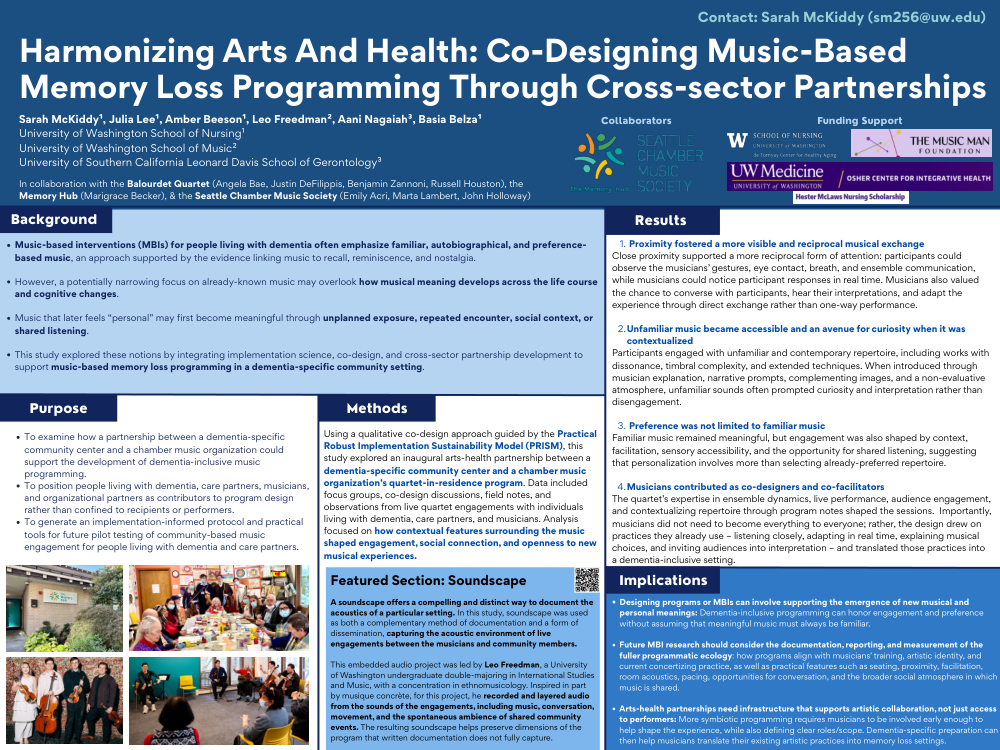
Harmonizing Arts And Health: Co-designing Music-based Memory Loss Programming Through Cross-sector Partnerships
Poster Presenter
Part of Topic
Harmonizing Arts And Health: Co-Designing Music-Based Memory Loss Programming Through Cross-sector Partnerships
Authors / Affiliations
Sarah McKiddy¹, Julia Lee¹, Amber Beeson¹, Leo Freedman², Basia Belza¹
University of Washington School of Nursing¹
University of Washington School of Music²
In collaboration with the Balourdet Quartet (Angela Bae, Justin DeFilippis, Benjamin Zannoni, Russell Houston), the Memory Hub (Marigrace Becker), & the Seattle Chamber Music Society (Emily Acri, Marta Lambert, John Holloway)
Background
Music-based interventions (MBIs) for people living with dementia often emphasize familiar, autobiographical, and preference-based music, an approach supported by the evidence linking music to recall, reminiscence, and nostalgia.
However, a potentially narrowing focus on already-known music may overlook how musical meaning develops across the life course and cognitive changes.
Music that later feels “personal” may first become meaningful through unplanned exposure, repeated encounter, social context, or shared listening.
This study explored these notions by integrating implementation science, co-design, and cross-sector partnership development to support music-based memory loss programming in a dementia-specific community setting.
Purpose
To examine how a partnership between a dementia-specific community center and a chamber music organization could support the development of dementia-inclusive music programming.
To position people living with dementia, care partners, musicians, and organizational partners as contributors to program design rather than confined to recipients or performers.
To generate an implementation-informed protocol and practical tools for future pilot testing of community-based music engagement for people living with dementia and care partners.
Methods
Using a qualitative co-design approach guided by the Practical Robust Implementation Sustainability Model (PRISM), this study explored an inaugural arts-health partnership between a dementia-specific community center and a chamber music organization’s quartet-in-residence program. Data included focus groups, co-design discussions, field notes, and observations from live quartet engagements with individuals living with dementia, care partners, and musicians. Analysis focused on how contextual features surrounding the music shaped engagement, social connection, and openness to new musical experiences.
Results
- Proximity fostered a more visible and reciprocal musical exchange
Close proximity supported a more reciprocal form of attention: participants could observe the musicians’ gestures, eye contact, breath, and ensemble communication, while musicians could notice participant responses in real time. Musicians also valued the chance to converse with participants, hear their interpretations, and adapt the experience through direct exchange rather than one-way performance.
- Unfamiliar music became accessible and an avenue for curiosity when it was contextualized
Participants engaged with unfamiliar and contemporary repertoire, including works with dissonance, timbral complexity, and extended techniques. When introduced through musician explanation, narrative prompts, complementing images, and a non-evaluative atmosphere, unfamiliar sounds often prompted curiosity and interpretation rather than disengagement.
- Preference was not limited to familiar music
Familiar music remained meaningful, but engagement was also shaped by context, facilitation, sensory accessibility, and the opportunity for shared listening, suggesting that personalization involves more than selecting already-preferred repertoire.
- Musicians contributed as co-designers and co-facilitators
The quartet’s expertise in ensemble dynamics, live performance, audience engagement, and contextualizing repertoire through program notes shaped the sessions. Importantly, musicians did not need to become everything to everyone; rather, the design drew on practices they already use – listening closely, adapting in real time, explaining musical choices, and inviting audiences into interpretation – and translated those practices into a dementia-inclusive setting.
Implications
Designing programs or MBIs can involve supporting the emergence of new musical and personal meanings: Dementia-inclusive programming can honor engagement and preference without assuming that meaningful music must always be familiar.
Future MBI research should consider the documentation, reporting, and measurement of the fuller programmatic ecology: how programs align with musicians’ training, artistic identity, and current concertizing practice, as well as practical features such as seating, proximity, facilitation, room acoustics, pacing, opportunities for conversation, and the broader social atmosphere in which music is shared.
Arts-health partnerships need infrastructure that supports artistic collaboration, not just access to performers: More symbiotic programming requires musicians to be involved early enough to help shape the experience, while also defining clear roles/scope. Dementia-specific preparation can then help musicians translate their existing artistic practices into memory loss settings.
Featured Section: Soundscape
A soundscape offers a compelling and distinct way to document the acoustics of a particular setting. In this study, soundscape was used as both a complementary method of documentation and a form of dissemination, capturing the acoustic environment of live engagements between the musicians and community members.
This embedded audio project was led by Leo Freedman, a University of Washington undergraduate double-majoring in International Studies and Music, with a concentration in ethnomusicology. Inspired in part by musique concrète, for this project, he recorded and layered audio from the sounds of the engagements, including music, conversation, movement, and the spontaneous ambience of shared community events. The resulting soundscape helps preserve dimensions of the program that written documentation does not fully capture.
Comments
Email is required but is not shown publicly.
Loading comments...