4,068 posters, 219 videos, 101 topics, 69 sessions, 14,365 authors, 6,128 institutions
ePostersLive by SciGen Technologies S.A. All rights reserved.
Alzheimer's Association International Conference 2026
July 12-15, 2026 | London, United Kingdom, and Online

4076
Cerebrospinal Fluid Level Of Ykl-40 As A Biomarker For The Diagnosis Of Alzheimer’S Disease: A Systematic Review And Meta-analysis
Part of Topic
Cerebrospinal Fluid Level of YKL-40 as a Biomarker for the Diagnosis of Alzheimer’s Disease: A Systematic Review and Meta-analysis
Abstract
Background
At present, the diagnosis of Alzheimer’s disease (AD) mainly focuses on imaging examinations and the detection of cerebrospinal fluid (CSF) markers. However, the high cost and inability to be widely available in clinical practice greatly hinder its feasibility. To improve the diagnosis and delay the process of AD, the development of biomarkers capable of detecting the early stages is of particular importance. YKL-40, also known as CHI3L1 (chitinase-3-like protein-1), may represent a novel and suitable biomarker with diagnostic utility for AD. Numerous studies aimed at assessing YKL-40 levels in AD have ended up with conflicting conclusions. We carried out a comprehensive meta-analysis to explore differences in YKL-40 levels in CSF between AD and healthy control subjects (HCs).
Method
In this systematic review and meta-analysis, we screened PubMed, Embase, Google Scholar, Scopus, and Web of Science for articles until December 2025 about comparing CSF YKL-40 levels between AD patients and HCs. Data were extracted and checked by two authors for accuracy. Between-studies heterogeneity was assessed using the I² statistic. Summary standardized mean difference (SMD) and 95% confidence interval (CI) in the CSF YKL-40 level were calculated using random effects models using RevMan version 5.4.
Result
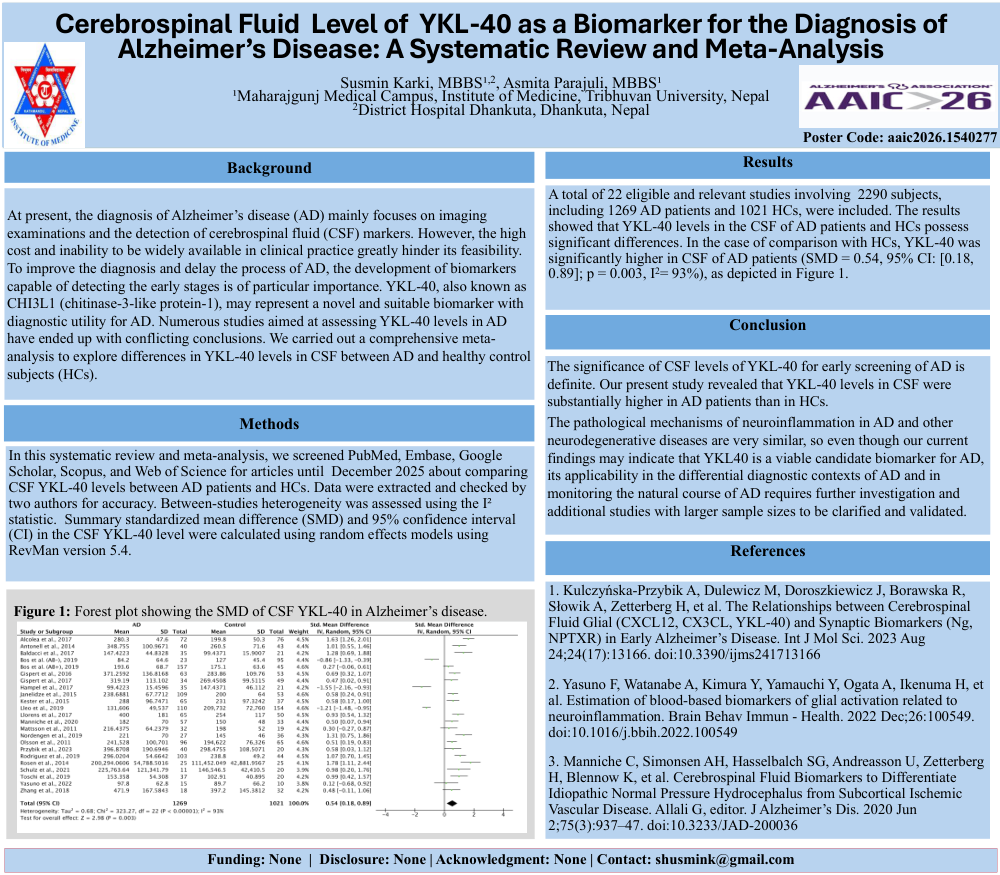
A total of 22 eligible and relevant studies involving 2290 subjects, including 1269 AD patients and 1021 HCs, were included. The results showed that YKL-40 levels in the CSF of AD patients and HCs possess significant differences. In the case of comparison with HCs, YKL-40 was significantly higher in CSF of AD patients (SMD = 0.54, 95% CI: [0.18, 0.89]; p = 0.003, I2= 93%), as depicted in Figure 1.
Conclusion
The significance of CSF levels of YKL-40 for early screening of AD is definite. Our present study revealed that YKL-40 levels in CSF were substantially higher in AD patients than in HCs.
The pathological mechanisms of neuroinflammation in AD and other neurodegenerative diseases are very similar, so even though our current findings may indicate that YKL40 is a viable candidate biomarker for AD, its applicability in the differential diagnostic contexts of AD and in monitoring the natural course of AD requires further investigation and additional studies with larger sample sizes to be clarified and validated.
Comments
Email is required but is not shown publicly.
Loading comments...