4,068 posters, 219 videos, 101 topics, 69 sessions, 14,365 authors, 6,128 institutions
ePostersLive by SciGen Technologies S.A. All rights reserved.
Alzheimer's Association International Conference 2026
July 12-15, 2026 | London, United Kingdom, and Online

2176
Longitudinal Associations Of Amyloid-β And Tau With Worry But Not Somatic Anxiety In Cognitively Unimpaired Older Adults
Poster Presenter
Authors
Affiliations
Departments of Psychiatry and Neurology, Mass General Brigham
Part of Topic
Background:
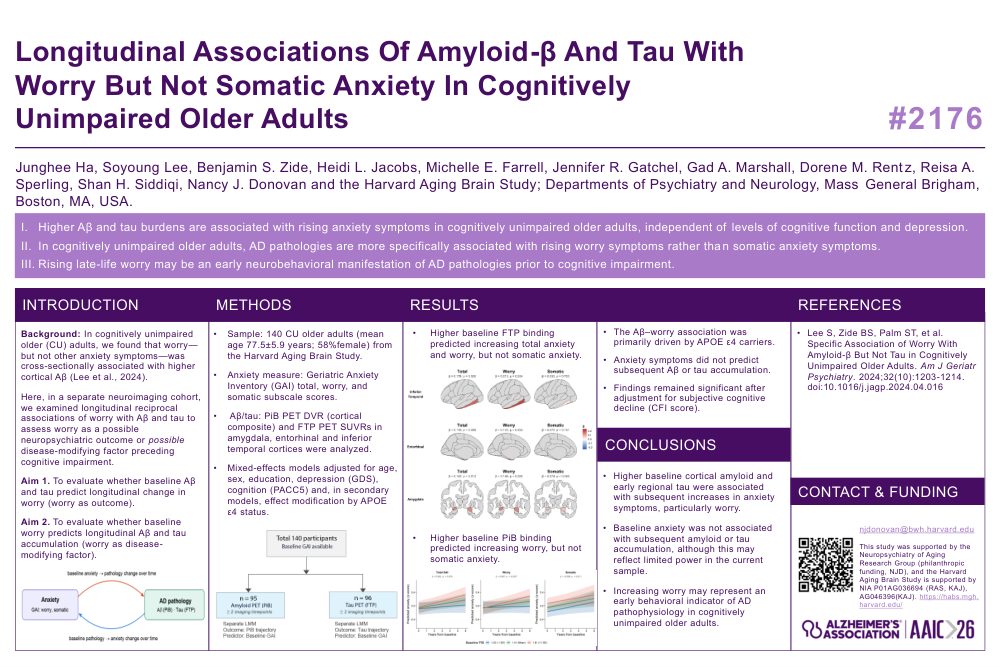
We previously reported a specific cross-sectional association of worry with higher in vivo cortical amyloid-β (Aβ) burden in cognitively unimpaired (CU) older adults. Using longitudinal data from aseparate neuroimaging cohort, we investigate reciprocal associations of Aβ and tau pathologies withanxiety symptoms—particularly worry—over time, to further examine worry as a neuropsychiatric outcomeor possible disease-modifying factor prior to cognitive impairment.
Methods:
CU older adults (n=140; mean age 77.5; 58% female) from the Harvard Aging Brain Studyunderwent assessments of anxiety (Geriatric Anxiety Inventory; GAI), objective cognition (PreclinicalAlzheimer’s Cognitive Composite; PACC5) and depression (Geriatric Depression Scale; GDS). GAI subscalescores for worry and somatic symptoms were derived from factor analysis of the sample. Aβ burden wasquantified using [¹¹C]-Pittsburgh compound-B (PiB) PET and regional tau with flortaucipir (FTP) PET inamygdala, entorhinal and inferior temporal cortices. Separate, longitudinal linear mixed-effects modelsestimated bidirectional associations of baseline PiB or FTP uptake with GAI scores over time (mean 5.6years) and, reciprocally, baseline GAI and its subscale scores with PET uptake over time among participantswith at least 2 serial PET acquisitions. Models adjusted for age, sex, education, PACC5, and GDS interactingwith time.
Results:
Baseline PiB binding was marginally associated with increasing total GAI scores over time (β= 0.05,p=0.08), positively associated with increasing worry subscale scores (β=0.07, p=0.02) and not associatedwith somatic subscale scores (β=-0.008, p=0.81). Baseline FTP binding in the amygdala, entorhinal cortex,and inferior temporal cortex was each positively associated with total GAI over time (β: 0.12-0.18, p<0.05)as well as worry over time (β: 0.12-0.21, p<0.01), but not with the somatic scores (β: 0.03-0.07, p>0.15).Reciprocally, baseline total GAI and subscale scores were not associated with changes in PiB or regionalFTP binding. Findings remained, adjusting for self-reported subjective cognitive decline.
Conclusion:
In CU older adults, greater Aβ and regional tau were associated with rising worry-relatedanxiety, whereas baseline worry itself was not associated with subsequent Aβ or tau accumulation in asmaller subsample. Increasing worry may be a specific signal of AD pathology in older adults prior tocognitive impairment.
Comments
Email is required but is not shown publicly.
Loading comments...