4,068 posters, 219 videos, 101 topics, 69 sessions, 14,365 authors, 6,128 institutions
ePostersLive by SciGen Technologies S.A. All rights reserved.
Alzheimer's Association International Conference 2026
July 12-15, 2026 | London, United Kingdom, and Online

9103
Evaluation Of The Clinical Impact Of Blood-based Biomarker Assays On Dementia Specialists' Decision-making (CIMBBBA)
Poster Presenter
Authors
Mark Eldaief, Sam Murdock, Erin Krahn, Neguine Rezaii, Diane Chan, Steven Arnold, Marina Avetisyan, John Dickson, Mark Albers, Anna Goodheart, Matthew Walsh, Sophal Lam, Yedda Li, Liliana Ramirez Gomez, Seth Gale, Scott McGinnis, Bradford Dickerson
Affiliations
Frontotemporal Disorders Unit, Department of Neurology, Massachusetts General Hospital and Harvard Medical School, Boston, MA 02114, Memory Disorders Unit, Department of Neurology, Massachusetts General Hospital and Harvard Medical School, Boston, MA 02114, Center for Brain Mind Medicine, Department of Neurology, Brigham & Women’s Hospital and Harvard Medical School, Boston, MA 02115
Part of Topic
Introduction
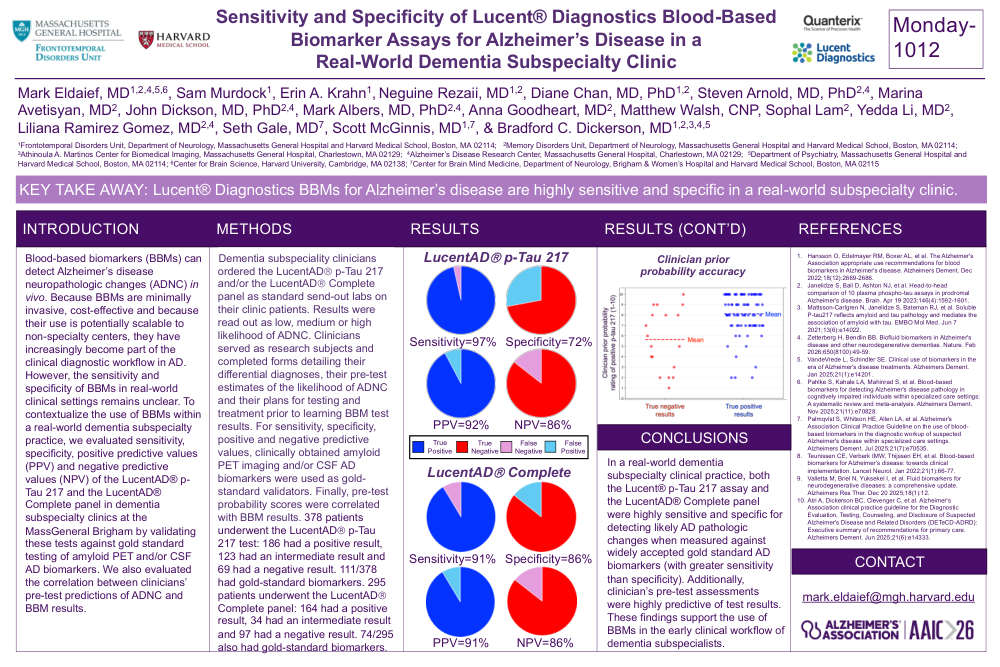
Blood-based biomarkers (BBMs) can detect Alzheimer’s disease neuropathologic changes (ADNC) in vivo. Because BBMs are minimally invasive, cost-effective and because their use is potentially scalable to non-specialty centers, they have increasingly become part of the clinical diagnostic workflow in AD. However, the sensitivity and specificity of BBMs in real-world clinical settings remains unclear. To contextualize the use of BBMs within a real-world dementia subspecialty practice, we evaluated sensitivity, specificity, positive predictive values (PPV) and negative predictive values (NPV) of the LucentAD® p-Tau 217 and the LucentAD® Complete panel in dementia subspecialty clinics at the MassGeneral Brigham by validating these tests against gold standard testing of amyloid PET and/or CSF AD biomarkers. We also evaluated the correlation between clinicians’ pre-test predictions of ADNC and BBM results.
Methods
Dementia subspeciality clinicians ordered the LucentADâ p-Tau 217 and/or the LucentADâ Complete panel as standard send-out labs on their clinic patients. Results were read out as low, medium or high likelihood of ADNC. Clinicians served as research subjects and completed forms detailing their differential diagnoses, their pre-test estimates of the likelihood of ADNC and their plans for testing and treatment prior to learning BBM test results. For sensitivity, specificity, positive and negative predictive values, clinically obtained amyloid PET imaging and/or CSF AD biomarkers were used as gold-standard validators. Finally, pre-test probability scores were correlated with BBM results. 378 patients underwent the LucentADâ p-Tau 217 test: 186 had a positive result, 123 had an intermediate result and 69 had a negative result. 111/378 had gold-standard biomarkers. 295 patients underwent the LucentADâ Complete panel: 164 had a positive result, 34 had an intermediate result and 97 had a negative result. 74/295 also had gold-standard biomarkers.
Results
The LucentAD p-Tau 217 test had a sensitivity of 97%, a specificity of 72%, a PPV of 92% and a NPV of 86%.
The LucentAD Complete test had a sensitivity of 91%, a specificity of 86%, a PPV of 91% and a NPV of 86%.
Clinician's prior probability of a positive test result was high.
Conclusions
In a real-world dementia subspecialty clinical practice, both the Lucent® p-Tau 217 assay and the LucentAD® Complete panel were highly sensitive and specific for detecting likely AD pathologic changes when measured against widely accepted gold standard AD biomarkers (with greater sensitivity than specificity). Additionally, clinician’s pre-test assessments were highly predictive of test results. These findings support the use of BBMs in the early clinical workflow of dementia subspecialists.
Comments
Email is required but is not shown publicly.
Loading comments...