Loading...

4,068 posters, 219 videos, 101 topics, 69 sessions, 14,365 authors, 6,128 institutions

ePostersLive by SciGen Technologies S.A. All rights reserved.

Alzheimer's Association International Conference 2026

July 12-15, 2026 | London, United Kingdom, and Online

Alzheimer's Association International Conference 2026 banner

10606

Evaluating The Feasibility And Efficacy Of The Memory Support System In A Canadian Memory Clinic And Geriatric Day Hospital.
Part of Topic

Background: Individuals with mild cognitive impairment (MCI) may have difficulty maintaining independence in their instrumental activities of daily living (IADLs). The Memory Support System (MSS) is a curriculum and calendar/note-taking system that aids individuals with MCI in maintaining their independence in IADLs. It is part of the Mayo Clinic Healthy Action to Benefit Independence & Thinking (HABIT) Program.

Objective: Determine the feasibility and efficacy of providing the MSS in a Canadian centre.

Methods: 

•Individuals with MCI and their study partner were trained to use the MSS.
•The MSS was administered in 10 sessions over the course of ~4-6 weeks.
•Recruitment is ongoing with a target of 20 participant-partner dyads.
•At baseline, treatment end, and 2-month follow-up sessions, the following outcome measures are assessed:
 
MSS adherence scale
Chronic Disease Self-Efficacy Scale
Depression (CES-D)
Anxiety (Stait-Trait Inventory)
Caregiver burden (ZBI-12)
Quality of Life (QOL-AD)
Cognitively mediated functioning (E-Cog)
IADLs (FAQ)
•Effect Sizes (Cohen’s d value) were calculated for treatment end and 2-month follow up sessions.
 
Results: 

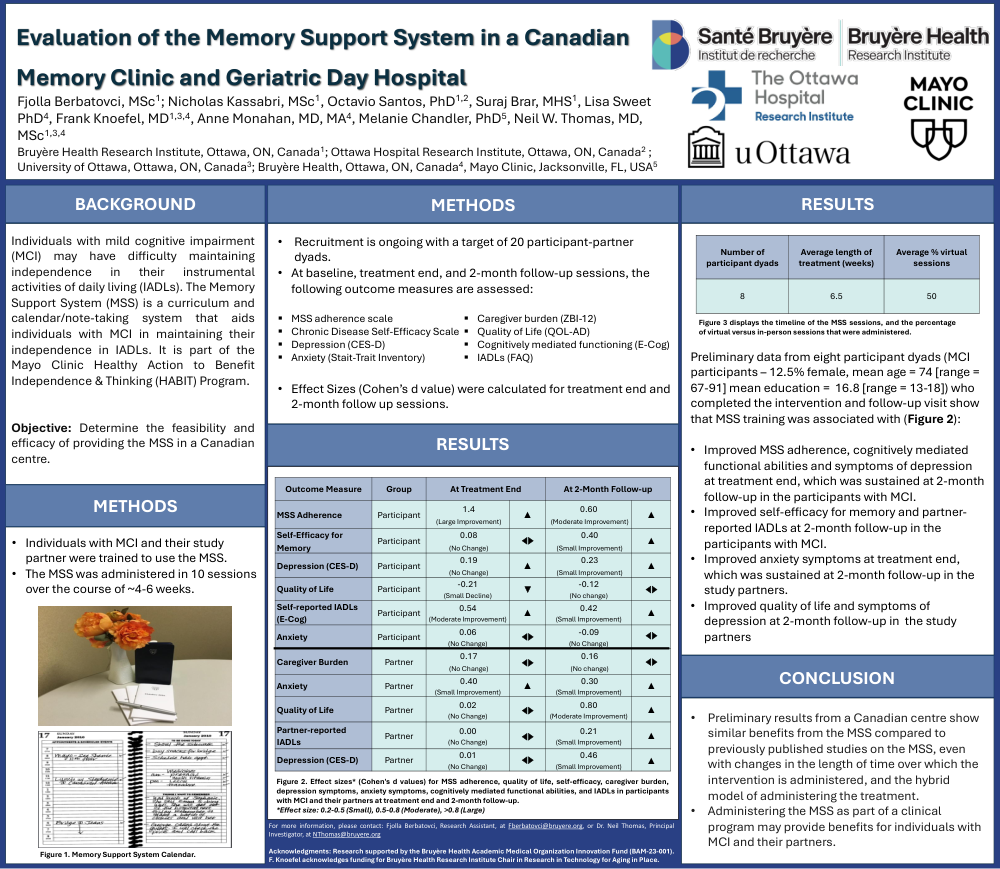
Preliminary data from eight participant dyads (MCI participants – 12.5% female, mean age = 74 [range = 67-91] mean education =  16.8 [range = 13-18]) who completed the intervention and follow-up visit show that MSS training was associated with (Figure 2):

•Improved MSS adherence, cognitively mediated functional abilities and symptoms of depression at treatment end, which was sustained at 2-month follow-up in the participants with MCI.

•Improved self-efficacy for memory and partner-reported IADLs at 2-month follow-up in the participants with MCI.
•Improved anxiety symptoms at treatment end, which was sustained at 2-month follow-up in the study partners.
•Improved quality of life and symptoms of depression at 2-month follow-up in  the study partners
 
Conclusions: 
•Preliminary results from a Canadian centre show similar benefits from the MSS compared to previously published studies on the MSS, even with changes in the length of time over which the intervention is administered, and the hybrid model of administering the treatment.
•Administering the MSS as part of a clinical program may provide benefits for individuals with MCI and their partners.

Comments

Email is required but is not shown publicly.

Loading comments...

aaic2026 banner
Copyright © 2015-2026, ePostersLive® SciGen is a registered trademark of SciGen Technologies S.A. Patent pending.

This website and third-party tools we use rely on cookies for the best user experience. By selecting "I agree", you agree to cookie usage as described in our Privacy Policy.