4,068 posters, 219 videos, 101 topics, 69 sessions, 14,365 authors, 6,128 institutions
ePostersLive by SciGen Technologies S.A. All rights reserved.
Alzheimer's Association International Conference 2026
July 12-15, 2026 | London, United Kingdom, and Online

5563
Cognitive Resilience And Risk In Dementia Caregivers: Stress, Lifestyle, Sleep Disruptions, And Race/Ethnicity.
Poster Presenter
Authors
Affiliations
Part of Topic
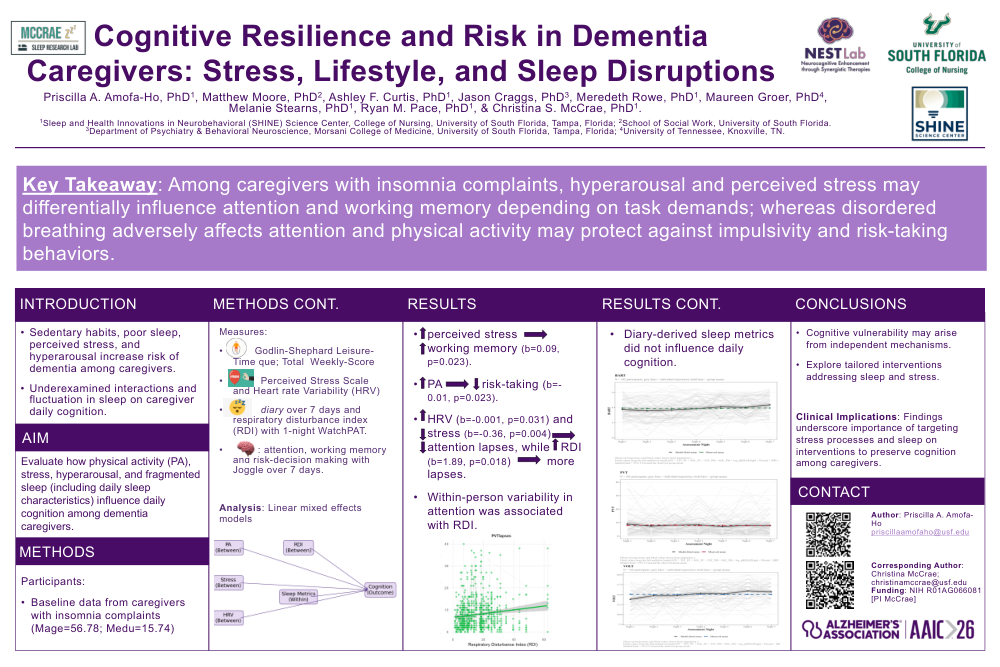
Title: Cognitive Resilience and Risk in Dementia Caregivers: Stress, Lifestyle, Sleep Disruptions, and Race/Ethnicity.
Authors: Priscilla A. Amofa-Ho, PhD1, Matthew Moore, PhD2, Ashley Curtis, PhD1, Jason Craggs, PhD3, Meredeth Rowe, PhD1, Maureen Groer, PhD4, Melanie Stearns, PhD1, Ryan Pace, PhD1, & Christina S. McCrae, PhD1.
Author’s Affiliation: 1Sleep and Health Innovations in Neurobehavioral (SHINE) Science Center, College of Nursing, University of South Florida, Tampa, Florida; 2School of Social Work, University of South Florida. 3Department of Psychiatry & Behavioral Neuroscience, Morsani College of Medicine, University of South Florida, Tampa, Florida; 4University of Tennessee, Knoxville, TN.
Background: Dementia caregivers (CGs) face higher risks of cardiometabolic diseases, sedentary habits, poor sleep, chronic stress, and hyperarousal—risk factors for cognitive decline. These risks are even greater among ethnic minority CGs. Sleep disruptions from apneas, hypopneas, and respiratory effort-related arousals (captured by the Respiratory Disturbance Index-RDI) affect cardiometabolic disease prevalence and development. The 2025 Alzheimer’s Disease Facts and Figures recognize sleep, sedentary lifestyles, and stress as risk factors. While their individual impacts on cognition are well established, the interactive relationships—especially among CGs—are less understood, particularly how fragmented and total sleep affect daily cognitive functioning.
Methods: CGs (N=102; Mage=56.8, F=86.8%, 11.76% Blacks, 15.69% Hispanics) with insomnia in an RCT (R01AG066081, NCT04896775) reported baseline physical activity (PA, Godin-Shephard Leisure-Time Total-Weekly-Score) and physiological (Heart Rate Variability-HRV) and perceived (Perceived Stress Scale-PSS) stress. They completed a 1-night WatchPAT One sleep test. Total sleep time (TST) and total wake time (TWT), along with daily cognitive tasks assessing attention (Joggle PVT lapses), working memory (WM, VOLT correct responses), and risk decision-making (BART Mean Pumps) were recorded over seven days. Linear mixed-effects models examined the effects of PA, stress, RDI, and daily TST and TWT on daily cognition.
Results: Male sex and Black race were associated with lower WM (b=-1.33, p=0.03; b=-2.09, p<.001), while higher perceived stress predicted higher WM (b=0.09, p=.023). Greater PA was associated with decreased risk-taking (b=-0.01, p=.023). Older age (b=-0.14, p=.002), higher HRV (b=-0.001, p=.031), and lower stress (b=-0.36, p=.004) predicted fewer attention lapses, while higher RDI (b=1.89, p=.018) and Hispanic race (b=5.07, p=.006) predicted more lapses. Daily sleep characteristics did not influence daily cognition. Instead, within-person variability was primarily associated with physiological stress and sleep-disordered breathing, with limited between-person differences.
Conclusion: Hyperarousal and stress may differently affect cognitive functions depending on task demands. Perceived stress influences attention, while disordered breathing could impair cognitive efficiency and signal worsening health outcomes. Lower risk-taking among active caregivers might reflect additional lifestyle benefits in a high-burden population. Lower baseline cognitive function among ethnic minorities in this sample could indicate cognitive challenges related to chronic social and structural disadvantages.
Comments
Email is required but is not shown publicly.
Loading comments...