4,068 posters, 219 videos, 101 topics, 69 sessions, 14,365 authors, 6,128 institutions
ePostersLive by SciGen Technologies S.A. All rights reserved.
Alzheimer's Association International Conference 2026
July 12-15, 2026 | London, United Kingdom, and Online

5138
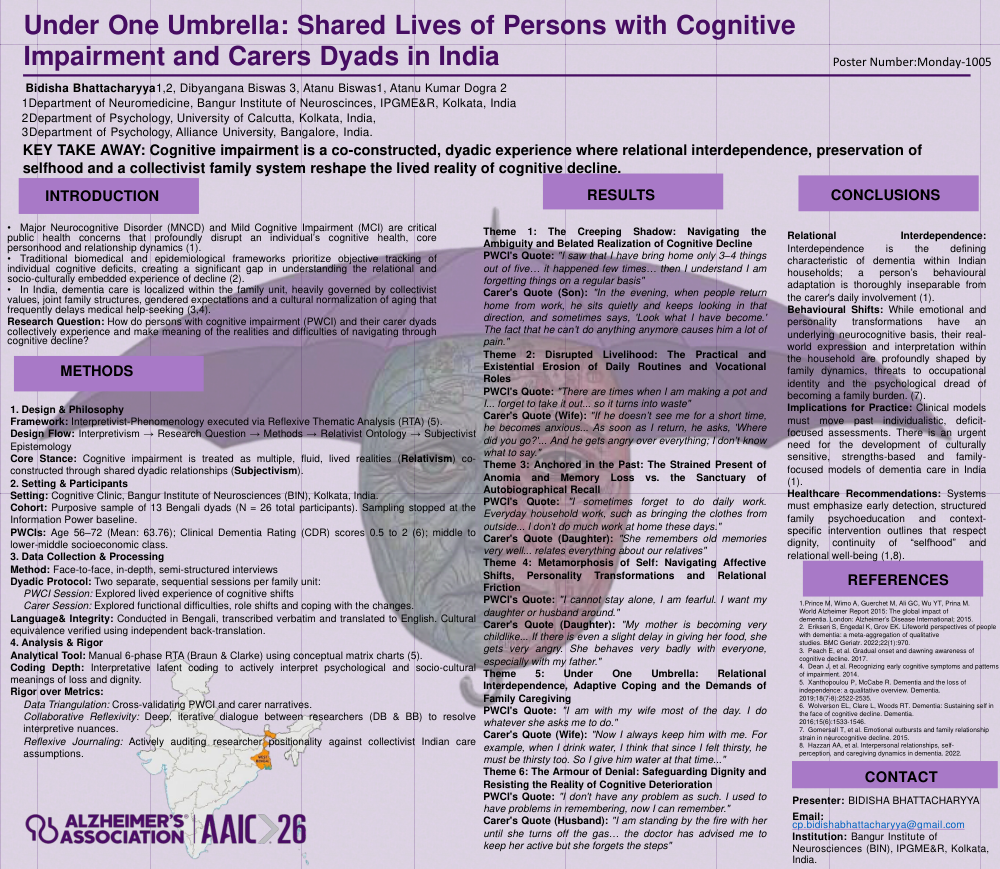
Under One Umbrella: Shared Lives Of Persons With Cognitive Impairment And Carers Dyads In India
Poster Presenter
Authors
BIDISHA BHATTACHARYYA, Dibyangana Biswas, Atanu Biswas, Atanu Kumar Dogra
Affiliations
Department of Neuromedicine, Bangur Institute of Neurosciences, IPGME&R and Department of Psychology, University of Calcutta, Department of Psychology, Alliance University, Bangalore, India, Department of Neuromedicine, Bangur Institute of Neurosciences, IPGME&R, Department of Psychology, University of Calcutta
Part of Topic
KEY TAKEAWAY
Cognitive impairment is a co-constructed, dyadic experience where relational interdependence, preservation of selfhood and a collectivist family system reshape the lived reality of cognitive decline.
INTRODUCTION
- Major Neurocognitive Disorder (MNCD) and Mild Cognitive Impairment (MCI) are critical public health concerns that profoundly disrupt an individual’s cognitive health, core personhood and relationship dynamics (1).
- Traditional biomedical and epidemiological frameworks prioritize objective tracking of individual cognitive deficits, creating a significant gap in understanding the relational and socio-culturally embedded experience of decline (2).
- In India, dementia care is localized within the family unit, heavily governed by collectivist values, joint family structures, gendered expectations and a cultural normalization of aging that frequently delays medical help-seeking (3,4).
Research Question: How do persons with cognitive impairment (PWCI) and their carer dyads collectively experience and make meaning of the realities and difficulties of navigating through cognitive decline?
METHODS
1. Design & Philosophy
- Framework: Interpretivist-Phenomenology executed via Reflexive Thematic Analysis (RTA) (5).
- Design Flow: Interpretivism → Research Question → Methods → Relativist Ontology → Subjectivist Epistemology
- Core Stance: Cognitive impairment is treated as multiple, fluid, lived realities (Relativism) co-constructed through shared dyadic relationships (Subjectivism).
2. Setting & Participants
- Setting: Cognitive Clinic, Bangur Institute of Neurosciences (BIN), Kolkata, India.
- Cohort: Purposive sample of 13 Bengali dyads (N = 26 total participants). Sampling stopped at the Information Power baseline.
- PWCIs: Age 56–72 (Mean: 63.76); Clinical Dementia Rating (CDR) scores 0.5 to 2 (6); middle to lower-middle socioeconomic class.
3. Data Collection & Processing
- Method: Face-to-face, in-depth, semi-structured interviews
- Dyadic Protocol: Two separate, sequential sessions per family unit:
- PWCI Session: Explored lived experience of cognitive shifts
- Carer Session: Explored functional difficulties, role shifts and coping with the changes.
- Language & Integrity: Conducted in Bengali, transcribed verbatim and translated to English. Cultural equivalence verified using independent back-translation.
4. Analysis & Rigor
- Analytical Tool: Manual 6-phase RTA (Braun & Clarke) using conceptual matrix charts (5).
- Coding Depth: Interpretative latent coding to actively interpret psychological and socio-cultural meanings of loss and dignity.
- Rigor over Metrics:
- Data Triangulation: Cross-validating PWCI and carer narratives.
- Collaborative Reflexivity: Deep, iterative dialogue between researchers (DB & BB) to resolve interpretive nuances.
- Reflexive Journaling: Actively auditing researcher positionality against collectivist Indian care assumptions.
RESULTS
Theme 1: The Creeping Shadow: Navigating the Ambiguity and Belated Realization of Cognitive Decline
- PWCI's Quote: "I saw that I have bring home only 3–4 things out of five… it happened few times… then I understand I am forgetting things on a regular basis"
- Carer's Quote (Son): "In the evening, when people return home from work, he sits quietly and keeps looking in that direction, and sometimes says, 'Look what I have become.' The fact that he can’t do anything anymore causes him a lot of pain."
Theme 2: Disrupted Livelihood: The Practical and Existential Erosion of Daily Routines and Vocational Roles
- PWCI's Quote: "There are times when I am making a pot and I... forget to take it out... so it turns into waste"
- Carer's Quote (Wife): "If he doesn’t see me for a short time, he becomes anxious... As soon as I return, he asks, 'Where did you go?'... And he gets angry over everything; I don’t know what to say."
Theme 3: Anchored in the Past: The Strained Present of Anomia and Memory Loss vs. the Sanctuary of Autobiographical Recall
- PWCI's Quote: "I sometimes forget to do daily work. Everyday household work, such as bringing the clothes from outside... I don’t do much work at home these days."
- Carer's Quote (Daughter): "She remembers old memories very well... relates everything about our relatives"
Theme 4: Metamorphosis of Self: Navigating Affective Shifts, Personality Transformations and Relational Friction
- PWCI's Quote: "I cannot stay alone, I am fearful. I want my daughter or husband around."
- Carer's Quote (Daughter): "My mother is becoming very childlike... If there is even a slight delay in giving her food, she gets very angry. She behaves very badly with everyone, especially with my father."
Theme 5: Under One Umbrella: Relational Interdependence, Adaptive Coping and the Demands of Family Caregiving
- PWCI's Quote: "I am with my wife most of the day. I do whatever she asks me to do."
- Carer's Quote (Wife): "Now I always keep him with me. For example, when I drink water, I think that since I felt thirsty, he must be thirsty too. So I give him water at that time..."
Theme 6: The Armour of Denial: Safeguarding Dignity and Resisting the Reality of Cognitive Deterioration
- PWCI's Quote: "I don't have any problem as such. I used to have problems in remembering, now I can remember."
- Carer's Quote (Husband): "I am standing by the fire with her until she turns off the gas… the doctor has advised me to keep her active but she forgets the steps"
CONCLUSIONS
- Relational Interdependence: Interdependence is the defining characteristic of dementia within Indian households; a person’s behavioural adaptation is thoroughly inseparable from the carer's daily involvement (1).
- Behavioural Shifts: While emotional and personality transformations have an underlying neurocognitive basis, their real-world expression and interpretation within the household are profoundly shaped by family dynamics, threats to occupational identity and the psychological dread of becoming a family burden. (7).
- Implications for Practice: Clinical models must move past individualistic, deficit-focused assessments. There is an urgent need for the development of culturally sensitive, strengths-based and family-focused models of dementia care in India (1).
- Healthcare Recommendations: Systems must emphasize early detection, structured family psychoeducation and context-specific intervention outlines that respect dignity, continuity of “selfhood” and relational well-being (1,8).
REFERENCES
- Prince M, Wimo A, Guerchet M, Ali GC, Wu YT, Prina M. World Alzheimer Report 2015: The global impact of dementia. London: Alzheimer’s Disease International; 2015.
- Eriksen S, Engedal K, Grov EK. Lifeworld perspectives of people with dementia: a meta-aggregation of qualitative studies. BMC Geriatr. 2022;22(1):970.
- Peach E, et al. Gradual onset and dawning awareness of cognitive decline. Qual Health Res. 2017;27(4):510-521.
- Dean J, et al. Recognizing early cognitive symptoms and patterns of impairment. Ageing Soc. 2014;34(6):915-932.
- Braun V, Clarke V. Using thematic analysis in psychology. Qual Res Psychol. 2006;3(2):77-101.
- Morris JC. The Clinical Dementia Rating (CDR): current version and scoring rules. Neurology. 1993;43(11):2412-2414.
- Hazzan AA, et al. Interpersonal relationships, self-perception, and caregiving dynamics in dementia. BMC Geriatr. 2022;22(1):112.
- Adams T. Kitwood's approach to dementia and dementia care: a critical but appreciative review. J Adv Nurs. 1996;23(5):948-53. doi: 10.1046/j.1365-2648.1996.10613.x.
Comments
Email is required but is not shown publicly.
Loading comments...