4,068 posters, 219 videos, 101 topics, 69 sessions, 14,365 authors, 6,128 institutions
ePostersLive by SciGen Technologies S.A. All rights reserved.
Alzheimer's Association International Conference 2026
July 12-15, 2026 | London, United Kingdom, and Online

3766
Family Communication About Alzheimer’S Disease Risk Information Among Latino Adults
Poster Presenter
Authors
Daniela Diaz Caro, John Wetmore, María Caban, Sophia Rodriguez, Courtney Brown-Bradley, Wendy R. Uhlman, Ruth Ottman, Karolynn Siegel
Affiliations
Columbia University Irving Medical Center, New York, NY, Columbia University Mailman School of Public Health, New York, NY, University of Michigan, Ann Arbor, MI
Part of Topic
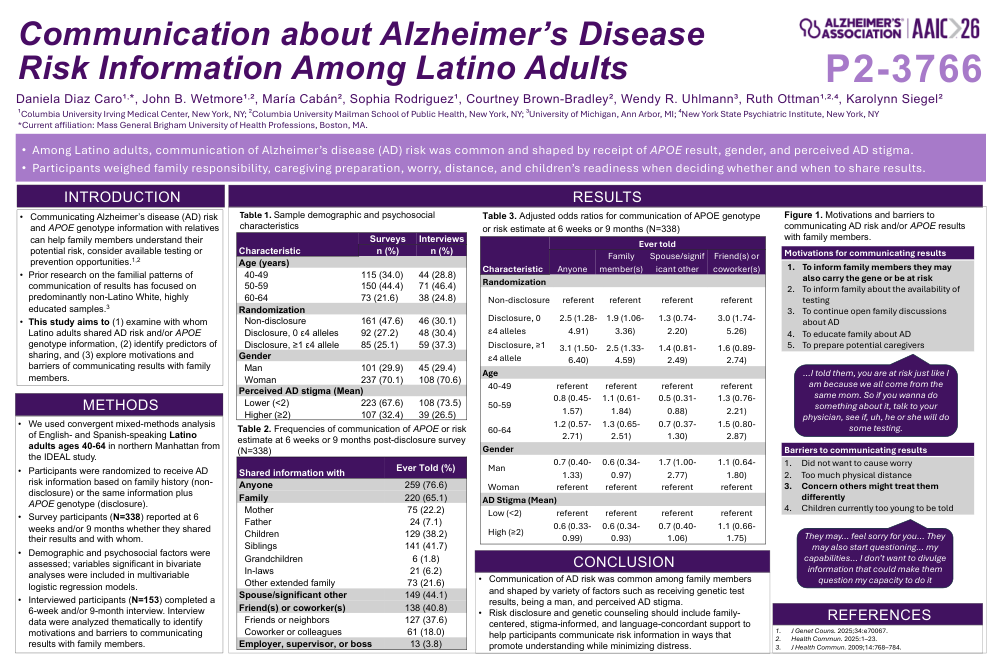
• Communicating Alzheimer’s disease (AD) risk and APOE genotype information with relatives can help family members understand their potential risk and consider available testing or prevention opportunities.
• Prior research on the familial patterns of communication of results has focused on predominantly non-Latino White, highly educated samples.
• This study aims to (1) examine with whom Latino adults shared AD risk and/or APOE genotype information, (2) identify predictors of sharing, and (3) explore motivations and barriers of communicating results with family members.
• We used convergent mixed-methods analysis of English- and Spanish-speaking Latino adults ages 40-64 in northern Manhattan from the IDEAL study.
• Participants were randomized to receive AD risk information based on family history (nondisclosure) or the same information plus APOE genotype (disclosure).
• Survey participants (N=338) reported at 6 weeks and/or 9 months whether they shared their results and with whom.
• Demographic and psychosocial factors were assessed; variables significant in bivariate analyses were included in multivariable logistic regression models.
• Interviewed participants (N=153) completed a 6-week and/or 9-month interview.
• Interview data were analyzed thematically to identify motivations and barriers to communicating results with family members.
• Communication of AD risk was common among family members and shaped by a variety of factors such as receiving genetic test results, being a man, and perceived AD stigma.
• Risk disclosure and genetic counseling should include family-centered, stigma-informed, and language-concordant support to help participants communicate risk information in ways that promote understanding while minimizing distress.
Comments
Email is required but is not shown publicly.
Loading comments...