4,068 posters, 219 videos, 101 topics, 69 sessions, 14,365 authors, 6,128 institutions
ePostersLive by SciGen Technologies S.A. All rights reserved.
Alzheimer's Association International Conference 2026
July 12-15, 2026 | London, United Kingdom, and Online

977
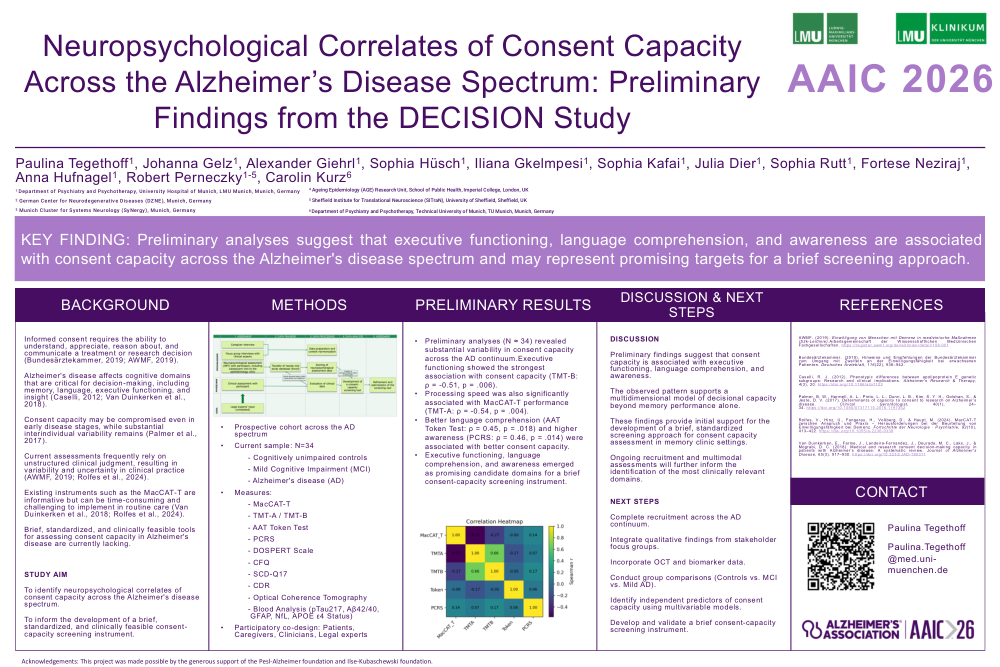
Standardized Assessment Of Consent Capacity Across The Alzheimer’s Disease Spectrum: Design Of The Decision Study
Poster Presenter
Part of Topic
BACKGROUND
Informed consent requires the ability to understand, appreciate, reason about, and communicate a treatment orresearch decision (Bundesärztekammer, 2019; AWMF, 2019).
Alzheimer's disease affects cognitive domains that are critical for decision-making, including memory, language, executive functioning, and insight (Caselli, 2012; Van Duinkerken et al., 2018).
Consent capacity may be compromised even in early disease stages, while substantial interindividual variability remains (Palmer et al., 2017).
Current assessments frequently rely on unstructured clinical judgment, resulting in variability and uncertainty in clinical practice (AWMF, 2019; Rolfes et al., 2024).
Existing instruments such as the MacCAT-T are informative but can be time-consuming and challenging to implement in routine care (Van Duinkerken et al., 2018; Rolfes et al., 2024).
Brief, standardized, and clinically feasible tools for assessingconsent capacity in Alzheimer's disease are currently lacking.
STUDY AIM
To identify neuropsychological correlates of consent capacity across the Alzheimer's disease spectrum.
To inform the development of a brief, standardized, and clinically feasible consent-capacity screening instrument.
METHODS
- Cognitively unimpaired controls
- Mild Cognitive Impairment (MCI)
- Alzheimer's disease (AD)
- MacCAT-T
- TMT-A / TMT-B
- AAT Token Test
- PCRS
- DOSPERT Scale
- CFQ
- SCD-Q17
- CDR
- Optical Coherence Tomography
- Blood Analysis (pTau217, Aβ42/40, GFAP, NfL, APOE ε4 Status)
DISCUSSION
Preliminary findings suggest that consent capacity isassociated with executive functioning, languagecomprehension, and awareness.
The observed pattern supports a multidimensional model ofdecisional capacity beyond memory performance alone.
These findings provide initial support for the development of a brief, standardized screening approach for consent capacityassessment in memory clinic settings.
Ongoing recruitment and multimodal assessments will furtherinform the identification of the most clinically relevant domains.
NEXT STEPS
Complete recruitment across the AD continuum.
Integrate qualitative findings from stakeholder focus groups.
Incorporate OCT and biomarker data.
Conduct group comparisons (Controls vs. MCI vs. Mild AD).
Identify independent predictors of consent capacity usingmultivariable models.
Develop and validate a brief consent-capacity screeninginstrument.
REFERENCES
AWMF. (2019). Einwilligung von Menschen mit Demenz in medizinische Maßnahmen (S2k-Leitlinie).Arbeitsgemeinschaft der Wissenschaftlichen Medizinischen Fachgesellschaften. https://register.awmf.org/de/leitlinien/detail/108-001
Bundesärztekammer. (2019). Hinweise und Empfehlungen der Bundesärztekammer zum Umgang mit Zweifeln an der Einwilligungsfähigkeit bei erwachsenen Patienten. Deutsches Ärzteblatt, 116(22), 936–942.
Caselli, R. J. (2012). Phenotypic differences between apolipoprotein E genetic subgroups: Research and clinical implications. Alzheimer's Research & Therapy, 4(3), 20. https://doi.org/10.1186/alzrt123
Palmer, B. W., Harmell, A. L., Pinto, L. L., Dunn, L. B., Kim, S. Y. H., Golshan, S., & Jeste, D. V. (2017). Determinants of capacity to consent to research on Alzheimer’s disease. Clinical Gerontologist, 40(1), 24–34. https://doi.org/10.1080/07317115.2016.1197352
Rolfes, V., Hinz, U., Fangerau, H., Voßberg, D., & Haupt, M. (2024). MacCAT-T zwischen Anspruch und Praxis – Herausforderungen bei der Beurteilung von Einwilligungsfähigkeit bei Demenz. Fortschritte der Neurologie · Psychiatrie, 92(10), 413–422. https://doi.org/10.1055/a-2236-9338
Van Duinkerken, E., Farme, J., Landeira-Fernandez, J., Dourado, M. C., Laks, J., & Mograbi, D. C. (2018). Medical and research consent decision-making capacity in patients with Alzheimer’s disease: A systematicreview. Journal of Alzheimer's Disease, 65(3), 917–930. https://doi.org/10.3233/JAD-180311
Comments
Email is required but is not shown publicly.
Loading comments...