4,068 posters, 219 videos, 101 topics, 69 sessions, 14,365 authors, 6,128 institutions
ePostersLive by SciGen Technologies S.A. All rights reserved.
Alzheimer's Association International Conference 2026
July 12-15, 2026 | London, United Kingdom, and Online

1684
Effect Of Acceptance And Commitment Therapy On Primary Family Caregivers Of Community-Dwelling People Living With Dementia
Part of Topic
Background
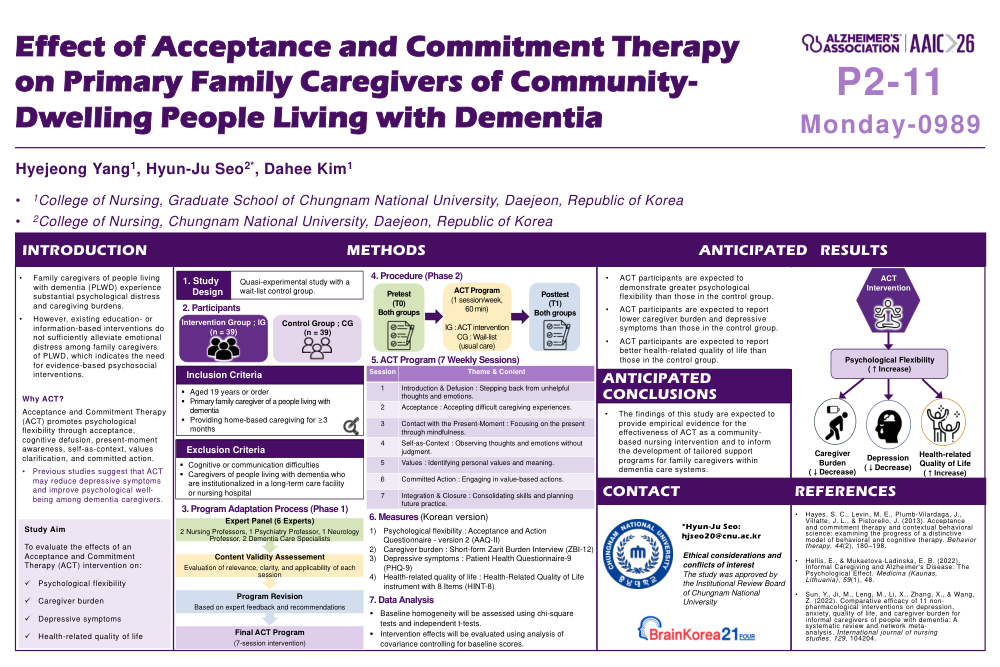
Family caregivers of people living with dementia (PLWD) experience substantial psychological and caregiving burdens. However, existing education- and information-based interventions do not sufficiently alleviate emotional distress, highlighting the need for evidence-based psychosocial interventions. Acceptance and Commitment Therapy (ACT) promotes psychological flexibility through acceptance, cognitive defusion, present-moment awareness, self-as-context, values clarification, and committed action. Previous studies suggest that ACT may reduce depressive symptoms and improve psychological well-being among dementia caregivers.
Aim
This study aims to evaluate the effects of an ACT intervention on psychological flexibility, caregiver burden, depressive symptoms, and health-related quality of life among primary family caregivers of community-dwelling people living with dementia.
Methods
This quasi-experimental study will employ a wait-list control group design. A total of 78 primary family caregivers (39 intervention; 39 control) will be recruited. Eligible participants are adults aged 19 years or older who have provided home-based care for a family member living with dementia for at least three months. The intervention consists of seven weekly 60-minute ACT sessions covering defusion, acceptance, contact with the present-moment, self-as-context, values, committed action, and integration. The ACT program was developed through expert panel review and content validity assessment. Outcomes include psychological flexibility (AAQ-II), caregiver burden (Short-form Zarit Burden Interview), depressive symptoms (PHQ-9), and health-related quality of life (HINT-8). Baseline homogeneity will be assessed using chi-square and independent t-tests, and intervention effects will be evaluated using analysis of covariance controlling for baseline scores.
Anticipated Results
Participants receiving the ACT intervention are expected to demonstrate greater psychological flexibility, lower caregiver burden, fewer depressive symptoms, and better health-related quality of life than those in the wait-list control group.
Anticipated Conclusions
The findings are expected to support ACT as an effective community-based psychosocial intervention for family caregivers of people living with dementia and to provide evidence for developing tailored caregiver support programs within dementia care systems.
Comments
Email is required but is not shown publicly.
Loading comments...