4,068 posters, 219 videos, 101 topics, 69 sessions, 14,365 authors, 6,128 institutions
ePostersLive by SciGen Technologies S.A. All rights reserved.
Alzheimer's Association International Conference 2026
July 12-15, 2026 | London, United Kingdom, and Online

4203
Exploring Needs Of Deaf Adults In Austria, Germany And Greece For Culturally And Linguistically Adapted Dementia Courses
Poster Presenter
Part of Topic
Exploring Needs Of Deaf Adults In Austria, Germany And Greece For Culturally And Linguistically Adapted Dementia Courses
#4203
Ioanna Antigoni Angelidou1,Tarsitsa Ntova1,3, Ege Karar1, Marianna Tsatali1,2, Doris Hoffmann-Lamplmair4, Romeo Seifert4, Lukas Nerat4, Kiriaki Chatziavannidou3, Patrick Martinetz4, and Birgit Teichmann1
INTRODUCTION
RESULTS
Access to dementia information and services remain challenging for many Deaf sign language users. While previous research has highlighted the issues mostly in the United Kingdom, evidence from other European Deaf communities is limited. This study explored perceptions of dementia, barriers to information and healthcare, and preferences for tailored dementia awareness courses among Deaf adults in Austria, Germany and Greece.
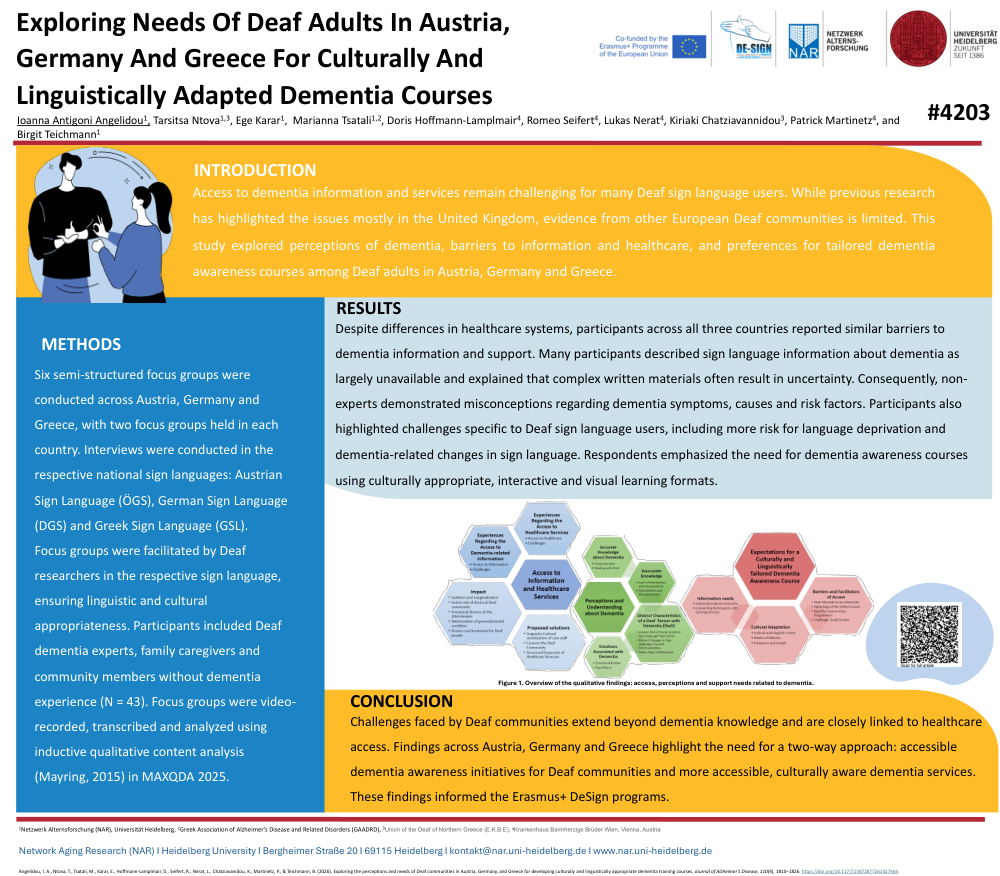
Despite differences in healthcare systems, participants across all three countries reported similar barriers to dementia information and support. Many participants described sign language information about dementia as largely unavailable and explained that complex written materials often result in uncertainty. Consequently, non-experts demonstrated misconceptions regarding dementia symptoms, causes and risk factors. Participants also highlighted challenges specific to Deaf sign language users, including more risk for language deprivation and dementia-related changes in sign language. Respondents emphasized the need for dementia awareness courses using culturally appropriate, interactive and visual learning formats.
METHODS
Six semi-structured focus groups were conducted across Austria, Germany and Greece, with two focus groups held in each country. Interviews were conducted in the respective national sign languages: Austrian Sign Language (ÖGS), German Sign Language (DGS) and Greek Sign Language (GSL).
Focus groups were facilitated by Deaf researchers in the respective sign language, ensuring linguistic and cultural appropriateness. Participants included Deaf dementia experts, family caregivers and community members without dementia experience (N = 43). Focus groups were video-recorded, transcribed and analyzed using inductive qualitative content analysis (Mayring, 2015) in MAXQDA 2025.
CONCLUSION
Challenges faced by Deaf communities extend beyond dementia knowledge and are closely linked to healthcare access. Findings across Austria, Germany and Greece highlight the need for a two-way approach: accessible dementia awareness initiatives for Deaf communities and more accessible, culturally aware dementia services. These findings informed the Erasmus+ DeSign programs.
Angelidou, I. A., Ntova, T., Tsatali, M., Karar, E., Hoffmann-Lamplmair, D., Seifert, R., Nerat, L., Chatziavanidou, K., Martinetz, P., & Teichmann, B. (2026). Exploringtheperceptionsand needsofDeafcommunitiesin Austria, Germany, and Greecefordevelopingculturallyand linguisticallyappropriatedementiatrainingcourses. Journal ofAlzheimer’sDisease, 110(4), 1810–1826. https://doi.org/10.1177/13872877261427464
Comments
Email is required but is not shown publicly.
Loading comments...